
Introduction
Charitable giving is one of the most underused tools in wealth planning. Used strategically, it reduces your tax burden, protects assets from estate erosion, and builds a legacy that outlasts you.
Yet many high-income earners and accredited investors give reactively. They write checks in response to year-end solicitations or a friend's fundraiser, missing out on thousands of dollars in tax savings and long-term planning benefits along the way.
This guide breaks down the tax rules governing charitable deductions and the giving vehicles available at different wealth levels. It also covers a five-step planning process and how to pair philanthropy with other tax-advantaged wealth-building strategies.
Key Takeaways
- Treat charitable giving as part of your financial and estate plan, not an isolated decision
- AGI deduction limits cap annual deductions at 60% for cash gifts and 30% for appreciated assets
- Donor-advised funds, private foundations, and charitable trusts trade off control, flexibility, and cost differently
- Donating appreciated stock or real estate directly avoids capital gains tax and preserves the full deduction
- Pairing philanthropy with tax-advantaged investments frees up capital for both giving and growth
Why Charitable Giving Deserves a Place in Your Wealth Plan
Most affluent households already treat philanthropy as more than a feel-good gesture. According to Bank of America's 2025 Study of Philanthropy, over 40% of affluent donors reported having a defined giving strategy, and 45% reported working from an annual giving budget. The study surveyed more than 1,500 U.S. households with net worth above $1 million or income of at least $200,000.
That level of intentionality matters, because structured giving delivers benefits reactive giving simply can't:
- Income tax deductions that lower your taxable income in the year you give
- Capital gains avoidance when donating appreciated securities or property
- Estate tax reduction through lifetime or bequest gifts
- Wealth preservation by directing dollars that would otherwise go to taxes toward causes you choose
Charitable decisions tend to resurface at specific inflection points: selling a business, retiring, transferring wealth to the next generation, or watching a concentrated stock position hit new highs. These are exactly the moments when a proactive plan pays off most.
The Great Wealth Transfer and Why Timing Matters
An estimated $124 trillion will change hands in the U.S. through 2048, with roughly $105 trillion flowing to heirs and $18 trillion to charity, according to Cerulli Associates. Baby Boomers and older generations account for nearly 81% of that transfer.
This trend is pushing more families to revisit their charitable strategies now rather than later. Waiting until a wealth transfer event forces a decision typically means fewer options and weaker tax outcomes. Starting the conversation early, while assets are still flexible, lets you align tax efficiency with the values you want passed down.

Tax Benefits and Rules Every Donor Should Know
Charitable contributions reduce your taxable income in the year you give. However, the gift only qualifies if it meets these IRS requirements:
- The recipient must be a registered nonprofit organization
- You need proper documentation to support the deduction
- The gift must fall within the correct tax year
AGI limits determine how much you can deduct:
- Cash gifts to public charities: deductible up to 60% of your adjusted gross income (AGI)
- Appreciated securities or property: deductible up to 30% of AGI
- Excess contributions above these limits carry forward for up to five tax years
According to IRS Publication 526, these percentage limits apply to gifts made to what the tax code calls "50%-limit organizations" — generally public charities, churches, schools, and hospitals.
These caps also depend on what you're giving. Donating appreciated assets avoids capital gains tax entirely. Say you bought stock for $50,000 that's now worth $200,000. Sell it, and you owe capital gains tax on the $150,000 gain. Donate it directly to a qualified charity instead, and you avoid that tax while still deducting the full $200,000 fair market value (subject to the 30% AGI cap).
Estate tax reduction works similarly. Property left to a qualifying charity is deductible from your gross estate, reported on Schedule O of Form 706, potentially saving substantial federal estate tax on larger estates.
Qualified Charitable Distributions (QCDs) for Donors 70½+
If you're 70½ or older, a QCD lets you transfer funds directly from a traditional or rollover IRA to a qualified charity. This satisfies your required minimum distribution (RMD) without adding a dime to your taxable income. For 2026, the annual QCD limit is $111,000 per individual.
There's a key restriction: the transfer must go directly from the IRA custodian to the charity. It can't pass through your hands first, and it can't come from an ongoing SEP or SIMPLE IRA.
Choosing the Right Charitable Giving Vehicle
The right vehicle depends on how much control you want, how much administrative burden you're willing to take on, and whether income generation for your family matters.
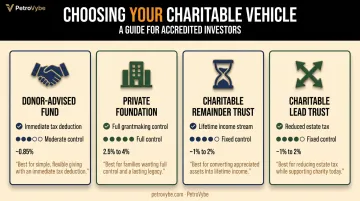
Donor-advised funds (DAFs) offer an immediate tax deduction with ongoing advisory control over when and where grants go. Administrative costs run around 0.85% or less annually plus investment management fees, far lower than a private foundation.
Private foundations give you more control and public visibility into your giving, but they come with higher administrative costs (roughly 2.5% to 4% annually) and a mandatory minimum distribution requirement of about 5% of assets each year.
Charitable remainder trusts (CRTs) and charitable lead trusts (CLTs) serve opposite purposes:
| Vehicle | Who benefits first | Best suited for |
|---|---|---|
| CRT | Donor or family receives income for life or a term, then charity gets the remainder | Concentrated stock positions you want to diversify tax-efficiently |
| CLT | Charity receives income for a term, then heirs get the remainder | Wealth transfer goals with reduced gift/estate tax exposure |
Direct gifts of business interests or real estate can produce a larger deduction than donating cash proceeds after a sale. Donating the interest before closing lets you claim the full fair-market-value deduction while the charity, not you, recognizes any gain. Coordinate this timing with your advisors before signing a sale agreement.
Quick guideline:
- Want simplicity and flexibility? Choose a DAF
- Prefer control and public visibility? Choose a private foundation
- Need income for yourself or your heirs? Choose a CRT or CLT
Building Your Charitable Giving Plan in 5 Steps
A written plan turns philanthropy from a series of one-off decisions into a coordinated strategy. Here's how to build one:
- Define your charitable mission. Clarify the values and impact you want your giving to reflect, and how you want to be remembered.
- Prioritize 2-5 core causes. Vet organizations using Charity Navigator, GuideStar, or the BBB Wise Giving Alliance before committing funds.
- Select your funding source and vehicle. Match cash, appreciated stock, a business interest, a DAF, or a trust to your tax situation and goals.
- Involve your family. Shared decision-making builds common values and prepares the next generation to carry the mission forward.
- Document and review annually. Revisit your plan with your financial, tax, and estate advisors as circumstances and tax laws shift.
Treat this document like any other part of your portfolio: review it regularly and rebalance it as your circumstances and priorities change.
Pairing Charitable Giving with Other Tax-Advantaged Wealth Strategies
High-income earners and business owners often face large tax bills from W-2 wages or capital gains, liabilities that eat into the capital available for both investing and giving. Charitable deductions help, but they're capped by AGI limits, so many donors look for complementary strategies that free up additional capacity.
Direct investments in tax-advantaged sectors, like natural gas development, offer deductions such as Intangible Drilling Costs (IDCs) that apply against active income, not just passive income.
PetroVybe, a Texas-based natural gas development company operating in Lavaca County and the Gulf Coast Basin, is one example. Its investment structure has delivered partners a first-year tax deduction of 91-94% against active income, including W-2 earnings and capital gains, through IDC deductions tied to drilling costs.
This differs from a more familiar tax strategy in one key way:
| Deduction Type | Income It Offsets |
|---|---|
| Real estate losses | Passive income only, unless you qualify as a real estate professional |
| IDC deductions | Active income, including W-2 wages and capital gains |
For a donor who has already maxed out their charitable AGI limit in a given year, this structure offers a path forward. Freeing up additional after-tax capital can support both continued investing and future giving capacity.
This isn't a substitute for a tax advisor's guidance, since every donor's AGI situation, income mix, and charitable carryforward balance is different. Before combining charitable strategies with alternative investments like oil and gas partnerships, consider:
- Your current AGI limit and available charitable carryforward balance
- How active vs. passive income restrictions apply to your specific mix of income
- Whether a CPA or tax attorney has modeled how the two strategies interact within your overall plan

Frequently Asked Questions
How do wealthy individuals use charitable giving to reduce taxes?
Wealthy donors typically donate appreciated assets to avoid capital gains tax and contribute to donor-advised funds or foundations for immediate deductions. Many also use QCDs or trusts to lower taxable income and reduce estate size.
What is the difference between a donor-advised fund and a private foundation?
A DAF offers lower costs, an immediate deduction, and less direct control. A private foundation offers more control and public visibility but carries higher administrative costs and mandatory annual payout requirements.
How much of my income can I deduct for charitable donations?
Cash gifts to public charities are deductible up to 60% of your AGI; appreciated assets are capped at 30%. Excess amounts carry forward for up to five tax years.
What is a qualified charitable distribution (QCD)?
A QCD lets IRA owners age 70½ or older transfer funds directly to a qualified charity to satisfy their RMD without increasing taxable income. The annual limit is $111,000 for 2026.
Can I donate appreciated stock to avoid capital gains tax?
Yes. Donating appreciated securities directly to a qualified charity avoids capital gains tax entirely while allowing you to deduct the full fair market value, subject to AGI limits.
How do I start building a charitable giving plan?
Start by defining your mission and core causes. Then consult a financial or tax advisor to select the funding source and giving vehicle that fits your tax situation.