
Education and skills remain the foundation of earning power. But labor income has hard limits. There are only so many hours in a day, active income gets taxed at higher rates than capital gains, and most careers eventually hit a ceiling no matter how much experience you stack up.
This article breaks down what human capital actually is, how it shapes personal income distribution, and why many high earners eventually pair labor income with capital investment once the career ceiling arrives.
Key Takeaways
- Human capital (education, training, health, soft skills) drives higher, widening pay over a career.
- 2024 U.S. education premium: $930/week (high school) to $1,840/week (master's degree).
- Unequal education access drives measured income inequality (U.S. Gini index: 0.488 in 2024).
- Time-capped, higher-taxed labor income pushes many high earners toward direct capital investments.
What Is Human Capital? Exploring the 4 Core Types
Human capital is an economic term for something intuitive: the stock of knowledge, skills, and abilities a person accumulates that determines how productive, and how well paid, they'll be over a career.
Economists treat it the same way they treat any other capital asset. You invest resources upfront, incur a cost, and expect a return in the form of higher future earnings.
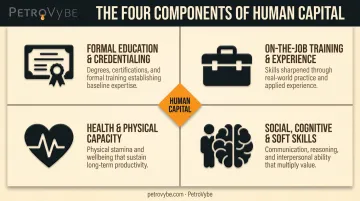
That stock breaks down into four components that interact throughout a career.
Formal Education and Credentialing
Degrees, trade certifications, and professional licenses are the most visible form of human capital investment, each representing money spent today for income gains later. A nursing license, a CPA credential, an electrician's certification, and a bachelor's degree all function the same way economically: building and signaling capability that employers pay for.
On-the-Job Training and Experience
Not all training is created equal. Firm-specific skills (knowing a particular company's internal systems, for example) mostly benefit the employer you currently work for. General skills, like learning a widely used software platform, travel with you to any employer. That distinction matters for who pays:
| Training Type | Who Typically Pays | Why |
|---|---|---|
| Firm-specific | Employer | The company captures most of the return |
| General | Worker (via lower wages during training) | Skills transfer to any employer, including competitors |
Health and Physical Capacity
Physical and mental wellbeing forms the foundation of human capital. A worker who can't sustain focus, energy, or physical capacity over decades of a career can't convert education and training into consistent output. Chronic health issues shorten careers and shrink lifetime earnings, regardless of how many credentials someone holds.
Social, Cognitive, and Soft Skills
Interpersonal skills, adaptability, and problem-solving increasingly separate top earners from the rest, especially as AI reshapes routine, task-based work. Employers now pay a premium for people who can navigate ambiguity, manage teams, and apply judgment, skills a machine can't easily replicate.
How Investment in Human Capital Affects Personal Income
Human capital investment isn't just about earning more at the entry level. It reshapes an entire career trajectory, a pattern economists call the age-earnings profile: more educated workers don't just start ahead, they pull further ahead every year.
The Education Premium Compounds Over a Career
| Education Level | 2024 Median Weekly Earnings |
|---|---|
| High school diploma | $930 |
| Associate's degree | $1,099 |
| Bachelor's degree | $1,543 |
| Master's degree | $1,840 |
Source: Bureau of Labor Statistics
That gap doesn't stay flat over time. According to Social Security Administration research, men with bachelor's degrees earn roughly $900,000 more over a lifetime than high school graduates, and men with graduate degrees earn about $1.5 million more.
The Real Cost of Human Capital Investment
Investing in education isn't free, even when tuition looks affordable. The true cost stacks two things:
- Direct costs: tuition, fees, books, licensing exams
- Opportunity cost: income foregone while studying instead of working
A four-year degree with $40,000 in tuition can also mean $160,000-plus in foregone entry-level wages, pushing the true cost past $200,000 before any return arrives. Weigh that against the discounted value of higher future earnings, and for most credentials the math still favors the worker, though the payoff period varies by field and credential quality.
That cost-benefit math isn't the whole story. A second theory, known as education-as-signaling, helps explain why the premium persists: economist Michael Spence's model argues credentials let employers identify high-productivity workers even when a credential adds limited new skill. It's simply cheaper for naturally high-productivity people to earn that credential in the first place. In practice, education builds real skill and signals it at the same time.
Access to this investment isn't distributed evenly, either. Among students who were high school sophomores in 2002, 93% whose parents held a bachelor's degree enrolled in college, compared with just 72% of students whose parents never attended college. That access gap shows up later as an income gap.
Understanding Personal Income Distribution: How Inequality Is Measured
Human capital differences don't stay personal, they aggregate into what economists call personal income distribution: the way earnings spread across an entire population. Several standard tools measure exactly how unequal that spread has become.
Measuring the Gap: Quintiles, Lorenz Curves, and the Gini Index
Economists typically rank households into quintiles or deciles, from poorest to richest, then track what share of total income each group receives. Plotting that data produces a Lorenz curve; the further it bows away from a straight diagonal line, the more unequal the distribution.
The Gini index condenses that curve into one number between 0 (perfect equality) and 1 (a single household holds all the income).
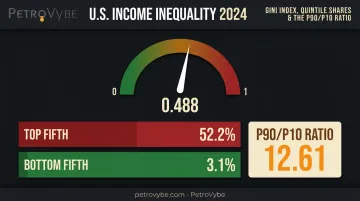
The U.S. Census Bureau put the national Gini index at 0.488 in 2024, with the top fifth of households capturing 52.2% of aggregate income while the bottom fifth received just 3.1%. The Census also reports a P90/P10 ratio of 12.61, meaning households at the 90th percentile earn nearly thirteen times what households at the 10th percentile earn.
For context, OECD figures show member-country Ginis ranging from roughly 0.22 in the Slovak Republic to more than double that elsewhere, though the two measures aren't directly comparable since they adjust for household size and taxes differently.
Three Forces Widening the Gap
- Globalization and outsourcing: estimated to account for 31%-51% of the rise in demand for skilled labor in U.S. manufacturing during the 1980s
- Skill-biased technological change: computers reward workers with advanced skills while replacing routine tasks, though most of the 1979-1999 wage-gap increase actually happened before 1985
- Declining unionization: membership fell from 20.1% in 1983 to just 10.0% in 2025, removing a mechanism that once compressed wage differences
None of these forces operates alone. Unequal human capital investment, reflected in who gets the degree, the apprenticeship, or the AI training, feeds directly into the quintile and Gini numbers above. The worker priced out of a credential today becomes a data point in next year's inequality report.
Practical Ways to Invest in Human Capital Today
Human capital investment doesn't stop at graduation. The highest earners treat it as continuous, especially as in-demand skills shift faster than ever.
- Reskill continuously, especially in AI: Employers expect 39% of workers' core skills to change by 2030, with AI and big data the fastest-growing categories.
- Consider trade certifications over four-year degrees: Georgetown's Center on Education and the Workforce found certificate and associate-degree programs deliver higher ROI in the first decade, since they cost less and get workers earning sooner. Bachelor's degrees overtake only after 40 years.
- Build mentorship and networks alongside formal credentials: On-the-job learning and relationships with experienced peers compound the value of a degree, turning a one-time credential into decades of applied, updated skill.
None of these replace each other. The people pulling ahead right now are stacking all three.
Beyond Human Capital: Why Capital Investment Completes the Wealth Equation
Every strategy above still runs into the same wall eventually. Labor income, no matter how much human capital backs it, is capped by hours in a day, a career ceiling, and tax rates that treat active income less favorably than capital gains. That's where capital investment enters the equation.
Capital income works differently. Ownership of productive assets, whether equity, real estate, or energy reserves in the ground, can compound and appreciate independent of how many hours you personally work.
Over time, that compounding can outpace wage growth. That's one reason high earners increasingly treat capital ownership as a parallel income stream rather than a retirement afterthought.
Many high W-2 earners and business owners now convert a portion of active income into capital investments. The goal: diversify income sources and reduce tax exposure, since certain capital structures carry deductions ordinary wages simply don't get.
This is the logic behind direct-participation capital investments like PetroVybe's natural gas development projects in Texas's Gulf Coast Basin. Structured as limited partnerships, they let accredited investors take a direct equity position in upstream energy development rather than buying shares of a public company.
Because intangible drilling cost (IDC) deductions aren't restricted to passive income the way many real estate deductions are, partners can apply them directly against active income. Specific terms include:
- Deductions applied directly against W-2 wages and capital gains, not just passive income
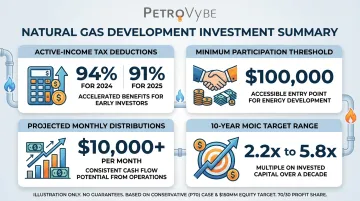
- 94% deduction against active income for 2024 partners, 91% for 2025 partners
- Minimum participation of $100,000 for accredited investors
Beyond the upfront tax offset, the project targets additional long-term value for partners:
- Monthly passive distributions projected to exceed $10,000 during peak production
- A 10-year MOIC target of roughly 2.2x to 5.8x
- Oversight by a chief geophysicist with a 75.2% well-success rate across a 48-year career, well above the sub-40% industry average
For accredited investors, it's one concrete way to move human capital earnings into long-term, compounding capital wealth.
Frequently Asked Questions
How does human capital affect income?
Higher human capital (education, skills, experience) raises worker productivity, and employers pay more for that productivity. This premium compounds over a career, which is why the earnings gap between education levels widens rather than narrows with age.
What is the best way to invest in human capital?
A mix works best: formal education or credentialing, continuous reskilling in high-demand fields like AI, and real on-the-job experience. Relying on just one usually stalls income growth sooner than combining all three.
What are the 4 types of human capital?
Formal education and credentials, on-the-job training and experience, health and physical capacity, and social/cognitive soft skills. Each contributes differently to productivity and pay over a career.
What is the difference between human capital and income distribution?
Human capital is an individual's productive capacity, built through education, skills, and health. Income distribution describes how earnings spread across an entire population, shaped partly by aggregate human capital differences.
Does more education always lead to higher income?
Education raises average earnings, but returns vary by field, credential quality, and market demand. Diminishing returns can also apply at very high education levels, where cost and time outweigh added income.
How can investors diversify beyond human capital to build long-term wealth?
Pairing labor income with capital investments, such as tax-advantaged natural gas development, creates a second income stream that isn't capped by hours worked. It's a way to keep building wealth once labor income hits its ceiling.