

The other half is quieter and, frankly, more expensive over time. It's the tax you overpay because nobody flagged a deduction. It's the credit that expired unclaimed. It's the exposure nobody at the company knew existed until a regulator asked about it.
Regulators aren't making this easier, either. The OECD, HMRC, and Australia's ATO have all pushed toward cooperative compliance models that expect companies (and increasingly, individuals) to self-police through documented controls rather than wait for an audit to find problems.
This guide walks through the types of tax risk you're actually exposed to, how to build a control framework that catches problems early, the practices that separate mature tax functions from reactive ones, and how proactive investors legally reduce their tax exposure rather than just defend against it.
Key Takeaways
- Tax risk spans financial, compliance, operational, reputational, and personal liability exposure, not just audits.
- The OECD's Tax Control Framework gives boards a repeatable structure for catching issues early.
- Scorecards, cross-department collaboration, and contemporaneous documentation separate mature tax functions from reactive ones.
- Missed deductions carry risk too: oil & gas IDC deductions let investors legally reduce active income exposure.
What Is Tax Risk Management?
Tax risk management is the process of identifying, assessing, mitigating, and reporting the risk that a business or individual pays or reports the wrong amount of tax. It also covers missing a legitimate opportunity to reduce that tax bill.
That definition cuts both directions: it covers avoiding penalties and catching missed savings with equal weight.
The goal isn't zero risk — that's impossible. The goal is keeping tax processes efficient, transparent, and controlled enough that:
- Tax authority challenges become less frequent and less costly
- Overpayment (missed credits, deductions, exemptions) gets caught before it compounds
- Underpayment (calculation errors, misapplied rules) gets caught before penalties stack up
This isn't only a Fortune 500 concern. Tax risk management now applies at three distinct levels:
- Multinational corporations managing transfer pricing, cross-border structuring, and multi-jurisdiction filings
- Mid-size businesses navigating state nexus rules, payroll tax complexity, and M&A due diligence
- High-income individuals and accredited investors managing personal exposure across W-2 income, capital gains, and alternative investments
That third category is growing fast, and the stakes are concrete: a missed election or a miscalculated basis on a K-1 can cost an individual investor tens of thousands of dollars in avoidable tax. As wealth concentrates and tax codes get more complex, personal tax risk management has become a legitimate financial planning discipline, not an afterthought handled once a year in April.
Types of Tax Risk Every Business and Investor Should Know
Tax risk is multifaceted. It extends well beyond the fear of "getting audited," and treating it as a single category is how most of it goes unmanaged.
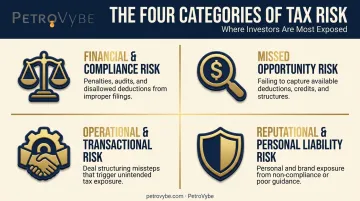
Financial and Compliance Risk
This is the risk most people already picture: unexpected liabilities from calculation errors, sudden legislative changes, or an unfavorable audit outcome.
It's also less common than most executives assume. According to the IRS's 2023 Data Book, examination coverage for tax years 2013–2021 ran:
| Return type | Examination coverage |
|---|---|
| Individual returns | 0.44% |
| Corporation returns | 0.74% |
| Individuals with $10M+ total positive income | 8.7% |
Low odds don't mean low stakes. The same data book reports $65.6 billion in civil penalties assessed across 45.5 million cases in FY2023 alone. When the audit does happen, the cost of being unprepared is steep.
Missed Opportunity Risk
This is the category almost nobody tracks, which is exactly why it erodes wealth so quietly. Failing to claim available credits, exemptions, or deductions creates a real, recurring cost that compounds year after year.
Individual taxpayers alone leave education credits, EITC dollars, and child tax credit eligibility on the table every year simply because no one flagged it. That same blind spot shows up in corporate deductions and investor-level incentives, compounding into real lost value across a portfolio.
Operational and Transactional Risk
Everyday business decisions create tax exposure long before anyone in finance notices:
- M&A activity: historical tax positions and deal structure can transfer liabilities to the acquirer
- Procurement and supply chain shifts: redomiciling assets or personnel can trigger exit taxes and customs exposure
- Remote work policies: a single employee working from a new state can create payroll withholding and franchise tax obligations
The common thread: none of these decisions start in the tax department, but all of them end up there.
Reputational and Personal Liability Risk
Negative tax publicity shapes investor confidence, and institutional investors increasingly factor tax conduct into ESG evaluations.
There's also a narrower, sharper version of this risk: the IRS's Trust Fund Recovery Penalty can hold a responsible individual, such as an officer, director, or payroll administrator, personally liable for unpaid trust-fund taxes if their failure to act was willful. This penalty doesn't apply to every tax mistake, but it's real enough that boards shouldn't ignore it.
Building a Tax Risk Control Framework
The OECD defines a Tax Control Framework (TCF) as the part of an organization's internal control system that assures the accuracy and completeness of its tax returns and disclosures.
According to the OECD's cooperative tax compliance guidance, an effective TCF has six defining features:
- A documented tax strategy owned by senior management
- Comprehensive coverage of all tax-relevant transactions
- Clearly assigned responsibility across the organization
- Documented governance rules
- Regular testing of controls
- Assurance that risks are actually controlled
Core Components of an Effective Framework
In practice, most mature tax functions translate those six features into four working tools:
- A documented tax policy — establishes the organization's risk appetite and who escalates what, to whom, and when
- A RACI matrix — clarifies who is Responsible, Accountable, Consulted, and Informed for each filing obligation, so nothing falls into the gap between departments
- A Risk and Controls Matrix (RACM) — a living register of identified risks paired with the controls meant to address them
- A reporting mechanism — gives senior leadership real-time visibility into tax risk KPIs instead of finding out at year-end
Board and management play different roles here. The board owns risk appetite, oversight, and accountability for the framework's design and effectiveness.
Management owns the day-to-day: testing controls, monitoring compliance, and flagging when something in the RACM needs attention. Confusing the two is one of the most common reasons frameworks look good on paper but fail in practice.
Best Practices and Strategies for Effective Tax Risk Management
A framework only works if the practices behind it are consistently applied. Here's what separates mature tax functions from reactive ones.
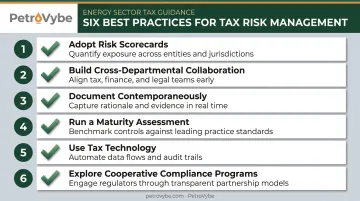
- Adopt tax risk scorecards. Rate each identified risk by likelihood and financial impact, then prioritize the top items first. This turns a vague sense of exposure into a concrete action plan.
- Build cross-departmental collaboration. Most tax risk starts outside the tax department — in HR, procurement, or treasury decisions. Give tax teams a seat at those tables before decisions are finalized, not after.
- Document contemporaneously. Board minutes, contracts, and correspondence created at the time of a transaction carry far more weight with tax authorities than reasoning reconstructed years later during an audit.
- Run a maturity assessment. Benchmark current operations against best-practice standards to separate quick wins from long-term structural fixes, so limited resources aren't spread too thin.
- Use tax technology. Automation reduces manual calculation errors and gives compliance teams real-time monitoring instead of quarterly spot-checks.
- Explore cooperative compliance programs. Programs like the IRS's Compliance Assurance Process resolve issues before filing rather than after, giving businesses with strong documented controls earlier certainty and less friction.
Reducing Tax Risk While Building Wealth: The Role of Strategic Tax-Advantaged Investing
Here's the reframe worth sitting with: missed opportunity risk isn't only about failing to claim a deduction you're already entitled to. It's also about not knowing which legislated incentives exist in the first place.
For accredited investors and high-income earners, one of the longest-standing examples is the Intangible Drilling Cost (IDC) deduction.
Under IRC 263(c) and Treasury Regulation 1.612-4, operators and working-interest holders can elect to deduct the non-salvageable costs of drilling — labor, fuel, chemicals, site prep — in the year those costs are incurred rather than capitalizing them over time.
What makes this provision unusual is where the deduction applies.
Under a working-interest structure that doesn't limit the holder's liability, the loss is treated as nonpassive, meaning it isn't confined to offsetting passive income the way most real estate deductions are. It can offset W-2 wages and capital gains directly, in the same tax year the investment is made.
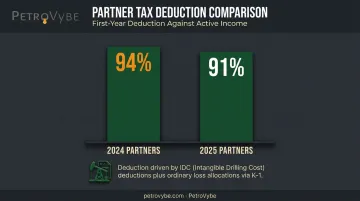
This is the mechanism PetroVybe uses in its natural gas development projects in South Texas. Partners who joined in 2024 received a 94% first-year deduction against active income; 2025 partners saw that figure land at 91%, driven by IDC deductions combined with ordinary loss allocations flowing through the K-1.
A few things worth knowing before evaluating any tax-advantaged structure like this:
- Minimum investment thresholds typically start around $100,000 in liquidity
- Participation requires verified accredited investor status: self-certification isn't enough under SEC Regulation D 506(c) rules; a CPA, tax attorney, or licensed advisor must confirm it
- Reserve valuations should be backed by independent, third-party engineering reports, not internal projections alone
- Investor review platforms, such as Invest Clearly, give prospective partners a way to see verified feedback before committing capital
The parallel to corporate tax risk management is direct: just as a board demands independent testing of its control framework, an individual investor should demand independent validation before trusting any deduction estimate. If you're evaluating whether this structure fits your income situation, PetroVybe offers a 30-minute consultation to walk through the numbers against your specific tax position.
Frequently Asked Questions
What are the types of tax risk management?
Tax risk falls into four core categories: financial/compliance risk, missed opportunity risk, operational and transactional risk, and reputational or personal liability risk. Most organizations only actively manage the first category.
What is the main goal of tax risk management?
The goal is keeping tax processes efficient, transparent, and well-controlled, so authorities have less reason to challenge you while you also avoid overpaying through missed deductions or credits.
What is the tax risk control framework?
Per the OECD standard, a Tax Control Framework is the internal control system that assures accuracy and completeness of tax returns and disclosures. Its core components include a documented tax strategy, assigned responsibility, testing, and reporting.
How often should a company reassess its tax risk management framework?
At minimum, annually. Reassessment should also happen immediately after major changes like M&A activity, entry into new markets, or significant legislative shifts affecting your industry.
What is a tax risk scorecard?
It's a tool used to register, rate, and communicate identified tax risks by likelihood and financial impact, giving senior management a prioritized view of where to focus resources first.
Can accredited investors use alternative investments to manage tax risk?
Yes. Vehicles like natural gas development partnerships offering IDC deductions can legally reduce active income tax exposure (including W-2 wages and capital gains) while diversifying beyond traditional stocks and real estate.