

This guide breaks down what company income really means, how it gets taxed, and why the distinction between revenue and income shapes real financial decisions — whether you're running a business or deciding where to put your capital.
We'll cover revenue versus income, the three layers of income (gross, operating, net), how taxation depends on business structure, and how investors use these figures to separate genuine opportunities from sales-growth mirages.
Key Takeaways
- Revenue is total earnings before costs; income remains after expenses, interest, and taxes.
- Company income has three layers: gross, operating, and net.
- C-corps pay entity-level tax, while pass-through entities tax owners directly.
- Smart investors track net income trends and tax efficiency, not just revenue growth
Revenue vs. Company Income: Understanding the Core Difference
Revenue and income get used interchangeably in casual conversation. On a financial statement, they mean very different things, and mixing them up can make a struggling company look successful, or a profitable one look weak.
What Is Revenue?
Revenue is the "top line": the total money a company generates from its core business activities before a single expense gets subtracted. The simplified formula:
Revenue = Units Sold × Average Selling Price
Common revenue sources include:
- Product or service sales
- Licensing fees
- Subscription payments
- Rental income
- Service and transaction fees
Recognition timing can vary by company and industry. Under U.S. accounting rules (ASC 606), revenue gets recorded when a company satisfies its obligation to the customer, not necessarily when cash changes hands.
That means two companies with identical sales volume can report revenue differently depending on contract terms. Always check the footnotes in financial statements before comparing two companies' top lines directly.
What Is Company Income?
Company income, specifically net income, is what remains after every cost gets deducted from revenue. This is the "bottom line," and it directly answers the question, "what is the income of a company?"
Net Income = Revenue – (COGS + Operating Expenses + Interest + Taxes)
This single number tells you whether a business actually made money, not just whether it sold a lot of stuff.
Why the Distinction Matters
Here's a real example. Amazon reported $637.959 billion in net sales for fiscal year 2024, alongside $59.248 billion in net income, according to its 10-K annual filing with the SEC. That's a gap of nearly $578.7 billion between what came in the door and what actually stuck around as profit.
That gap isn't a red flag. It reflects the normal cost of running a massive operation: logistics, salaries, R&D, interest, and taxes.
But it illustrates a critical point: high revenue never guarantees profitability. A company can grow sales every quarter while losing money faster, if costs climb even quicker. The reverse is also true: a business can shrink revenue and still improve its bottom line through cost discipline.
The Three Types of Company Income
Net income doesn't appear out of nowhere. It's the last stop after three progressive layers of deduction, each revealing something different about how a business operates.
Gross Income
Gross income equals Revenue minus Cost of Goods Sold (COGS). It shows how efficiently a company produces or delivers what it sells, before any overhead gets factored in. A software company earning $2M in revenue with $200K in COGS reports a 90% gross margin, while a manufacturer with the same revenue and $1M in COGS nets only 50%.
Operating Income
Operating income equals Gross Income minus operating expenses — rent, salaries, marketing, depreciation, and similar day-to-day costs. This figure isolates how well the core business runs, stripped of financing decisions or one-time events. A retailer with $800K in gross income and $600K in operating expenses nets $200K in operating income, the cleanest measure of operational health since it excludes financing and tax effects.
Net Income
Net income equals Operating Income minus interest, taxes, and other non-operating items. This is the figure used to calculate profit margin, earnings per share (EPS), and most other headline ratios investors rely on.
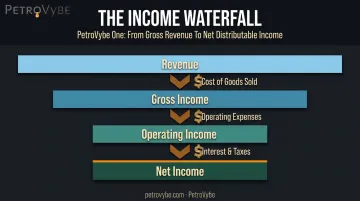
Here's how the calculation flows step by step:
| Stage | Calculation | Result |
|---|---|---|
| Revenue | Total sales | Top line |
| Minus COGS | Direct production costs | → Gross Income |
| Minus Operating Expenses | Rent, salaries, marketing, depreciation | → Operating Income |
| Minus Interest & Taxes | Financing costs, tax liability | → Net Income |
Each layer strips away a different category of cost. By the time you reach net income, you're looking at what truly belongs to the owners or shareholders.
How Company Income Is Taxed
Corporate Income Tax Basics
C-corporations pay federal tax on taxable income (not revenue) at a flat 21% rate, per IRS Publication 542. That's just the federal layer. States add their own corporate income tax on top, and the range is wide.
North Carolina, for example, taxes corporate income at just 2.25% in 2025 (down from 2.5% in 2024), while New Jersey charges up to 9% on entire net income over $100,000, according to New Jersey's Division of Taxation. Where a company operates, and how it apportions income across states, materially changes its real tax burden.
Does Company Income Count as Personal Income?
This depends entirely on legal structure. C-corporations pay tax at the entity level, and if profits get distributed as dividends, shareholders pay tax again, triggering the classic "double taxation" problem. Pass-through entities (S-corps, partnerships, most LLCs) don't pay federal income tax themselves; instead, income, deductions, and credits flow directly to owners' personal returns.
There's also a distinction worth understanding for tax planning. W-2 wage income is earned through employment and subject to payroll withholding. Business or investment income (including pass-through income) is taxed differently, and it can sometimes be offset by specific deductions unavailable to wage earners.
Reducing the Tax Burden on Income Through Deductions
Certain deductions can meaningfully offset taxable income, and some go further than others. In oil and gas development, Intangible Drilling Costs (IDCs) let operators expense qualifying costs like labor, fuel, and site preparation in the year incurred, under IRC Section 263(c).
PetroVybe's own partner reporting illustrates how substantial these deductions can be in practice. Partners received a 94% tax deduction against active income in 2024, and a 91% deduction in 2025, based on redacted K-1 documentation and verified performance reporting.
What makes this deduction structure notably different from most tax breaks:
- Most passive-loss rules limit deductions to offsetting passive income only
- IDC deductions, held through a limited partnership working interest, are classified as nonpassive
- That means they can offset active income, including W-2 wages and capital gains, unlike deductions restricted to passive income alone

One verified PetroVybe partner reported eliminating a $30,000 tax liability through this structure, illustrating the deduction's real-world effect rather than just a projection.
Why Company Income Matters for Investors
Revenue growth headlines are easy to chase and easy to misread. A company can post record sales quarter after quarter while burning cash. Net income trends over time, not top-line growth, tell you whether a business is actually creating value.
For evaluating any investment opportunity, three metrics matter most:
- Net income: what's left after all costs, the clearest signal of real profitability
- MOIC (Multiple on Invested Capital): total value returned relative to capital invested, without regard to timing
- IRR (Internal Rate of Return): the annualized return rate, accounting for when cash flows arrive

No single metric tells the whole story. Two investments can share an identical MOIC yet produce very different IRRs, depending on how quickly distributions arrive.
PetroVybe's natural gas development projects target a 10-year MOIC of roughly 2.2x to 5.8x, with a projected IRR near 26%. These targets rely on production ramp-up assumptions and a "protect and scale" strategy: stabilizing legacy production assets while reinvesting cash flow into new development.
Beyond PetroVybe's own projections, accredited investors increasingly look beyond stocks, bonds, and real estate for opportunities that pair income-generating potential with tax efficiency. Natural gas development, with its combination of nonpassive deduction treatment and tangible asset backing, has become one category worth a closer look. That evaluation should apply the same net-income and after-tax lens investors use for any other opportunity.
Frequently Asked Questions
How much tax do you pay on company income?
C-corporations pay a flat 21% federal rate plus applicable state tax, while pass-through entity owners pay individual income tax rates on their share of the business income.
Does company income count as personal income?
C-corp income stays separate from personal income until distributed as dividends. Pass-through entities, including oil and gas partnerships, work differently: income flows directly onto the owner's personal tax return each year, typically reported via a K-1.
What is the income of a company?
Company income typically refers to net income — what remains after cost of goods sold, operating expenses, interest, and taxes are subtracted from total revenue.
Is revenue the same as income?
No. Revenue is total money earned before any expenses are deducted, while income (net income) is what remains afterward. They're related but represent very different points on the financial statement.
Can income be higher than revenue?
This scenario is rare. It typically happens when a company records significant non-operating gains, such as an asset sale or investment gain, that exceed its normal expenses and losses for the period.
What's the difference between net income and profit?
"Net profit" and "net income" are used interchangeably in practice. Net income is simply the more formal accounting term used on official financial statements.
Bottom Line
Revenue shows how well a company sells. Net income shows whether it can turn those sales into real, sustainable profit after every expense, interest payment, and tax bill gets paid.
That distinction matters most when you're evaluating any business or investment opportunity: look past the top-line growth story. Ask what's happening to net income, and ask how tax-efficient that income actually is once it reaches your pocket. Tax-advantaged, income-generating assets, including PetroVybe's natural gas development opportunities for accredited investors, deserve evaluation through exactly this lens. What an investor actually keeps matters more than what a project earns on paper.