
Introduction
Every retiree eventually faces the same quiet argument with themselves: live off dividends and interest, or sell appreciated assets as needed? It sounds like a technical detail. It isn't.
This single decision shapes how you diversify, how you're taxed, and how your portfolio holds up when markets get rough.
Here's the catch with income-only investing: it narrows your options more than most people realize.
Research from Dimensional Fund Advisors, cited in a McLean Asset Management analysis, found that only about 52% of U.S. companies paid dividends on average between 1963 and 2019. Build a portfolio around dividends alone, and you're automatically excluding roughly half the market.
This article breaks down both strategies, the tax math behind them, and where a hybrid approach might fit.
Key Takeaways
- Income investing spends dividends without touching principal; total return investing sells assets too when cash is needed
- Total return strategies offer better diversification and more control over when you pay capital gains tax
- Dividend-heavy portfolios can unintentionally concentrate in a handful of sectors, capping long-term growth
- The right approach depends on your tax bracket, risk tolerance, and need for predictable cash flow
- Hybrid models, including certain tax-advantaged alternative investments, can combine both philosophies at once
Total Return vs. Income Investing: Quick Comparison
Before we get into specifics, here's a quick side-by-side look at how these two strategies compare.
| Factor | Income Investing | Total Return Investing |
|---|---|---|
| Approach | Spends dividends/interest; share count stays fixed | Blends income + appreciation; sells assets as needed |
| Tax treatment | Dividends/interest taxed as ordinary income when received | Capital gains taxed only when sold, often at lower rates |
| Diversification | Limited to dividend/interest-paying assets | Full market access, including growth stocks |
| Withdrawal control | Dictated by what companies choose to pay | Investor controls timing and amount |
| Risk profile | Feels safer, but dividends can be cut | Requires comfort selling during downturns |
The biggest misconception in that table is that income investing feels safer. Dividend cuts happen, and they happen at the worst possible time — during recessions, when investors need cash flow the most.
What Is Income Investing?
Income investing means building a portfolio specifically to generate spendable interest and dividends. You collect the cash, and you never sell a share.
The appeal is obvious for retirees who fear "eating into principal." Watching your account balance stay flat (or grow) while cash lands in your bank account every quarter feels psychologically safer than deciding when to sell.
Core benefit: predictable, budget-friendly cash flow. You don't have to guess whether this is a good month to sell.
Core tradeoff: a narrower, less diversified asset pool. If a company doesn't pay a dividend, it typically isn't in your portfolio, even if it's a stronger long-term business.
The Hidden Principal Erosion Problem
Here's what most income-focused investors miss: when a company pays a dividend, its share price typically drops by a roughly similar amount. That $1 dividend check didn't materialize from nowhere. It came out of the stock's value.
In other words, income investing isn't actually "principal-preserving" in the way many assume. You're just moving value from one column (share price) to another (your bank account).
Common income investing subtypes:
- Dividend growth stocks
- Bond laddering
- REIT income funds
- Fixed annuities
Where Income Investing Fits Best
Income investing tends to suit conservative, near-retirement or retired investors who value simplicity and steady cash flow over maximum growth. Typical strongholds include:
- Utility and consumer staples dividend stocks
- Municipal bonds
- Dividend-focused ETFs
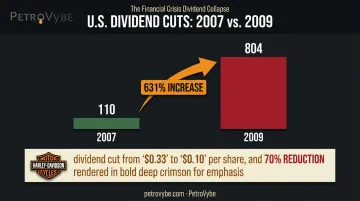
But "steady" doesn't mean "guaranteed." During the 2008-2009 financial crisis, S&P reported 804 U.S. dividend cuts in 2009, compared to just 110 in 2007 (a 631% jump), marking the worst year for dividends since S&P began tracking the data in 1955.
Harley-Davidson slashed its quarterly dividend from $0.33 to $0.10 per share that year, a 70% cut. Income isn't guaranteed just because it's called "income."
What Is Total Return Investing?
Total return investing treats every dollar the same, whether it arrives as a dividend or from selling an appreciated asset. Price growth plus income equals your return. Full stop.
Core benefit: greater tax control. You only pay capital gains tax when you actually sell, and you decide the timing. Need less income this year? Sell less. Want more next year? Sell more.
Variations include:
- Systematic withdrawal strategies — selling a set percentage annually
- Balanced growth-and-income portfolios — blending stocks and bonds for both appreciation and yield
- Tactical rebalancing — advisors periodically trim winners and top off underweighted positions
Total return strategies also open the door to alternative assets that generate value primarily through appreciation and tax efficiency rather than regular cash payouts.
Where Total Return Investing Fits Best
This approach suits investors who want maximum diversification, tax efficiency, and control over how they access their money. Common territory includes:
- Broad market index funds
- Balanced growth-and-income portfolios
- Private alternative investments, such as energy development projects offering appreciation plus tax-advantaged cash benefits
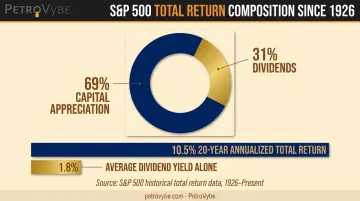
Even traditional public markets back up this approach. Since 1926, dividends have supplied only about 31% of the S&P 500's total return, while capital appreciation accounted for roughly 69%, according to S&P Dow Jones Indices.
The same report notes the S&P 500's 20-year annualized total return sat near 10.5% through February 2025, while the average dividend yield alone hovered around just 1.8%. Chasing yield means leaving most of the market's actual return on the table.
Total Return vs. Income Investing: Which Is Better for You?
There's no universal winner here. The right fit depends on a handful of practical factors:
- Cash flow needs — Do you need predictable monthly income, or can you tolerate variable withdrawals?
- Tax bracket: Higher earners often benefit more from capital gains deferral
- Time horizon — Longer horizons favor total return's growth potential
- Diversification appetite: Total return opens a wider opportunity set
- Comfort selling assets — Some investors simply can't stomach selling during a downturn, regardless of the math
If psychological comfort around "never touching principal" outweighs the cost of reduced diversification, income investing may suit you. If tax efficiency, flexibility, and long-term growth matter more, total return investing is the stronger fit.
Many advisors now blend both. Nasdaq's 2025 advisor survey found 42% pursued a total-return approach, versus 32% prioritizing pure income replacement — a plurality, not a landslide consensus. Morningstar's Christine Benz has advocated openly for a hybrid model: draw some natural income, then sell strategically to fill the gap.
This is where alternative asset classes purpose-built for early tax-advantaged cash flow plus long-term appreciation start to look interesting. They don't force you to choose.
Real-World Example: A Hybrid Approach for Accredited Investors
High-income investors face a specific squeeze: heavy ordinary income tax bills, combined with dividend income that's market-dependent and offers little real inflation protection. Neither pure income investing nor pure total return investing solves both problems at once.
This is the gap PetroVybe's natural gas development model, PetroVybe ONE, was built to address. The structure blends both worlds:
| Benefit Type | What It Delivers |
|---|---|
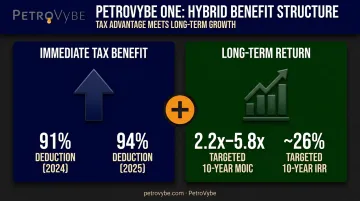
| Immediate, income-style benefit | Upfront IDC tax deduction applied against active income, including W-2 earnings and capital gains, not just passive income. PetroVybe partners realized a 91% deduction in 2024 and 94% in 2025. |
| Long-term, total-return-style outcome | Ongoing production income plus an eventual cash exit, targeting a 10-year MOIC range of roughly 2.2x to 5.8x and a targeted 10-year IRR near 26%. |
That combination is rare: a tax break today, cash flow and equity growth tomorrow. For investors already maxed out on stocks, bonds, and real estate, this kind of tangible, cash-flowing asset offers something dividend stocks can't — a hedge tied to real production, not just market sentiment.
Who this fits:
- Accredited investors carrying a heavy annual tax burden
- Investors seeking diversification beyond public markets
- Investors comfortable with a longer hold period (typically 2-3 years to first distribution, 5-10 years to full target returns)
For accredited investors, income versus total return isn't a binary choice: certain structures deliver both at once, pairing an immediate tax-advantaged benefit with long-term capital appreciation in a single investment.
If you're exploring tax-efficient, total-return-oriented diversification, learn more about PetroVybe's natural gas development opportunities across South Texas and the Gulf Coast Basin.
Frequently Asked Questions
What is the difference between income returns and personal investment returns?
Income returns come from dividends and interest paid on your holdings. Personal investment returns, or total return, include that income plus any change in the asset's value — a fuller picture of actual performance.
Is a 20% return on investment good?
Generally, yes. Broad equity indexes have historically returned closer to 8-10% annually over the long run, so 20% in a single year outpaces that benchmark. Context still matters: consider the risk taken and the time period measured.
Which strategy is better for retirement income: income investing or total return investing?
Total return investing is typically favored by financial advisors for retirement because it allows broader diversification and flexible withdrawals. Income investing can still suit investors who strongly prefer never selling assets.
Can you combine income investing and total return investing?
Yes. Many investors blend both strategies, and certain alternative assets are specifically structured to provide early tax-advantaged cash benefits alongside long-term capital appreciation.
How are income investing and total return investing taxed differently?
Interest and dividends are usually taxed as ordinary income in the year received. Capital gains from total return strategies are only taxed upon sale, often at lower long-term capital gains rates.
How does inflation affect income investing versus total return investing?
Fixed income payouts can lose purchasing power during high inflation since the payment amount stays flat. Total-return and appreciation-driven assets, including certain tangible asset investments, may better keep pace with rising prices over time.