That's the entire premise behind income shifting. It's not a loophole. It's a decades-old, IRS-recognized set of planning techniques that families, business owners, and high-net-worth investors have used for generations to legally reduce their total tax bill.
This guide walks through the traditional shifting playbook, family employment, trusts, timing strategies, and then covers something most tax content skips entirely: a way for high-income earners to shift active income itself through direct investment in tangible assets like oil and gas development.
Key Takeaways
- Income shifting redirects income to lower-bracket people, later tax years, or more favorably taxed income types.
- Family employment, custodial gifts, family limited partnerships, and timing strategies remain the most common tools.
- The kiddie tax and reasonable-compensation rules cap how aggressively you can shift income to relatives.
- Most traditional strategies only touch passive or investment income, not W-2 wages or capital gains.
- Intangible Drilling Cost (IDC) deductions from direct oil and gas working interests are a rare exception that reduces active income immediately.
What Is Income Shifting?
Income shifting, sometimes called income splitting, is the legal transfer of income (or the property that produces it) to a lower-tax-bracket individual, entity, or future tax year. Done correctly, it reduces the total tax a family or business pays on the same economic gain.
The logic is called bracket arbitrage. Because U.S. tax brackets are progressive, the same dollar of income can be taxed very differently depending on who reports it.
A simple numeric example
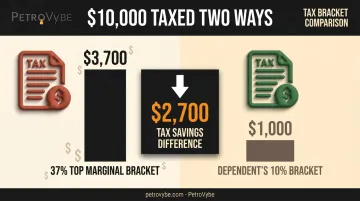
Say you have $10,000 of investment income sitting at the top of your bracket.
- Taxed at the 37% top marginal rate: roughly $3,700 in federal tax
- Taxed at a dependent's 10% bracket: approximately $1,000 in federal tax
- Difference: $2,700 on the exact same $10,000
That gap is the entire reason income shifting exists. But moving the income legally, not just the payment, is what separates a valid strategy from an audit risk (more on that below).
Income shifting works across three dimensions:
- People — moving income to a family member in a lower bracket
- Time: deferring income to a future, potentially lower-tax year, or accelerating deductions into the current one
- Character: converting ordinary income into capital gains, or restructuring how income is classified
Congress has built guardrails into each of these dimensions over the decades. The 2026 federal tax brackets still run from 10% to 37%, but rules like the kiddie tax and IRS attribution standards exist specifically to prevent taxpayers from assigning income to family members who did nothing to earn it.
Top Income-Shifting Strategies for Individuals and Families
Most income-shifting conversations start here, with strategies that shift income across people and time. Nearly all of them work best on passive or business income rather than wages.
- Hire family members. Employ children or parents at reasonable wages for real work; the salary is deductible and shifts income into their lower bracket. Sole proprietorships hiring a child under 18 often skip Social Security and Medicare withholding too.
- Gift income-producing assets through UTMA/UGMA accounts. Transferring dividend-paying stocks or bonds to a custodial account shifts future income to the child's tax rate, within annual gift limits and kiddie tax rules.
- Set up a Family Limited Partnership (FLP). Business owners transfer partnership interests to relatives, spreading business income across several lower-bracket family members. The donor still needs to take reasonable compensation for services first.
- Max out retirement accounts. SEP IRAs and solo 401(k)s shift taxable income into future years. For 2026, the combined SEP/solo 401(k) contribution ceiling is $72,000, separate from catch-up contributions.
- Time your income and deductions. Self-employed taxpayers can defer invoices or bonuses into January, or accelerate deductible expenses into December. Cash-method taxpayers recognize income when received, while accrual-method taxpayers follow the all-events test instead.

If someone asks for "the" common income-shifting strategy, it's usually one of the first and last bullets above: family employment and timing. Both are accessible, well-documented, and don't require complex entities to execute.
Business and Entity-Level Income Shifting
Beyond the family level, business owners have entity-level tools for shifting how income is characterized and taxed.
Reasonable compensation and entity choice
S-corp shareholder-employees must take a reasonable wage before taking nonwage distributions. Get this wrong and the IRS can reclassify distributions as wages, adding payroll tax exposure you didn't plan for.
C-corp officers face a similar reasonable-compensation test, but dividends carry a second layer of tax since the corporation can't deduct them.
Sale-leasebacks and gift-leasebacks
An owner transfers a business asset to a relative, then leases it back. This shifts rental income to the relative while the owner keeps using the asset.
These arrangements only hold up as genuine transactions. Courts look for:
- Giving up real control over the asset
- Setting rent at fair market rates
- Having a legitimate business reason for the lease
Courts have disallowed rent deductions in cases where any of these elements were missing.
Trusts, life insurance, and annuities
These vehicles can defer or redirect income to a beneficiary or a future date. One catch: grantor trusts don't shift current income tax the way people assume.
Under IRC 671-677, if the grantor retains certain powers over the trust, the income is still taxed to them directly. This is one of the more misunderstood areas of estate planning, and it's worth a conversation with a tax attorney before assuming a trust will move income off your return.
Risks, Rules, and the Limits of Traditional Income Shifting
Every income-shifting strategy above has a ceiling. Congress built these limits in on purpose.
The kiddie tax
This is the biggest constraint on family-based shifting. Under current rules, a child's unearned income over $2,700 is taxed at the parent's rate rather than the child's own bracket.
That closes the original loophole that made gifting investment assets to minors so attractive. Shift too much unearned income to a child, and you're right back to paying tax at your own rate.
The 60% trap
Combine an income-shifting move with a charitable deduction strategy, and you can run into a limitation that catches people off guard. Cash contributions to public charities are generally deductible only up to 60% of adjusted gross income.
Push past that cap, and the excess deduction doesn't disappear. It carries forward for up to five years, but that won't help you this year the way you planned.
The active-income gap
Here's the pattern worth noticing across every strategy above: they almost all apply to passive or investment income. Family wages shift earned income, sure, but they require an actual job and actual payroll.
Gifting, FLPs, and trusts all move investment or business income. Almost none of them offer meaningful relief against W-2 wages or realized capital gains in the same tax year you earn them.
That gap is exactly where a different kind of strategy comes in.
A Different Kind of Income Shift: Reducing Active Income Tax Through Oil & Gas Development
Very few IRS-sanctioned strategies let a high earner directly reduce this year's active income, meaning W-2 wages, self-employment income, or capital gains, without a family structure or a multi-year deferral plan. Most of what we've covered so far only touches passive income.
Direct working-interest participation in oil and natural gas development is one of the exceptions.
How Intangible Drilling Costs work
Under IRC 263(c), operators holding a direct working interest in a U.S. well can elect to expense Intangible Drilling Costs (IDCs), specifically the labor, fuel, chemicals, and site prep costs involved in drilling. These costs typically make up the bulk of a well's upfront budget, which is why the deduction carries real weight for participating investors.
Under IRC 469(c)(3), a working interest held directly, or through an entity that doesn't limit the investor's liability, is excluded from passive-activity treatment. That's the mechanism that makes this deduction different: it isn't capped by passive-loss rules the way rental income or limited-partnership losses usually are.
What that's looked like in practice
PetroVybe's own natural gas development projects give a real-world look at how this plays out:
- 2024: partners achieved a 94% tax deduction against ordinary income
- 2025: partners achieved a 91% tax deduction against ordinary income
These are actual figures that landed on partner K-1s, not projections. For an accredited investor with a heavy W-2 or capital gains tax bill, that's a current-year deduction, not a future-year deferral or a family transfer.
Why due diligence still matters here
This deduction comes with real operating risk attached, since you're investing in an actual working interest, not a paper structure. That's why the underlying project quality matters as much as the tax mechanics. A few things worth checking on any direct participation program:
- Track record of the technical team. PetroVybe's Chief Geophysicist has a documented 75.2% success rate on well location selection across a 48-year career, well above the industry peer average of under 40%.
- Third-party validation of reserves. PetroVybe's proved reserves have been valued at $48 million (PV-09) by a licensed third-party engineering firm, not an internal estimate.
- Regulatory standing. Operators should hold an active license with the Texas Railroad Commission, which is publicly searchable.

A complement, not a replacement
This strategy complements the traditional approaches covered earlier by addressing the piece they can't touch: active income, right now, in the current tax year. Used alongside family employment, retirement maximization, and smart timing, it rounds out a more complete tax picture.
If you're an accredited investor carrying a heavy active-income tax burden, PetroVybe's development projects across South Texas and the Gulf Coast Basin are built around exactly this: reducing this year's tax exposure while building long-term passive income from a tangible asset. A 30-minute call with the PetroVybe team is the easiest way to see whether it fits your situation.
Frequently Asked Questions
What is a common income shifting strategy?
Hiring family members at reasonable wages and timing or deferring income into lower-tax years are the two most widely used and accessible strategies. Both work within existing business structures without needing trusts or partnerships.
What is the 60% trap?
It's the AGI-based limit on cash charitable contribution deductions, generally capped at 60% of adjusted gross income. Combining this with other income or deduction strategies without proper planning pushes part of your deduction into future tax years instead of helping you now.
Is income shifting legal?
Yes, when done through IRS-recognized methods and properly documented. It's fully distinct from tax evasion, which involves hiding or misreporting income rather than legally redirecting it.
What is the kiddie tax and how does it limit income shifting to children?
Unearned income above a set threshold, currently $2,700, is taxed at the parent's rate instead of the child's. This reduces the benefit of gifting investment assets to minors once their unearned income crosses that line.
Can income shifting reduce taxes on active income like W-2 wages, not just investments?
Most traditional strategies only affect passive or investment income. IDC deductions from a direct oil and gas working interest are a notable exception, since they can offset active income including W-2 wages and capital gains in the same tax year.
How much can I gift a family member tax-free each year for income-shifting purposes?
The annual gift tax exclusion allows you to gift up to $19,000 per recipient without triggering gift tax reporting. Always confirm the current-year figure with the IRS before relying on it for planning.