
Plenty of people earning $150,000 a year carry more debt than savings, while a retired teacher with a paid-off house and a modest 401(k) might be objectively wealthier. That gap between "makes a lot" and "has a lot" trips up even smart, disciplined people.
Economists and financial planners don't measure wealth by paycheck size. They measure it as a balance, not a paycheck. This guide breaks down how wealth is actually defined and calculated, why absolute and relative wealth tell different stories, and what it takes to convert income into real, lasting net worth, including tax-advantaged assets most people never consider.
Key Takeaways
- Wealth is a snapshot (assets minus liabilities); income is a stream, not interchangeable with it.
- Nearly half of Americans earning over $100,000 still live paycheck to paycheck.
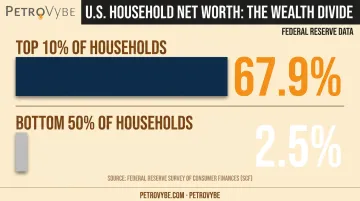
- The top 10% of U.S. households hold 68% of net worth versus 2.5% for the bottom half.
- Building lasting wealth means directing surplus income into appreciating, tax-efficient assets, not lifestyle spending.
What Is Wealth? Defining the Core Concept
Wealth is the total value of everything a person, business, or nation owns, minus everything they owe. That includes tangible assets like a home or land, and intangible ones like stock holdings or a business stake. Subtract the mortgage, the credit card balances, and the loans, and what's left is wealth.
Wealth is a stock. Income is a flow. Think of a bathtub: income is the water pouring in from the faucet each month, while wealth is the water already sitting in the tub. You can have a strong flow and still have an empty tub if there's a hole letting water out just as fast.
Money is the modern unit of account for wealth, but that's a relatively recent convention. Historically, wealth took different forms:
- Livestock (cattle, sheep, goats) among herding cultures
- Grain and wheat stores in ancient agricultural societies
- Land ownership across feudal and early modern economies
Absolute Wealth vs. Relative Wealth
Whatever form it takes, wealth isn't as simple to measure as reading a single number. There are two distinct ways to do it:
- Absolute wealth: the actual dollar value of your assets minus liabilities, full stop
- Relative wealth: how your assets stack up against your neighbors, peers, or society at large
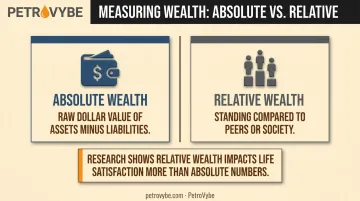
Here's the interesting part: research suggests people's sense of financial well-being tracks relative wealth more closely than absolute wealth. One study of British households found that a person's income rank among peers predicted life satisfaction far better than their raw income number did.
In other words, feeling wealthy has less to do with your bank balance and more to do with who you're comparing yourself to.
Wealth vs. Income: Why They're Not the Same Thing
Income is money earned over a specific period, such as wages, business profit, dividends, or rental checks, and it's taxed as income tax. Wealth, when transferred at death, is taxed differently under estate tax rules, because the taxable event is a transfer of ownership, not the receipt of earnings.
This distinction matters in practice too: high income doesn't automatically create wealth. The missing variable is profit, income minus expenses, and if spending rises in lockstep with earnings, profit stays flat no matter how big the paycheck gets.
This isn't theoretical. Nearly half of U.S. consumers earning more than $100,000 annually reported living paycheck to paycheck in 2024, according to PYMNTS Intelligence. Even among those earning over $200,000, more than a third said the same.
A quick comparison makes the point:
| Profile | Annual Income | Debt Load | Net Worth |
|---|---|---|---|
| High-earning professional | $180,000 | $90,000 in car/credit debt, large mortgage | Modest or negative |
| Modest earner, disciplined saver | $65,000 | Paid-off home, no consumer debt | Substantially higher |
The professional out-earns the saver every year. The saver still ends up wealthier, because surplus income, not gross income, is what builds net worth. Converting a paycheck into wealth requires deliberately routing surplus earnings into appreciating or income-producing assets instead of absorbing it into lifestyle spending.
How Is Wealth Measured? Net Worth and Beyond
Net Worth: The Standard Formula
The standard formula is simple: Net Worth = Assets − Liabilities.
Assets typically include:
- Home equity and real estate
- Investment and retirement accounts
- Cash and cash equivalents
- Business ownership stakes
- Alternative assets like direct energy or private equity partnerships
Liabilities typically include:
- Mortgage balances
- Student and auto loans
- Credit card debt
- Any other outstanding obligations
Add up your assets, subtract your liabilities, and you've got your net worth as of that exact moment.
Measuring Wealth for Businesses and Nations
Businesses measure their version of net worth through shareholders' equity, or book value: total assets minus total liabilities on the balance sheet.
Nations are trickier. Here's a common misconception worth correcting: GDP does not measure national wealth. GDP measures the flow of goods and services produced in a given period, an income measure, not a balance-sheet measure. A country could post strong GDP growth while its underlying asset base, including natural resources, infrastructure, and financial reserves, stays flat or even shrinks.
That gap between national growth and actual asset accumulation shows up at the household level too. According to Federal Reserve data, the top 10% of U.S. households hold roughly 67.9% of aggregate net worth, while the bottom 50% hold just 2.5%.
Net worth has real limitations, though. It doesn't reveal:
- Liquidity (can you actually access that value quickly?)
- Cash flow (is it generating income, or just sitting there?)
- Debt structure (is it low-interest and manageable, or high-interest and risky?)
That's why financial planners look beyond net worth to supplementary indicators: retirement savings growth rate, debt-free status, and overall financial flexibility. Financial flexibility means the ability to absorb a financial shock without derailing your plan.
Wealth Distribution and the Psychology of "Feeling Rich"
Ask Americans how much money it takes to be "wealthy," and the number keeps climbing. Schwab's 2025 Modern Wealth Survey found respondents believe it takes $2.3 million to be considered wealthy, and $839,000 just to feel financially comfortable.
That aspirational figure reflects perception, not financial security. Someone with $800,000 in assets but a mountain of debt isn't automatically comfortable, while someone with far less, but zero debt and predictable cash flow, may feel more secure than the number suggests.
Two forces drive this perception gap. Lifestyle creep causes spending to rise quietly alongside income, keeping the "surplus" perpetually out of reach. Social comparison (measuring your finances against neighbors, coworkers, or social media instead of your own goals) reinforces the same gap.
High earners aren't immune. In fact, they're often more exposed, because bigger incomes tend to invite bigger obligations: larger homes, nicer cars, private school tuition. Feeling wealthy and being financially secure are two different projects, and only one of them is measurable.
How to Build Real, Lasting Wealth
Building wealth starts with a handful of unglamorous habits:
- Create a financial plan: know your numbers before you try to move them
- Eliminate high-interest debt: nothing generates a guaranteed return like paying off a 22% credit card
- Automate savings and investing: remove willpower from the equation
From there, compounding does the heavy lifting. Every dollar of surplus income redirected into an income-producing or appreciating asset starts generating its own returns, which then generate returns of their own. The earlier and more consistently that happens, the faster net worth accelerates.
Traditional stocks, bonds, and real estate remain the foundation for most portfolios. But investors looking to diversify further, particularly those facing a heavy tax burden or worried about inflation eroding their gains, often look toward tangible, income-generating alternative assets outside the usual mix.
This is where a company like PetroVybe fits into the conversation. PetroVybe is a private Texas natural gas development company offering accredited investors direct equity access to upstream energy projects in the South Texas Gulf Coast Basin. A few specifics worth knowing:
- Minimum investment: $100,000 in liquidity, restricted to accredited investors
- Tax advantage: Intangible Drilling Cost deductions that can reach up to 100% of invested capital, with PetroVybe partners realizing a 94% deduction against active income in 2024, and 91% in 2025
- Active income applicability: unlike most real estate deductions, IDC deductions apply directly against W-2 wages and capital gains, not just passive income
- Passive income potential: monthly distributions on PetroVybe's flagship PetroVybe ONE project are projected to peak above $10,000 per unit during full production
- Return targets: a 10-year MOIC window of roughly 2.2x–5.8x and an approximate 26% IRR, based on company projections

None of this replaces the fundamentals: spend less than you earn, kill high-interest debt, invest consistently. But once those basics are handled, tax-advantaged, tangible assets are how disciplined earners turn surplus income into wealth that keeps compounding, and keeps working, long after the paycheck stops.
Frequently Asked Questions
What are the two measures of wealth?
Wealth is measured in absolute terms (the total dollar value of assets minus liabilities) and relative terms (how your wealth compares to others). Both matter: one tells you your actual financial standing, the other shapes how secure you feel.
How is wealth different from income?
Income is money earned over a period, a flow, like wages or business profit. Wealth is the total accumulated value of assets minus debts at a single point in time, a stock. You can have high income and low wealth, or the reverse.
What net worth is considered "wealthy"?
Perception varies widely; Schwab's 2025 survey put the figure at $2.3 million nationally. But true wealth is better judged against your own expenses and debt load than any fixed dollar threshold.
What is wealth management?
Wealth management is a comprehensive advisory service combining investment management, tax planning, and estate preparation, typically offered to higher-net-worth individuals and families.
What is generational wealth?
Generational wealth refers to assets, cash, real estate, securities, or business interests, passed down through family generations. It's usually built through tax-efficient investing and disciplined, long-term saving.
How can I start building wealth if I'm just starting out?
Track income against expenses, eliminate high-interest debt first, and start investing consistently, even in small amounts. Compounding rewards time in the market far more than timing it.
Conclusion
Paycheck size has little to do with wealth. What matters is the disciplined, unglamorous work of accumulating assets that outpace liabilities, year after year, regardless of what your income statement says.
The clearest path forward combines the fundamentals (spending discipline, debt reduction, consistent investing) with a willingness to look past traditional accounts. Tax-advantaged, tangible assets are increasingly part of that picture for accredited investors seeking inflation resistance and real diversification. If that describes where you're headed, PetroVybe's natural gas development partnerships are worth a closer look.