

Search "financial optimization" and you'll mostly find articles about automating accounts payable or streamlining ERP systems. Useful if you run a finance department. Not so useful if you're trying to protect your own capital from taxes and inflation.
This guide is different. We're covering tax efficiency, income diversification, passive cash flow, and risk-adjusted portfolio construction, the exact strategies sophisticated investors use to compound wealth over decades, not quarters.
Key Takeaways
- Financial optimization maximizes after-tax returns and income, not just stock picks
- Tax strategy and income diversification are the top two levers for high earners
- Tangible assets like natural gas development hedge inflation and provide tax deductions
- Optimization requires ongoing monitoring, third-party validation, and rebalancing
What Is Financial Optimization?
Financial optimization is the strategic allocation of income, capital, and assets to generate the highest possible after-tax return while managing risk and liquidity. Rather than a single tactic, it operates as a framework built on four pillars:
- Tax/cost efficiency: minimizing the drag of taxes and fees on every dollar earned
- Cash flow management: structuring income so it works for you, not just sits idle
- Data-driven insight: tracking real performance metrics instead of gut feel
- Marginal return: finding where your next dollar does the most work
Most content on this topic targets corporate finance teams optimizing internal processes. That's not what we're talking about here.
This guide is written for individual investors and high-income earners whose goal is compounding personal wealth. Instead of an accounting department, your process is your paycheck, your capital gains, and your long-term net worth.
Tax Optimization: The First Lever of Financial Optimization
For most high earners, taxes are the single largest recurring expense you'll ever pay, and it's not close.
According to IRS Statistics of Income data, the top 1% of earners paid an average federal income-tax rate of 26.09% in tax year 2022. That group contributed over 40% of all federal income tax collected despite earning roughly 22% of total adjusted gross income.
That's before state taxes, payroll taxes, and the phase-outs that hit high earners specifically.
Standard Tax-Advantaged Moves
Before exploring anything exotic, make sure you've maxed out the basics:
- Retirement accounts — 401(k), backdoor Roth, and SEP-IRA contributions reduce taxable income annually
- Tax-loss harvesting — offsetting capital gains with strategic losses in your portfolio
- Entity structuring — holding income-generating assets through LLCs or S-corps where appropriate
These strategies work. They're also well known, which means they only get you so far.
The IDC Deduction: An Underused Lever
Here's where it gets interesting for W-2 earners and capital gains holders specifically. Intangible Drilling Cost (IDC) deductions in oil and gas development are among the few deductions the IRS permits against active income, not just passive income.
Working interests held directly, or through an entity that doesn't limit liability, are treated as nonpassive under IRS rules (Publication 925). This removes the passive-activity-loss restriction that trips up strategies like real estate depreciation.
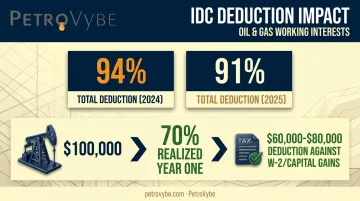
PetroVybe, a Texas-based natural gas development company, offers a real-world illustration. Accredited investors partnering on PetroVybe ONE development projects saw a 94% total tax deduction against ordinary income in 2024 and 91% in 2025.
Roughly 70% of that deduction is typically realized in year one. On a $100,000 investment, that can translate to a $60,000-$80,000 deduction applied directly against W-2 wages or capital gains.
One caveat worth stating plainly: actual deduction amounts depend on basis, at-risk rules, and excess-business-loss limitations, and recapture under IRC 1254 can apply upon disposition. This isn't a blanket write-off. It's a powerful, well-established tool that requires proper structuring.
Year-end matters here. Many of these strategies carry annual deadlines and require accredited investor status, so model your scenarios with a CPA before December, not after.
Income Diversification & Passive Cash Flow Strategies
Stocks, bonds, and real estate are the default portfolio. They're also correlated, meaning when one drops, the others often follow. That leaves high earners overexposed precisely when they need protection most, especially against inflation.
Consider the math: annual CPI-U data from the Bureau of Labor Statistics shows the index rose from 237.017 in 2015 to 321.943 in 2025. That's a 35.83% cumulative price increase, meaning a fixed dollar lost approximately 26.38% of its purchasing power over that decade. Cash sitting still isn't neutral. It's losing.
Why Non-Correlated Assets Matter
Diversifying into private equity, natural resources, and energy development reduces reliance on public-market swings. These asset classes don't move in lockstep with the S&P 500, which smooths portfolio volatility over time.
The appeal goes beyond diversification, though. Passive income streams matter most to people who don't have extra hours to manage a second job disguised as an investment. PetroVybe positions its natural gas development partnerships around a 10-year target MOIC of approximately 2.2x-5.8x and a target IRR near 26%, structured so investors participate without day-to-day involvement.
The AI Demand Angle
Here's a trend that's easy to overlook: AI infrastructure runs on electricity, and electricity increasingly runs on natural gas. The International Energy Agency projects U.S. natural gas generation serving data centers will add more than 130 terawatt-hours annually by 2030. Natural gas liquids, which command premium pricing over dry gas, sit directly in the path of that demand curve.
A Practical Allocation Guideline
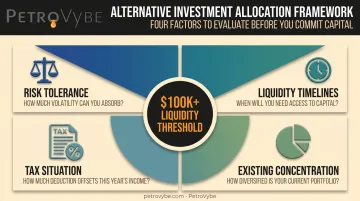
That demand trajectory turns the allocation question practical, not theoretical. If you've got $100,000 or more in liquidity and a meaningful tax burden, evaluate what percentage of net worth belongs in non-correlated alternatives. Factors to weigh:
- Risk tolerance: alternatives carry different risk profiles than public equities
- Liquidity timelines: many alternative investments lock up capital for years
- Tax situation: the higher your active income, the more IDC-style deductions matter
- Existing concentration: the more you're already exposed to public markets, the more diversification helps
Building a Risk-Adjusted, Data-Driven Portfolio
Optimization means finding where your next dollar produces the best risk-adjusted outcome, not simply chasing the highest return. That's the concept of marginal return applied personally: not "should I invest," but "where does this specific dollar do the most good, after tax and after risk?"
Due Diligence Isn't Optional
Before committing capital to any alternative investment, verify the fundamentals independently. Look for:
- Independent engineering reports: third-party validated reserves, not just sponsor projections
- Verified investor reviews: platforms like Invest Clearly provide outside validation
- Transparent reporting: ongoing production and financial data, not annual summaries only
PetroVybe, for example, cites a $48 million proved reserves valuation determined by a licensed third-party engineering firm. Its lead geophysicist carries a documented 75.2% success rate on well location selection across a 48-year career, well above the sub-40% industry peer average. Numbers like these are the kind of specifics investors should demand from any sponsor.
Track the Right KPIs
| Metric | What it measures | Watch out for |
|---|---|---|
| MOIC | Total value returned divided by capital invested | Doesn't account for time invested |
| IRR | Annualized rate accounting for cash flow timing | Sensitive to distribution timing |
| Cash-on-cash return | Annual cash flow divided by cash invested | Measures yield, not total appreciation |
Track these quarterly, not just at tax time. A portfolio that looked optimized in January can drift by June as tax law shifts, markets move, or personal goals change. Treat rebalancing as ongoing maintenance rather than a one-time event.
Common Mistakes to Avoid in Financial Optimization
Even sophisticated investors stumble on the same handful of errors. Watch for these:
- Over-concentration in public equities. A portfolio that's 90% stocks looks diversified on a brokerage statement but isn't diversified against inflation or a market correction.
- Chasing short-term tax breaks without a long-term plan. A deduction that creates cash flow strain or derails compounding elsewhere isn't optimization. It's a distraction.
- Skipping sponsor due diligence. Before backing any alternative investment operator, verify their track record on delivering promised deductions, asset performance, and downside management.
Vague answers to these questions are a red flag. Sponsors with real track records can produce specific, quantifiable numbers on request, not just marketing language.
Frequently Asked Questions
What is financial optimization?
Financial optimization is the strategic allocation of capital and resources to maximize after-tax returns, income, and long-term wealth while actively managing risk. It applies to individuals and businesses alike.
Why is optimization important in finance?
Optimization identifies the most efficient use of limited capital, reducing unnecessary tax and cost drag while improving risk-adjusted returns. It's about squeezing more value from every dollar already at work in your portfolio.
What are the best financial optimization strategies for high-income earners?
Start with tax-advantaged accounts and tax-loss harvesting, then layer in alternative investments offering active-income deductions, such as oil and gas IDC write-offs. Combining both addresses income and long-term wealth simultaneously.
How can alternative investments improve financial optimization?
Alternative investments reduce correlation to public markets, generate passive income streams, and often carry unique tax advantages unavailable through stocks or bonds. They round out a portfolio that's otherwise overexposed to market swings.
Is oil and gas investing a good tax optimization strategy?
IDC deductions allow substantial first-year write-offs against active income, including W-2 wages and capital gains, making this a distinctive tool for high earners. Eligibility requires accredited investor status and careful structuring with a tax professional.
How much should I allocate to alternative investments for diversification?
Allocation depends on your liquidity, risk tolerance, and current tax burden, so there's no universal percentage. Consult a financial advisor before committing capital, and never allocate beyond what you're prepared to hold long-term.