

Many people default to letting the money sit in a checking account earning next to nothing, or they spend it before giving it a second thought. Neither move puts that cash to work.
This guide walks through a decision framework for extra money: shoring up your finances first, parking short-term cash wisely, growing long-term wealth, and — for accredited investors carrying a heavy tax burden — exploring alternative assets that diversify beyond the stock market.
Key Takeaways
- Pay down high-interest debt and build an emergency fund before investing a dollar elsewhere.
- Money needed within three years belongs in high-yield savings, CDs, or money market funds.
- Long-term goals favor retirement accounts, index funds, and stocks.
- Accredited investors with high tax bills can offset up to 90%+ of active income through natural gas development deductions.
- There's no single "best" answer — it depends on your risk tolerance, timeline, and tax situation.
Step 1: Shore Up Your Financial Foundation Before You Invest
Before you invest a single dollar, look at what's costing you money right now. The average credit card APR for accounts assessed interest recently topped 22%, according to the Federal Reserve's G.19 consumer credit release, while Bankrate's tracker puts the average offered rate closer to 19.57%.
Either number tells the same story: almost no investment reliably returns 20% a year. Paying down that debt is a guaranteed, tax-free return equal to the interest rate you're no longer paying.
Build Your Buffer First
Once high-interest debt is under control, keep a starter cash cushion, roughly $1,000, accessible at all times. This covers small emergencies without forcing you to reach for a credit card.
From there, work toward a full emergency fund:
- 3 months of essential expenses if you're single, have stable income, and no dependents
- 6 months or more if you're a sole earner, support a family, or work in a less stable industry
- Somewhere in between if your situation shifts year to year
Skipping this step is the most common reason people end up back in debt right after they start investing.
Step 2: Where to Park Extra Money for Short-Term Goals
If you'll need the money within one to three years, growth potential matters less than safety and access. This is where short-term parking spots come in.
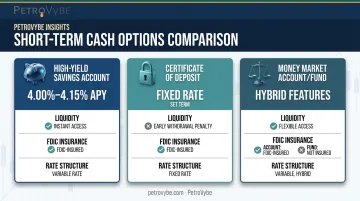
High-yield savings accounts (HYSAs) are the default choice for most people. They're FDIC-insured up to $250,000 per depositor, per bank, per ownership category. Top accounts pay 4.00% to 4.15% APY, according to Bankrate's savings rate rankings, which track rates continuously. Compare that to the FDIC's national average savings rate of just 0.38%, a rate more than ten times lower.
Certificates of deposit (CDs) work well when you know exactly when you'll need the money, say, a down payment in 18 months. You lock in a rate for a set term, but early withdrawal comes with a penalty:
- Expect three to six months of interest lost on shorter-term CDs
- Face a full year of interest lost on longer-term CDs
- Check the fine print closely, since penalties vary by bank
Money market accounts and money market funds sit in between. A money market account is a deposit product at a bank, insured like a savings account.
A money market fund, by contrast, is a mutual fund holding short-term debt, and it's not FDIC-insured. It can technically lose value, though that's rare in practice, so don't confuse the two when comparing options.
Step 3: Best Long-Term Investment Options to Grow Extra Money
Once your debt is handled and your emergency fund is funded, extra money with a five-year-plus horizon can go to work building real wealth.
Maximize Tax-Advantaged Retirement Accounts First
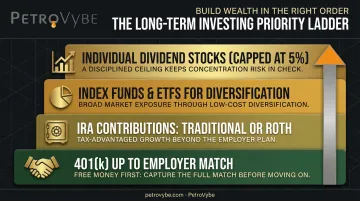
Start with your 401(k), at least up to any employer match. That match is money your employer hands you simply for participating, and skipping it is leaving free cash on the table. Contributions also reduce your taxable income today.
For 2026, the IRS raised the employee deferral limit to $24,500, with an $8,000 catch-up for those 50 and older (or $11,250 for ages 60-63).
IRAs are the next building block:
- Traditional IRA: Contributions may be deductible now; withdrawals are taxed later.
- Roth IRA: Contributions aren't deductible, but qualified withdrawals are tax-free.
- Combined 2026 contribution limit across both types: $7,500, plus a $1,100 catch-up for those 50+.
Build a Diversified Portfolio With Funds and Stocks
After maxing out available tax-advantaged space, index funds and ETFs offer a low-cost way to own the broader market. A fund tracking the S&P 500 spreads your risk across hundreds of companies instead of betting on one.
For context, $100 invested in the S&P 500 at the start of 1928 grew to over $1.15 million by the end of 2025, including dividends, according to NYU Stern's historical returns data.
That works out to roughly 10.02% annualized over 98 years. It's a historical average, not a promise — any single year can swing wildly, with returns ranging from -43.84% to +52.56% in that dataset.
Dividend stocks add another layer: passive income plus growth potential. Qualified dividends are taxed at the same preferential rates as long-term capital gains (0%, 15%, or 20%, depending on income), which is friendlier than ordinary income tax rates.
If you enjoy picking individual stocks, Fidelity's rule of thumb caps any single stock at around 5% of your stock portfolio. Concentration can pay off, but it can also wipe out gains fast if one company stumbles.
Step 4: Consider Alternative Investments for Diversification and Tax Efficiency
Stocks, bonds, and mutual funds all move with the same public markets. When one drops, correlated assets often drop with it. That's why accredited investors frequently look beyond Wall Street toward private, tangible assets: real estate, private equity, and energy development among them.
What Makes Someone an Accredited Investor
Under SEC rules, an individual qualifies as an accredited investor by meeting at least one of these:
- Net worth over $1 million, excluding the primary residence
- Individual income over $200,000 in each of the last two years, with the same expected this year
- Joint income over $300,000 with a spouse under the same conditions
- Professional license, holding an active Series 7, 65, or 82 registration
This status unlocks private placements unavailable to the general public, including direct participation in energy development projects.
Why Natural Gas Development Draws Interest
Oil and gas working interests come with a tax feature that real estate can't match. Intangible Drilling Costs (IDCs), meaning wages, fuel, and supplies tied to drilling, can be deducted in the first year under IRC Section 263(c). Because a working interest isn't classified as a passive activity, those deductions can offset active income, including W-2 wages and capital gains. Passive rental losses generally can't do that.
PetroVybe, a Texas-based natural gas development company, gives accredited investors direct access to early-stage gas development across South Texas and the Gulf Coast Basin. A few specifics worth knowing:
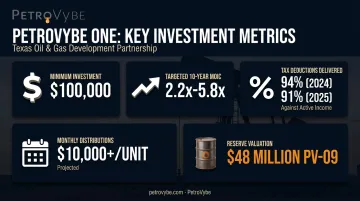
- Minimum investment: $100,000 per partnership unit
- Targeted 10-year MOIC: roughly 2.2x to 5.8x, with a targeted IRR near 26%
- Actual tax deductions delivered to partners: 94% against active income in 2024, and 91% in 2025
- Monthly passive distributions: projected to peak above $10,000 per unit during the production phase
- Reserve valuation: $48 million (PV-09), confirmed by a licensed third-party engineering firm, alongside a clean 2025 independent audit
One verified partner reported his $30,000 tax liability was fully eliminated through the structure, an illustration of how the IDC deduction plays out in practice.
The Tradeoffs
Alternative investments complement Steps 1-3 rather than replace them:
- They're illiquid, often locking up capital for a decade or more.
- They require accredited investor status, so they're off-limits to most first-time investors.
- Returns depend heavily on operator quality, not just market conditions.
Before committing capital to any private energy deal, ask for a supportable, quantifiable track record on well-site selection. PetroVybe, for instance, points to a Chief Geophysicist with a 75.2% career hit rate on profitable locations over 48 years, well above the sub-40% industry average. Look for independent engineering validation and a verifiable audit history before writing a check.
How to Choose the Right Home for Your Extra Money
There's no universal answer, but three questions narrow it down fast:
- Time horizon: When will you actually need this money? Under three years points to savings or CDs. Five-plus years opens the door to stocks, funds, or alternatives.
- Risk tolerance: Could you stomach a 20% drop without panic-selling? If not, lean toward more conservative options.
- Tax situation: Do you need deductions against active income this year, or is tax-deferred growth enough? Oil and gas partnerships like PetroVybe's, for instance, can offer deductions against active income that savings accounts can't match.
Rather than putting an entire windfall in one place, consider splitting it across multiple goals:
- A portion toward paying down debt
- A portion into an emergency fund or HYSA
- A portion toward long-term growth or alternatives
For larger sums, especially anything headed toward private or alternative investments, talk to a financial or tax advisor first. The stakes go up alongside the dollar amount, and a second opinion rarely hurts.
Frequently Asked Questions
Where is the best place to invest extra money?
It depends on your debt load, emergency savings status, time horizon, and risk tolerance. Work through the framework above in order: foundation first, then short-term parking, then long-term growth or alternatives.
How much extra money should I invest each month?
A common guideline suggests investing 10% to 15% of your income toward retirement once debt and emergency savings are addressed. Adjust up or down based on your goals and timeline.
Should I pay off debt or invest extra money first?
High-interest debt like credit cards should generally come first since few investments beat a 20%+ APR. Lower-interest debt, like a mortgage, can often be balanced alongside investing.
What's a good return on extra money invested?
Savings accounts currently yield around 4% at the top end, 10-year Treasury bonds have averaged about 4.54% annually since 1928, and the S&P 500 has averaged roughly 10% annually over the same span. Expect swings in any single year.
Can accredited investors get tax breaks by investing extra money in oil and gas?
Yes. Intangible Drilling Cost deductions can offset active W-2 and capital gains income, not just passive income. PetroVybe delivered a 94% deduction against active income for partners in 2024 and 91% in 2025.
How risky are alternative investments like natural gas development?
These are illiquid, long-hold investments best suited for accredited investors seeking diversification, not quick access to cash. Vet the operator's track record and third-party engineering validation before committing capital.