Introduction
A mid-market manufacturer closes its fiscal year with EBITDA up 20% over plan. The management team is ready to celebrate, until the credit agreement compliance certificate lands on the CFO's desk.
Buried in Section 2.05(b) is a mandatory prepayment of $3.2 million, due within ten business days of the audited financials.
That's excess cash flow (ECF) at work. The concept sounds straightforward: when a business generates surplus cash, lenders get paid down faster. But the actual math varies wildly by credit agreement, industry, and negotiated terms.
This guide walks through the exact formula lenders and borrowers use, the step-by-step calculation process, the variables that swing the result, and the mistakes that trip up even experienced finance teams.
Key Takeaways
- ECF is a contractually defined prepayment amount, unlike standardized metrics such as EBITDA
- Calculations begin with EBITDA or net income, then subtract interest, taxes, capex, and debt service
- Sweep percentages, typically 50-75%, dictate how much surplus cash goes to lenders
- Unlike Free Cash Flow, ECF follows no universal, non-negotiated formula
- Debt-financed deals route cash to lenders first; direct working-interest deals often skip this step
How to Calculate Excess Cash Flow: Step-by-Step Formula
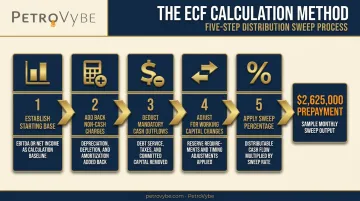
There's no single universal formula for ECF since it's a negotiated contract term. Every credit agreement writes its own definition. That said, most calculations follow a consistent five-step logic that mirrors language found across the majority of leveraged loan documents.
Step 1: Establish the Starting Base
First, confirm whether your agreement begins with EBITDA or Consolidated Net Income. This single choice shapes everything downstream. EBITDA-anchored formulas tend to be more generous to borrowers since non-cash charges are already excluded before you even start deducting cash costs.
Check the exact defined term in your agreement. "EBITDA" and "Adjusted EBITDA" often include materially different add-backs, and assuming they're interchangeable is a common early mistake.
Step 2: Add Back Non-Cash Charges
Add back depreciation, amortization, stock compensation, impairment charges, and other non-cash items not already stripped out of the base metric.
If your calculation started with net income rather than EBITDA, this is where most of the heavy lifting happens. Net-income-anchored agreements require far more manual add-back work than EBITDA-anchored ones.
Step 3: Deduct Mandatory Cash Outflows
Now subtract the cash actually leaving the business: interest paid, taxes paid, scheduled debt amortization, and capital expenditures incurred during the period.
Here's a simplified worked example:
| Line Item | Amount |
|---|---|
| Starting EBITDA | $10,000,000 |
| Less: cash interest paid | ($2,000,000) |
| Less: cash taxes paid | ($1,000,000) |
| Less: capital expenditures | ($3,000,000) |
| Preliminary cash flow | $4,000,000 |
Step 4: Adjust for Net Working Capital Changes
An increase in working capital, such as higher receivables or inventory, typically reduces ECF because that cash is tied up rather than sitting free. A decrease in working capital does the opposite.
The methodology matters here, since whether the agreement measures point-in-time balances, averages, or year-over-year change can swing the result substantially, especially for seasonal businesses.
Continuing the example, say working capital increased by $500,000 during the year. That drops the preliminary figure to $3,500,000.
Step 5: Apply the Contractual Sweep Percentage
Multiply the resulting ECF figure by the negotiated sweep percentage. According to Practical Law's guidance on Excess Cash Flow, most agreements require 50% to 75% of calculated ECF to go toward prepayment.
At a 75% sweep on our $3,500,000 figure, the mandatory prepayment comes to $2,625,000. Many agreements also build in step-downs, where the sweep percentage drops once the borrower hits an agreed leverage ratio.
Key Variables That Affect Your Excess Cash Flow Calculation
Final ECF outcomes swing significantly based on a handful of negotiated variables. Understanding these before signing (or evaluating) a credit agreement matters more than the arithmetic itself.
Anchor Metric and Capital Expenditure Rules
The starting metric determines which non-cash items an agreement automatically excludes versus which require a manual add-back. EBITDA-anchored definitions generally produce a lower ECF figure than net-income-anchored versions, meaning lenders sweep less debt.
Capex treatment carries similar weight, since agreements differ widely on what counts:
- Only actual cash-incurred capex counts toward the calculation
- Budgeted and committed capex qualifies in more permissive agreements
- Unused capex carries forward into future periods in select deals
Restrictive capex treatment inflates ECF and can trigger a much larger sweep payment than a borrower expected.
Working Capital Baseline and Leverage Step-Downs
Seasonal businesses need clarity on whether the calculation uses year-over-year change or a fixed baseline. Get this wrong, and lenders may treat normal seasonal cash cycles as "excess" cash that isn't actually excess at all.
Leverage step-downs sound favorable on paper, but the definition of leverage matters just as much as the step-down itself. According to Simpson Thacher's leveraged finance covenant handbook, voluntary prepayment credits and net-debt treatment determine whether a "favorable" step-down is ever actually reached.
Tax Distribution Deductions for Pass-Through Entities
Pass-through borrowers need an explicit deduction for owner tax distributions in the ECF definition. Without it, owners face personal tax bills at the same time lenders sweep their cash, creating a genuine double liquidity strain.
Excess Cash Flow vs. Free Cash Flow: What's the Difference
These two terms get confused constantly, and the mix-up matters. Free Cash Flow (FCF) is a standardized finance metric. S&P Dow Jones Indices defines it as net cash from operating activities minus capital expenditures. It's used broadly to assess how efficiently a company generates cash.
ECF is different. It's a bespoke legal definition baked into a specific credit agreement.
| Excess Cash Flow | Free Cash Flow | |
|---|---|---|
| Governed by | Credit agreement / loan document | Standard accounting practice |
| Answers | How much surplus cash must go to lenders | How much cash the business generates |
| Adjustments | Negotiated, deal-specific | Consistent formula regardless of deal |
| Tax distributions | May be explicitly deducted or not | Not a formal line item |
The practical contrast comes down to this:
- FCF shows how much cash the entire business generates before any lender involvement
- ECF shows how much of that cash is contractually earmarked for lenders first
- The gap between the two figures reveals how much cushion equity investors actually have
This distinction matters for anyone evaluating a capital-intensive, debt-financed venture, including leveraged oil and gas development projects. If a project carries a bank credit facility with an ECF sweep, a meaningful share of operating cash flow may go to accelerated debt paydown before investors receive anything.
By contrast, PetroVybe's structure for accredited investors is built primarily around direct working-interest partnership equity, K-1 reporting, and partner distributions, not a lender-driven prepayment hierarchy. Partner distributions flow as a function of project-level operating cash flow rather than sitting behind a third-party lender's mandatory sweep.

Investors comparing opportunities should still confirm how any credit facilities in a given deal are structured before assuming distributions are unaffected by debt obligations.
When It Applies and Common Mistakes to Avoid
When Does an Excess Cash Flow Calculation Apply?
ECF provisions show up primarily in:
- Leveraged loan agreements and syndicated term loans
- Private credit deals, including sponsor-backed transactions
- Asset-based lending structures with cash dominion features
They're especially common in private equity-backed deals and capital-intensive industries like oil and gas development, where lenders want to accelerate deleveraging whenever performance beats expectations.
Businesses financed through equity partnerships or direct working-interest capital typically skip ECF sweeps entirely. Without a lender in the capital stack, there's no cash flow obligation to sweep toward debt reduction.
Common Mistakes When Calculating Excess Cash Flow
- Assuming a standard formula exists. Every agreement writes its own defined terms. Read the actual document, not a generic template.
- Confusing ECF with cash in the bank. ECF is a formula-driven obligation. A company may owe a prepayment even if it has to draw on its revolver to fund it.
- Overlooking capex carve-outs or reinvestment rights. These provisions can legitimately shrink the mandatory sweep, but only if someone catches them during negotiation or calculation.
Conclusion
Excess cash flow depends on a negotiated, contract-specific formula rather than a fixed accounting standard. The result depends heavily on the starting anchor, capex treatment, and working capital methodology chosen by the parties at the table.
Most miscalculations trace back to misunderstanding these mechanics, not to bad arithmetic. For investors weighing debt-financed opportunities against equity-based alternatives, understanding how ECF works matters. It clarifies how much of a project's cash flow might be committed to lenders before it ever reaches an investor's account.
Frequently Asked Questions
What is excess cash flow?
Excess cash flow is a contractually defined amount of surplus cash a borrower must use to prepay debt under a loan agreement or bond indenture. It's distinct from ordinary operating cash flow or cash on hand.
What should you do with excess cash flow?
Options typically include mandatory debt prepayment if covenants require it, reinvestment in growth or capex, or distributions to owners and investors. What's permitted depends entirely on the specific credit agreement in place.
How is excess cash flow different from free cash flow?
Free cash flow is a standardized metric measuring cash generated after operating and capital costs. Excess cash flow is a lender-defined figure used specifically to calculate mandatory debt paydowns.
What triggers a mandatory excess cash flow payment?
Common triggers include stronger-than-expected EBITDA, proceeds from asset sales, and cash raised through new equity or debt issuances. The specific triggers are defined in each credit agreement.
How often is excess cash flow typically calculated?
ECF is usually calculated annually, tied to fiscal year-end audited financial statements. Payment is typically due shortly after those financials are delivered to lenders.
Is excess cash flow the same as cash sitting in a company's bank account?
No. ECF is a formula-driven contractual obligation, not a literal cash balance. A company may need to draw on a revolver to make the required payment even if operating cash is tight.