

This confusion is common. Investors often confuse acquisition year with the date negotiations started, or worse, with when funding cleared their bank account. Neither is correct, and the mix-up can mean missing a deduction window entirely or misapplying one to the wrong filing year.
This article defines acquisition year in plain terms, explains why it matters for tax planning, clarifies how it differs from related terms like acquisition date, and shows how it applies specifically to oil and gas development investments.
Key Takeaways
- Acquisition year is the tax year an asset's control actually transfers, not when talks began.
- Depreciation, depletion, and cost basis calculations all anchor to this single date.
- Closing before December 31 determines whether a deduction applies this year or next.
- Misidentifying the year can trigger amended returns or IRS compliance headaches.
What Is Acquisition Year? Definition & Core Concept
Acquisition year is the taxable or calendar year in which an asset, interest, or business is legally acquired for accounting and tax reporting purposes. Rather than a standalone line item in the tax code, it functions as a transaction fact that other rules build on.
Once established, acquisition year becomes the anchor point for several things:
- Depreciation schedules (though depreciation itself starts when property is "placed in service," a related but separate trigger)
- Depletion allowance calculations for oil and gas properties
- Cost basis, which determines gain, loss, and future deduction limits
Control Transfer, Not Negotiation Start
The acquisition date ties to when control or ownership rights actually transfer. PwC's accounting guidance on business combinations confirms this is generally the closing date, though facts and agreement terms can shift it earlier or later. In plain English: the clock starts when you actually own the thing, not when you first started talking about buying it.
Example: A Working Interest Purchase Closing
Say a working interest purchase agreement closes on December 15. The acquisition year is that year, even if onboarding paperwork, wire confirmations, or partnership admission letters aren't finalized until January of the following year. The paperwork trailing behind doesn't move the acquisition year. The closing date does.

Individual taxpayers generally operate on the calendar year, while some entities file on a different fiscal year. If you're investing through an LLC or trust, confirm which year applies to your specific structure before assuming the calendar year governs.
Why Acquisition Year Matters for Investors
Getting this date right carries real financial weight. It determines which tax year your deductions apply to, and that timing translates directly into dollar-for-dollar consequences on your return.
Deductions Follow the Acquisition Year
Intangible Drilling Costs (IDC), depletion allowances, and depreciation timelines all count forward from the acquisition year. If you're trying to offset active income, such as W2 wages or capital gains, with a working interest deduction, the acquisition year determines whether that offset happens on this year's return or next year's.
This is why some investors intentionally close deals before December 31. Locking in that year's acquisition date locks in eligibility for that year's deduction against active income, rather than pushing the benefit into the following tax year.
The Cost of Getting It Wrong
Missing that December 31 window, or misdating the acquisition entirely, creates real downstream problems. It can mean:
- Claiming a deduction in the wrong filing year, which the IRS may flag
- Needing to file Form 1040-X amended returns for one or more years
- Facing a potential 20% accuracy-related penalty under IRC 6662, unless reasonable cause applies
Impact on Investment Return Metrics
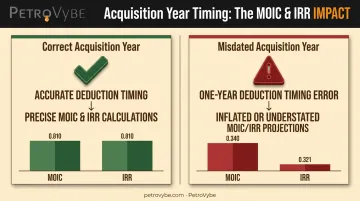
Correct acquisition year documentation also protects the accuracy of tax-adjusted cash flow projections. If you're calculating MOIC (multiple on invested capital) or IRR (internal rate of return) using deduction timing that's off by a year, your projected returns won't match reality. That gap can lead you to overestimate returns before you've committed a dollar of capital.
Acquisition Year vs. Acquisition Date vs. Purchase Date
These three terms get used interchangeably, and that's where a lot of the confusion starts.
| Term | What It Means | Key Nuance |
|---|---|---|
| Acquisition date | The specific day control transfers | Usually the closing date, but not always |
| Acquisition year | The calendar/tax year containing the acquisition date | Simply a container for the date |
| Purchase date | Often used as a synonym for acquisition date | Can diverge in deals with earn-outs or deferred closings |
Are acquisition date and purchase date the same thing? Often, yes. But they can differ meaningfully in deals involving earn-outs, deferred closings, or contingent regulatory approvals.
Federal tax ownership generally follows the transfer of benefits and burdens of ownership, a principle the IRS reinforced in Revenue Ruling 2005-74 when it addressed a sale determined by facts on the ground rather than the label on a document.
A real-world scenario: a letter of intent gets signed in November. Due diligence, financing contingencies, and title review push actual closing into February. The acquisition date, and therefore the acquisition year, is the following year, not the year the LOI was signed.
How Acquisition Year Is Determined
Acquisition year is typically set by the closing or completion date specified in the purchase agreement. Not by when due diligence started. Not by when the term sheet was signed.
Several factors can complicate this timeline:
- Regulatory approvals that must clear before closing can proceed
- Financing contingencies tied to lender requirements or capital calls
- Multi-stage earn-outs where full ownership transfers in phases rather than all at once
Complex acquisitions, particularly those involving multiple parties or extensive title work, can take many months to finalize. That's a common reality in oil and gas transactions, where title and environmental diligence often extend the runway between signing and closing.
Always confirm the specific effective or closing date stated in your agreement. That date governs your acquisition year for tax reporting, regardless of any earlier negotiation milestone you might remember as "when the deal happened."
Acquisition Year in Oil & Gas Development Investments
In oil and gas, acquisition year governs when investors can claim IDC and depletion deductions against active income. The working interest exception under IRC 469(c)(3) allows a working interest held directly, or through an entity that doesn't limit liability, to avoid passive-activity treatment.
This exception carries real weight for investors:
- Losses can offset nonpassive income, including W2 wages
- No material participation requirement applies to qualifying working interests
- Basis and at-risk rules still cap how much can be deducted
Because those limits still apply, the acquisition year remains essential for tracking each calculation correctly.
Why Documentation Matters Here
A development partner should clearly document capital contributions and well-interest acquisitions with a defined closing date. Without that clarity, investors are left guessing which tax year their deduction applies to, which is exactly the kind of ambiguity that leads to amended returns.
This is one reason many accredited investors evaluate deploying capital into gas development projects before year-end. Doing so captures that tax year's deduction opportunity against W2 income or capital gains, rather than pushing the benefit twelve months down the road.
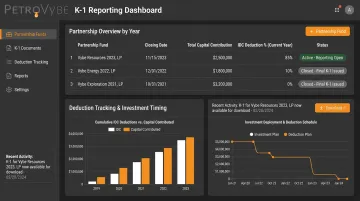
PetroVybe structures its natural gas development opportunities in south-central Texas with defined closing timelines and K-1 reporting that documents capital contributions and IDC deductions for each partnership year. Combined with third-party engineered reserve reporting, this gives partners clarity on their investment timing relative to personal tax planning goals.
PetroVybe partners have historically received first-year deductions in the 91-94% range against active income. That track record shows why the specific closing date on a well-interest agreement carries real financial weight.
Frequently Asked Questions
What is an acquisition year?
Acquisition year is the taxable year in which an asset or interest is legally acquired. It anchors depreciation schedules, depletion calculations, and deduction timelines for whatever comes after.
Is acquisition date the same as purchase date?
Often, yes, they're used interchangeably. But they can differ when deals involve deferred closings, earn-outs, or contingent regulatory approvals that push actual control transfer later.
What does acquisition mean?
Acquisition broadly refers to the process of obtaining ownership or control of an asset, business, or interest through a purchase transaction. The acquisition date is when that transfer actually happens.
Why does acquisition year matter for tax deductions?
It determines which tax filing year deductions like IDC (Intangible Drilling Costs) and depletion allowances apply to. Get the year wrong, and you risk claiming a deduction in the wrong filing period.
How is acquisition year determined in an oil and gas investment?
It's based on the closing date specified in the purchase or partnership agreement, not the date negotiations or due diligence began. Always check the effective date in your agreement.
Can acquisition year differ from the year a deal was first negotiated?
Yes, especially when regulatory approvals, financing contingencies, or multi-stage closings delay the actual transfer of control into a later calendar year than when talks began.