

This scenario plays out across the country every single day. Profit and cash flow are not the same thing, and that gap catches even experienced owners off guard.
51% of small employer firms reported uneven cash flow as a financial challenge in the past 12 months, according to the Federal Reserve's 2025 Report on Employer Firms. That's more than half of small businesses in America wrestling with the same core problem.
This article breaks down the top cash flow problems small businesses face, why they happen, a practical framework for fixing them, and when it's time to call in professional help.
Key Takeaways
- Most cash flow issues trace to timing, costs, or growth mismatches, not luck
- Late payments, overspending, and inventory bloat cause most small business cash shortfalls
- Internal fixes resolve most issues, but persistent problems need professional financial guidance
- Stable cash flow frees up capital for reinvestment, debt reduction, or long-term growth
Top Cash Flow Problems in Small Businesses
Most cash flow failures aren't random. They follow a handful of recurring, identifiable patterns. Once you know what to look for, spotting the problem in your own business gets a lot easier.
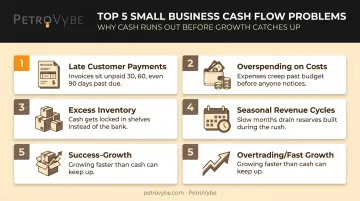
Problem 1: Late Customer Payments and Overdue Invoices
Symptoms: Accounts receivable keeps climbing. You're spending hours chasing payments instead of running your business. Cash on hand doesn't match what your sales reports say you should have.
60% of surveyed small businesses wait more than 30 days for invoices to get paid, according to Intuit QuickBooks' small business insights data. That's a full month of delivered work sitting on the books as unpaid receivables.
The usual cause? Inconsistent invoicing practices or unclear payment terms. Fixes that actually work:
- Send invoices immediately after delivery, not at the end of the month
- State payment terms clearly on every invoice (net 15, net 30, whatever fits your business)
- Automate payment reminders instead of relying on manual follow-up
- Offer small early-payment discounts (1-2%) to encourage faster payment
Problem 2: Overspending on Fixed and Discretionary Costs
Symptoms: Cash drains faster than expected even though revenue looks steady. Margins are shrinking, and it's not obvious why.
Rising costs are hitting small businesses hard right now. 75% of small employer firms cited rising costs of goods, services, or wages as a financial challenge, according to the Federal Reserve's Small Business Credit Survey. Combine that with unreviewed subscriptions and creeping overhead, and margins get squeezed from both directions.
Skip the across-the-board cut. Instead:
- Audit every recurring subscription and vendor contract quarterly
- Renegotiate top vendor contracts individually rather than slashing everything by the same percentage
- Compare your expense ratios against industry benchmarks for your specific sector, since overhead norms vary widely by industry
Problem 3: Cash Tied Up in Excess Inventory
Symptoms: Sales figures look fine, but liquid cash is thin. Storage costs keep rising, and certain stock just isn't moving.
Inventory ties up cash longer than most owners realize. As ACCA's guidance on working capital management explains, the cash operating cycle equals inventory days plus receivables days minus payables days. More inventory days means a longer wait before cash comes back.
Poor demand forecasting or "assortment creep" (adding new SKUs without cutting old ones) is usually the root cause. The fix:
- Switch to just-in-time ordering for slow-moving categories
- Apply the 80/20 rule: identify the roughly 20% of products generating most of your profit
- Cut or discount underperforming SKUs instead of letting them sit on shelves
Problem 4: Seasonal or Inconsistent Revenue Cycles
Symptoms: Strong months are followed by lean stretches, but rent, payroll, and insurance don't take a break just because sales slowed down.
Seasonal cash crunches are common enough that the SBA built a specific loan product, the Seasonal CAPLine, to finance seasonal increases in receivables and inventory. That's government-level acknowledgment that cyclical revenue creates real working capital gaps.
The typical cause is depending on a single revenue stream with no reserve built during the good months. Fixes:
- Build a monthly cash forecast that flags upcoming lean periods before they hit
- Set up automatic transfers into a reserve account during peak months
- Explore a secondary revenue stream to smooth out the cycle
Problem 5: Growing Too Fast Without Enough Working Capital
Symptoms: You're stretching supplier terms, leaning harder on credit lines, and new contracts are straining your ability to pay bills on time.
This is called overtrading, and it's a classic trap. ACCA defines it as insufficient working capital to support the level of business activity, and notes that even profitable firms can fail when they can't meet short-term obligations. Growth outpacing funding is the usual culprit: hiring, inventory, or expansion decisions made before the money to support them was secured.
The fix: pace growth against available capital, or line up financing before you need it urgently.
How to Fix Cash Flow Problems: A Step-by-Step Diagnostic Framework
Jumping straight to a generic fix, like taking out a loan or slashing expenses across the board, often wastes money. Worse, it lets the real problem resurface a few months later because you never diagnosed the actual bottleneck.
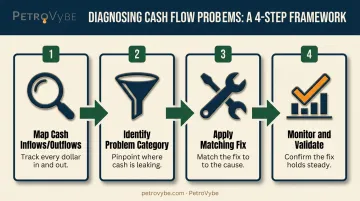
Step 1: Map Your Actual Cash Inflows and Outflows
Pull cash flow statements from your accounting software, separating operating, investing, and financing activity. Look at 3-6 months of data, not just last month. Patterns show up over time that a single snapshot hides, like receivables quietly dropping while revenue stays flat.
Step 2: Identify Which Category the Problem Falls Into
Every cash flow issue falls into one of three buckets:
- Timing: Receivables and payables are misaligned
- Structural: Fixed costs, margins, or inventory practices are the underlying problem
- Growth-related: Overtrading or lack of forecasting is driving the shortfall
Treating low cash as the problem itself, instead of confirming which category it falls into, is how businesses end up applying the wrong fix.
Step 3: Apply the Fix That Matches the Root Cause
| Root Cause | Targeted Fix |
|---|---|
| Timing | Faster invoicing, automated reminders, early-payment discounts, renegotiated supplier terms |
| Structural (costs, margins, inventory) | Vendor renegotiation, industry benchmarking, just-in-time ordering, cutting slow-moving SKUs |
| Growth/forecast | Rolling 13-week cash flow forecast, securing credit before it's urgent |
ICAEW's guidance on scale-up cash flow pitfalls specifically recommends a rolling 13-week forecast reviewed at least monthly for growing businesses. That cadence catches funding gaps well before they become emergencies.
Step 4: Monitor and Validate the Fix
Pick the specific metric that was failing, whether it's days sales outstanding, reserve balance, or inventory turnover, and track it weekly for a full cycle. Then rebuild your forecast with the corrected assumptions so early warning signs get caught sooner next time.
When to Fix It Yourself vs. When to Bring in a Financial Professional
Business size, complexity, and severity of the shortfall all determine whether internal fixes are enough or you need outside expertise.
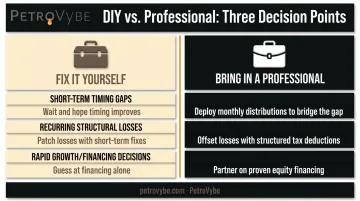
Scenario 1: Short-Term Timing Gaps
Fix it yourself: Adjust your invoicing cadence, negotiate small extensions with vendors, or use a short-term credit line to bridge the gap.
Bring in a pro: If receivables keep growing past 60 days despite process changes, that's a sign of something deeper than a timing hiccup.
Scenario 2: Recurring Structural Losses
Fix it yourself: Trim discretionary costs you've already identified and renegotiate your top vendor contracts.
Bring in a pro: If margins stay thin after cost-cutting, the real issue might be pricing or unit economics, not expenses. That requires a deeper financial diagnosis.
Scenario 3: Rapid Growth or Complex Financing Decisions
Fix it yourself: Build a basic cash forecast and phase your hiring or expansion timeline accordingly.
Bring in a pro: When you're evaluating financing structures, debt restructuring, or investment and acquisition scenarios, detailed financial modeling matters. This is where mistakes get expensive fast.
Common Mistakes and Prevention Tips to Keep Cash Flow Healthy
Common Mistakes to Avoid
- Treating low cash (the symptom) as the problem instead of diagnosing the root cause
- Making panic-driven, broad cuts like halting all marketing spend instead of targeted reductions
- Relying on gut feeling instead of a written, regularly updated cash flow forecast
Avoiding these missteps starts with turning good habits into fixed routines.
Preventive Measures for the Long Term
- Automate transfers into a cash reserve account so saving isn't optional
- Run a rolling weekly or monthly cash flow forecast as a standing habit, not a once-a-year exercise
- Review vendor contracts, payment terms, and expense categories on a set schedule, such as quarterly
Beyond Fixing Cash Flow: Turning Stability into Long-Term, Tax-Efficient Wealth
Once cash flow is stable and your business consistently generates surplus capital, a new question comes up: where does that money go? Leaving it exposed to high income tax brackets isn't the only option.
Many profitable business owners and high-income earners look beyond stocks, bonds, and real estate for asset classes that offer both passive income and meaningful upfront tax advantages.
For business owners generating six-figure surpluses, this is where PetroVybe's approach comes in. Through its PetroVybe ONE natural gas development projects in Lavaca County, Texas, accredited investors with $100,000 or more in liquidity can participate directly in upstream energy development. A few specifics worth knowing:
- Intangible Drilling Cost (IDC) deductions can offset roughly 70% of the investment against active income in year one, including W2 earnings and capital gains
- The company targets a 10-year MOIC of approximately 2.2x to 5.8x, alongside a projected 26% IRR
- Monthly passive distributions are projected to peak above $10,000 per month during peak production
These figures are forward-looking projections tied to commodity pricing and production performance, not guarantees. Participation also requires verified accredited investor status, per SEC rules, since these opportunities carry real risk and aren't suited for every investor.
Fixing cash flow gives your business surplus capital to work with. What you do with that surplus, whether it's IDC-eligible energy partnerships or another tax-advantaged vehicle, separates temporary stability from long-term wealth. Talk to a financial or tax advisor before committing capital to confirm the strategy fits your situation.

Frequently Asked Questions
What are cash flow issues?
A cash flow issue is a mismatch between money coming in and money going out, distinct from profitability on paper. A business can show a profit and still run short on the actual cash needed to cover bills.
How do you fix cash flow issues?
Identify which root cause category the problem falls into: timing, cost structure, or growth-related. Then apply the specific fix that matches that category and monitor the relevant metric to confirm it holds.
What is an example of a cash flow issue?
A profitable business waits 60-90 days on customer invoices while payroll and rent are due immediately. The revenue exists on paper, but the cash to cover expenses hasn't arrived yet.
Why do most people struggle with cash flow issues?
Lack of forecasting visibility is the biggest driver. Businesses that manage cash reactively, rather than tracking a rolling forecast, get blindsided by gaps they could have seen coming.
What is the difference between cash flow and profit?
Profit is revenue minus expenses on paper, over a set period. Cash flow reflects the actual timing of money moving in and out of your bank account, which can look very different.
How often should a small business review its cash flow?
Weekly for tight-margin or fast-growing businesses, at minimum monthly for everyone else. A continuously updated rolling forecast catches problems before they become emergencies.