Methane leaks during extraction erode much of the climate advantage gas is supposed to have. Fracking operations consume millions of gallons of water per well. Prices can triple overnight when a winter storm hits Texas. These aren't fringe concerns.
As AI data centers, home heating demand, and grid electrification all compete for natural gas supply, investors, homeowners, and policymakers need the full picture before committing capital or infrastructure decisions. This article breaks down the environmental, economic, health, and comparative disadvantages of natural gas, and where the risks are genuinely improving.
Key Takeaways
- Methane leaks during extraction can offset natural gas's climate advantage over coal
- Fracking risks include water contamination, wastewater disposal, and basin-specific seismicity
- Price volatility and high infrastructure costs create real economic uncertainty for developers
- Better engineering and leak detection, plus growing NGL output, are cutting these risks
Environmental Disadvantages of Natural Gas
Methane Emissions and Climate Impact
Methane is the main ingredient in natural gas, and it's a much bigger climate problem than most people realize. The EPA rates methane's 20-year global warming potential at 81 to 83 times that of CO2, even though its 100-year potential (27-30x) gets cited more often in policy debates.
That distinction matters. A leak today does most of its warming damage in the next two decades, not the next century.
Oil and natural gas systems rank as the second-largest source of U.S. methane emissions after agriculture, according to EPA's national inventory. Aircraft-based measurements from the MethaneAIR program found emissions of roughly 7.5 million metric tons per year across 12 major U.S. basins, several times higher than some earlier ground-based estimates.
Fracking's Water and Wastewater Footprint
Hydraulic fracturing is water-intensive by design. USGS puts typical usage at 1.5 million to 16 million gallons per well, depending on formation depth and lateral length. That water, mixed with chemical additives, has to go somewhere afterward.
Most of it ends up injected into disposal wells, and that practice carries its own risk:
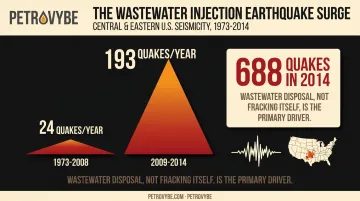
- USGS data shows central and eastern U.S. earthquakes of magnitude 3.0+ jumped from 24 per year (1973-2008) to 193 per year (2009-2014), including 688 quakes in 2014 alone
- Wastewater injection, not fracking itself, is the primary driver USGS identifies
- Only a small fraction of the more than 40,000 oil-and-gas disposal wells nationwide are linked to felt seismic events
Land Disturbance, Flaring, and Monitoring Advances
Well pads, access roads, and pipeline corridors fragment habitat and disturb vegetation. A modern unconventional pad runs about 3 acres, but horizontal drilling now lets 6-8 wells share a single pad, meaningfully shrinking the footprint per well compared to older vertical drilling.
Flaring adds another layer. Operators burn off excess gas rather than release raw methane, which is the lesser evil but still releases pollutants: nitrogen oxides, carbon monoxide, sulfur dioxide, and CO2. It's cleaner than venting, not clean.
The good news: satellite methane monitoring and EPA's tightened leak-detection rules are working. EPA projects its updated methane rule will avoid roughly 58 million short tons of methane emissions between 2024 and 2038. That's a projection, not a measured result yet, but it points in the right direction.
Economic Disadvantages of Natural Gas
Price Volatility from Weather and Demand Swings
Natural gas prices can move violently in a matter of hours. During Winter Storm Uri in February 2021, the Henry Hub spot price spiked to nearly $24 per MMBtu, its highest inflation-adjusted daily reading since 2003.
Here's the part that trips people up: the monthly average for that same February landed at just $5.35/MMBtu. Daily spikes get buried in monthly data, which means budget forecasts based on averages can badly underestimate short-term exposure.
Infrastructure, Geopolitical, and Resource Economics
Price swings aren't the only cost driver. Moving gas from wellhead to burner tip requires enormous fixed investment:
- The U.S. operates roughly 3 million miles of natural gas pipeline infrastructure
- INGAA estimates more than $1 trillion in new midstream investment may be needed through 2052, or $40-48 billion annually
- Domestic supply insulates the U.S. from the geopolitical shocks that hit oil markets, but import-dependent regions abroad still face price swings tied to global events
There's a longer-term economics problem too: natural gas is finite. As easily accessible reserves deplete, extraction shifts to deeper, tighter, or more remote formations, and the cost curve climbs.
U.S. proved reserves stood at 583.9 Tcf at year-end 2024, down 3% from the prior year, equal to roughly 15.5 to 18 years of supply depending on which consumption figure you use.
Boom-Bust Cycles and Regulatory Compliance Costs
Depletion isn't the only long-term risk. Drilling activity tracks commodity prices almost exactly, and local economies pay for that whiplash.
After the 2014 price crash, Texas and New Mexico lost a combined 120,000 oil-and-gas jobs. Regional employment fell 29% between December 2014 and December 2017, even as production rose 14% over the same span.
Add regulatory compliance on top of that cycle. Stricter methane and wastewater rules raise operating costs for producers, and those costs tend to flow through to consumers over time. It's a real tradeoff: tighter environmental standards protect communities, but they aren't free.
Health, Safety & Community Concerns
Natural gas development doesn't just carry climate and economic risk. It affects the people living near it.
- Respiratory symptoms: A Pennsylvania study of 492 residents found those living within 1 kilometer of a well site had 3.1 times higher odds of upper-respiratory symptoms than those living farther away
- Pediatric asthma: A separate analysis of 16,000 Pennsylvania pediatric asthma hospitalizations found 25% higher odds of hospitalization during quarters with active nearby drilling
- Pipeline safety: Mercaptan odorant additives help detect leaks, but ruptures and equipment failures still happen, requiring ongoing oversight from the Pipeline and Hazardous Materials Safety Administration (PHMSA)
- Noise: Homes within 300 meters of compressor stations averaged nearly 10 decibels louder at night than control homes , one pilot study found, plus added truck traffic during drilling
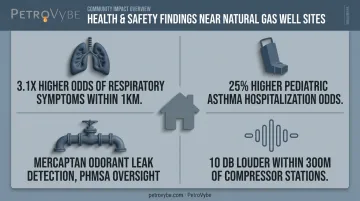
These studies use proximity as an exposure proxy rather than proving direct causation, but the associations are consistent enough that they shouldn't be dismissed.
Natural Gas vs. Other Energy Sources: Where It Falls Short
Natural Gas vs. Electricity for Home Use
Burning pipeline natural gas releases about 117 lb of CO2 per MMBtu at the point of use, according to EIA emissions data. An electric heat pump produces zero on-site combustion emissions and can deliver up to three units of heat for every unit of electricity consumed.
But that comparison isn't universal. A heat pump running on a coal-heavy grid may still carry a larger footprint than a modern gas furnace. It depends entirely on what's feeding the local grid.
Cost Comparison
That grid dependency carries over to cost as well. As of early 2026, the EIA reported U.S. residential natural gas at $18.17 per thousand cubic feet and residential electricity at roughly 16.78 cents per kWh.
Direct comparison requires converting for heat content and appliance efficiency, and both figures vary heavily by state. Gas still tends to win on raw heating cost in most regions; electricity's advantage depends on how clean the grid is and how efficient the equipment is.
Lifecycle Environmental Comparison
These figures come from NREL's life cycle assessment harmonization data:
| Generation Source | Median Lifecycle Emissions (g CO2e/kWh) |
|---|---|
| Coal | 1,001 |
| Natural gas | 486 |
| Solar PV | 43 |
| Nuclear or wind | 13 |
Natural gas cuts emissions roughly in half compared to coal. But a grid running on nuclear or renewables outperforms gas by more than 30 times on a lifecycle basis. Gas is a genuine improvement over coal. It's not a finish line.
Weighing the Disadvantages: Is Natural Gas Development Still Worth Considering?
The disadvantages above are real. They're also not static. Engineering and monitoring technology are narrowing the gap between natural gas's reputation and its actual footprint:
- Third-party engineering validation of reserves and production data reduces the guesswork that used to plague upstream investing
- Satellite and aircraft-based methane monitoring now catch leaks that used to go undetected for months
- Stricter EPA leak-reduction rules are pushing the entire industry toward lower emissions intensity, even if compliance costs rise along with it
One structural shift matters more than most: the move away from raw dry gas toward Natural Gas Liquids (NGLs). NGLs burn cleaner than crude oil and coal, and they command premium pricing at lower extraction cost.
This pricing advantage improves margins while partially addressing the environmental critique leveled at dry gas. PetroVybe's development projects across South Texas and the Gulf Coast Basin are built around this liquids-focused approach, prioritizing oil and NGL output over pure dry gas as part of its production mix strategy.
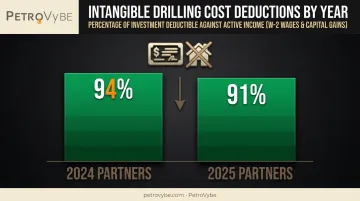
For accredited investors, there's also a tax dimension worth understanding. Intangible drilling cost (IDC) deductions apply against active income, meaning W-2 earnings and capital gains, not just passive income the way most real estate deductions work.
PetroVybe partners who joined in 2024 received a 94% deduction against active income, while 2025 partners received 91%. That doesn't eliminate commodity price risk, but it changes the math on it. A structural tax advantage delivered in year one provides a return floor before a single well ever produces a barrel.
None of this erases methane leakage, water use, or price volatility. It does mean disciplined, liquids-focused development with independent engineering oversight is a materially different proposition than a speculative dry-gas play. Investors weighing the sector should ask specifically how a project sources its data, structures its hedges, and validates its reserves, details available through resources like PetroVybe's Data Drive.
Frequently Asked Questions
Is natural gas better than electric?
It depends on the local grid's fuel mix and appliance efficiency. Natural gas often wins on heating cost and reliability, while electric can be cleaner where renewables or nuclear dominate the grid.
Can natural gas cause health issues?
Natural gas combustion and extraction can release pollutants linked to respiratory issues in nearby communities. Modern appliances and tighter safety standards have reduced both indoor and community-level risks.
Is natural gas bad for the environment?
It's cleaner than coal and oil on a combustion basis, but methane leaks during extraction and transport still contribute to climate change, plus localized impacts from drilling and fracking.
What is the biggest disadvantage of natural gas?
Methane leakage is the most significant disadvantage. Methane traps 81-83 times more heat than CO2 over a 20-year period, so even small leak rates carry an outsized climate cost.
Will natural gas run out?
Not soon, but eventually. U.S. proved reserves equal roughly 15.5 to 18 years of current consumption, and natural gas remains a finite, non-renewable resource.
Is fracking safe?
Fracking carries manageable risk under proper regulation, but it can cause localized water contamination and induced seismicity from wastewater disposal in certain basins.