
The real problem usually isn't the rate. It's the advisor. Most CPAs are built to file what already happened, not to build forward-looking strategy using the code's most powerful provisions.
This guide breaks down the strategies tax plan experts actually use, including entity restructuring, cost segregation, and retirement optimization, then goes deep on one of the most overlooked: oil and gas intangible drilling cost (IDC) deductions, which can offset active income in ways few other strategies can.
Key Takeaways
- Specialized tax planning, not just filing, keeps six-figure sums in high earners' pockets each year.
- Entity restructuring, cost segregation, and IDC deductions offset both W2 wages and capital gains.
- Credentials and third-party verified results outweigh marketing claims when vetting a tax expert.
- Alternative investments like natural gas development pair tax efficiency with passive income and asset growth.
Why High-Income Earners & Business Owners Need Specialized Tax Planning
Once income crosses into six or seven figures, the tax code stops being simple. Marginal brackets stack, deductions phase out, and surtaxes apply that most taxpayers never encounter.
The numbers make the gap clear. For tax year 2022, the average individual income tax rate across all filers was 14.48%, but the top 5% of earners paid 23.07%, and the top 1% paid 26.09%, according to Tax Foundation analysis of IRS data. High earners aren't just paying more dollars. They're paying a meaningfully higher rate.
Several thresholds compound the pressure:
- 37% top bracket begins at $626,350 (single) or $751,600 (married filing jointly) in 2025
- Net Investment Income Tax (3.8%) applies above $200,000 (single) or $250,000 (MFJ) in MAGI
- Additional Medicare Tax (0.9%) kicks in at those same thresholds
- QBI deduction phase-out starts at $197,300 (single) or $394,600 (MFJ), potentially cutting the deduction for service-business owners
Business owners carry extra weight on top of this:
- Self-employment tax runs 15.3% on 92.35% of net earnings
- Entity structure affects payroll tax exposure and deduction eligibility
- Quarterly estimated payments require hitting a 110% prior-year safe harbor once AGI passes $150,000

None of this gets addressed by tax software or a general preparer working through filing season. It requires proactive strategies, such as intangible drilling cost deductions from qualifying energy investments, mapped out before the year ends, not scrambled together after.
Top Tax Reduction Strategies Used by Tax Plan Experts
Expert-level tax planning goes beyond a Schedule A deduction list. It uses structures the tax code specifically sanctions to defer, reduce, or eliminate liability, legally and repeatedly, not as a one-time trick.
Entity Structuring & Retirement Optimization
Business owners taxed as sole proprietors pay self-employment tax on nearly all net earnings. Restructuring into an S-corp, or layering in a holding company, lets an owner split income between reasonable wages and distributions. This reduces payroll tax exposure on the distribution portion, though wages must still reflect fair value for the work performed.
Retirement plans go further for high earners:
| Plan Type | 2025 Limit | Best For |
|---|---|---|
| 401(k) employee deferral | $23,500 | Any earner |
| Defined-benefit annual benefit | $280,000 | Owners 45+ wanting large shelter |
| Cash-balance plan | Actuarially determined | Owners wanting flexible, scalable funding |
A defined benefit or cash balance plan can shelter far more income than a standard 401(k), often six figures annually for an owner in their 50s. Funding is actuarial rather than a flat contribution limit, so amounts vary by age and income.
Depreciation & Cost Segregation
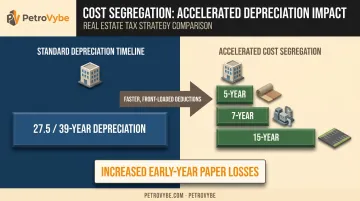
A cost segregation study reclassifies parts of a real estate purchase (flooring, wiring, parking lots) out of the standard 27.5 or 39-year depreciation schedule and into 5, 7, or 15-year categories. That acceleration front-loads depreciation, creating a large paper loss in early years that can offset active income for owners who qualify as real estate professionals.
Alternative & Passive Investment Strategies
Real estate, oil and gas, and equipment leasing all combine investment upside with deductions that dwarf what's available in a standard brokerage account. Real estate losses are usually capped by passive activity rules unless you qualify as a real estate professional. Oil and gas working interests work differently: intangible drilling cost (IDC) deductions, the structure firms like PetroVybe build their partnerships around, apply directly against active income, including W-2 wages and capital gains, a distinction significant enough to deserve its own section below.
Charitable & Trust-Based Strategies
For owners facing a large capital gains event, such as a business sale or a concentrated stock position, donor-advised funds (DAFs) and charitable remainder trusts (CRTs) offer a way to offset the gain. A DAF lets you contribute appreciated assets and take a deduction now while directing grants over time. A CRT pays you an income stream first, then passes the remainder to charity, deferring (not eliminating) tax on the underlying gain.
Oil & Gas IDC Deductions: The High-Income Earner's Most Overlooked Tax Strategy
What Qualifies as an Intangible Drilling Cost
Intangible Drilling Costs (IDCs) cover the labor, fuel, drilling mud, hauling, and site preparation expenses that go into a well before it starts producing: items with no salvage value once drilling is complete. Under IRC 263(c) and the IRS Oil and Gas Audit Technique Guide, taxpayers can elect to deduct these costs in the year paid or incurred instead of capitalizing them over the life of the well.
That election matters because IDCs typically represent a large share of a drilling project's total cost, often cited in the 60%-80%+ range for a new development well. The exact figure depends on the specific well's cost breakdown, though, not a fixed statutory percentage. Always ask for the actual cost documentation behind any number a sponsor quotes.
Why This Beats a Typical Passive Loss
Most losses from real estate or a passive business investment get trapped by passive activity rules: they only offset passive income, not your W2 wages or capital gains. Oil and gas working interests get a specific carve-out.
Under IRC 469(c)(3), a working interest held with unlimited liability isn't treated as passive, regardless of how much time you personally spend on it. That means the loss can offset active income directly, subject to basis and at-risk limits.
How PetroVybe Structures This in Practice
PetroVybe, a Texas-based natural gas developer working South Texas and the Gulf Coast Basin, offers accredited investors direct working interest positions rather than shares in a fund. That distinction matters for the deduction: a fund wrapper interposes a corporate entity between you and the drilling activity, which typically blocks the IDC pass-through. A direct working interest, reported on a K-1, passes the deduction straight to your personal return.
PetroVybe partners received deductions of 94% against active income in 2024 and 91% in 2025, figures that include W2 wages and capital gains, not just passive income. One redacted 2025 K-1 shows a $600,000 capital contribution generating $401,772 in deductions tied to ordinary loss and IDC treatment.
Those deductions sit alongside third-party validation:
- A $48 million PV-09 reserve valuation from an independent engineering firm
- A clean 2025 audit from Weaver
- A Chief Geophysicist with a career 75.2% well-selection success rate, against an industry average below 40%
Who This Strategy Actually Fits
This isn't a universal fix. It generally requires:
- Accredited investor status (net worth over $1 million excluding primary residence, or income over $200,000 individually/$300,000 jointly)
- At least $100,000 in liquidity to meet typical minimums
- A genuine appetite for energy sector risk. Commodity prices move and wells underperform; this isn't a bond substitute.
For the right investor, though, it's one of the few code provisions that turns a tax bill into a funded, income-producing asset.
How to Choose the Right Tax Plan Expert for Your Situation
Not every "tax expert" has actually handled a situation like yours. A preparer comfortable with W2 returns and a Schedule C isn't necessarily equipped for entity restructuring, defined benefit plan design, or working interest deductions.
Before hiring anyone, check for:
- A track record with clients in your income bracket and business structure, not just general tax prep experience
- Verifiable credentials, confirmed through the IRS preparer directory (CPA, enrolled agent, or attorney credentials carry full representation rights)
- Third-party verified reviews, beyond testimonials on a sales page. Platforms like Invest Clearly show verified, independently sourced feedback from actual investors.
- Coordination with your investment advisor, so tax strategy and portfolio strategy move together instead of in silos
That last point matters more than it sounds. A strategy that recommends an alternative investment without checking your overall liquidity and risk tolerance is planning in isolation.
The strongest tax plan experts loop in your advisor before recommending action, or work directly with sponsors who require CPAs and tax attorneys to verify accredited status before you write the check.
Common Mistakes High-Income Earners Make in Tax Planning
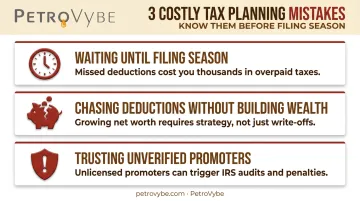
Waiting until filing season. Many high earners only talk to a tax professional in Q1, once the prior year is already locked. Entity elections, retirement plan funding, and working interest investments all need to happen before December 31, sometimes months earlier, to count for that tax year.
Chasing deductions without building wealth. A deduction that reduces your tax bill but doesn't produce an asset or income stream is a short-term fix. The stronger approach pairs tax efficiency with long-term value. Consider a cost segregation study on a property you plan to hold, or a working interest that keeps paying passive distributions long after the first-year deduction is claimed.
Trusting unverified promoters. Alternative investment tax strategies attract sponsors who overstate deduction percentages or skip real due diligence. Before committing capital, confirm:
- Independent engineering or financial validation, not just the sponsor's own projections
- A verifiable operator license and public filing history
- Third-party audited financials, not internal-only reporting
Skipping this step is how investors end up with a bare-bones Form D filing (the minimal SEC notice sponsors file) and little else backing the promised numbers.
Frequently Asked Questions
What is the difference between tax preparation and tax planning?
Tax preparation is retrospective, filing the return for a year that's already closed. Tax planning is proactive, using strategies like entity restructuring or working interest investments before year-end to shape the actual outcome.
Can business owners really deduct 90%+ of an investment against active income?
Yes, in specific cases. Oil and gas working interests are one of the few structures where intangible drilling cost deductions can offset active income, including W2 wages and capital gains, subject to at-risk and basis limits.
Who qualifies as an accredited investor for these tax-advantaged strategies?
Under SEC's accredited investor definition, you qualify with a net worth over $1 million (excluding your primary residence) or income over $200,000 individually ($300,000 jointly) in each of the last two years.
Is investing in oil & gas development risky compared to other tax strategies?
Yes. Commodity prices and drilling outcomes carry real risk, more than a cost segregation study or retirement plan. Third-party engineering validation and an experienced operator track record help manage that risk, but they don't eliminate it.
How much does hiring a tax plan expert typically cost?
Fees vary: hourly, flat-fee, or retainer models are all common depending on complexity. Weigh the cost against tax saved, since a $10,000 engagement that saves $80,000 differs greatly from one that saves $12,000.
When should a business owner start working with a tax plan expert?
Well before year-end, ideally as part of annual financial planning rather than a scramble in March. Many strategies, including entity elections, retirement plan funding, and working interest investments, have hard deadlines tied to the calendar year.