
Introduction
Picture this: you buy a $2,000 sofa with a "0% interest for 12 months" store card. You pay diligently, month after month.
Then, one payment short of the deadline, life happens — you're $200 short. Suddenly, your statement shows a retroactive interest charge that wipes out every dollar you thought you'd saved.
That's deferred interest, and it catches millions of shoppers off guard every year.
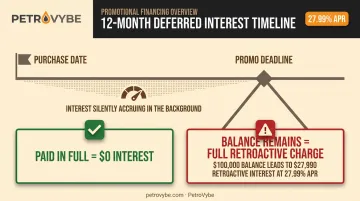
In plain terms: deferred interest accrues from your purchase date at the card's standard APR. It's only added to your account if you fail to pay the full balance before the promotional period ends.
Miss that deadline by even a few dollars, and the interest clock you thought was frozen gets backdated.
These offers show up on credit cards, retail financing, medical procedures, and even mortgages. This guide breaks down how deferred interest actually works, where you'll run into it, and how to sidestep the trap entirely.
Key Takeaways
- Interest accrues silently throughout the promotional period, whether or not you notice
- A single late payment can void the offer early and trigger retroactive charges immediately
- Minimum payments rarely clear the balance in time, leaving many borrowers exposed at the deadline
- Paying the full balance before the deadline is the only guaranteed way to avoid the charge
How Does Deferred Interest Work?
Deferred interest sounds simple: buy now, pay later, no interest. The mechanics underneath are less forgiving.
Here's what actually happens:
- Interest starts accruing at the account's standard APR from the day you make the purchase, not from the day the promo ends
- You're required to make a minimum payment each month, just like any other credit account
- If you pay the entire promotional balance before the deadline, that accrued interest is waived and never shows up on your statement
- If any balance remains when the clock runs out, the accrued interest gets added as a lump sum
A Worked Example
Say you finance a $2,000 purchase with a 12-month deferred interest offer at a 27.99% APR. You make steady payments and knock the balance down to $200 by month 12 (impressive progress).
But because your balance stayed close to the full $2,000 for most of the year, interest kept accruing in the background. By the deadline, it can add up to nearly what you'd owe if the rate had applied to the whole purchase from day one.
Card issuers technically calculate this interest cycle by cycle rather than as one flat charge on the original amount. In practice, though, if you're paying down slowly, your average monthly balance barely moves, so the end result feels the same: a bill for hundreds of dollars on a purchase you thought was interest-free.
Other triggers that can void your offer early:
- A single late or missed payment
- Going over your credit limit
- Returning an item and reducing the balance in a way that violates the terms
Once revoked, retroactive interest can apply immediately, not just at the promo's natural end date.
The scale of this risk is real. Average APRs on deferred-interest cards have historically run in the 25%-30% range. By late 2024, private-label card APRs averaged over 31%, with more than 90% of retail cards carrying maximum APRs above 30%, according to a 2025 CFPB consumer credit card market report. That's the rate applied retroactively if you miss the deadline.
Deferred Interest vs. 0% Intro APR
These two offers look nearly identical on a store display. They are not the same product, and the difference matters more than the marketing suggests.
0% intro APR: Interest only starts accruing on whatever balance remains after the promotional period ends. You never pay for the months you already enjoyed at 0%.
Deferred interest: If any balance remains at the deadline, interest is charged retroactively, covering the entire promotional period — not just what's left.
Side-by-Side Comparison
Consider a $5,000 balance with $1,000 remaining when the promo period ends on both offer types:
| Offer Type | What Happens to the $1,000 | What Happens to the Other $4,000 |
|---|---|---|
| 0% Intro APR | Starts accruing interest going forward, from this point on | No interest, since you already paid it off during the 0% window |
| Deferred Interest | Interest accrues retroactively | Interest also accrues retroactively, back to the purchase date |
The dollar difference between these two outcomes can run into hundreds, sometimes thousands, of dollars depending on the APR and how long the balance sat unpaid.
Watch for the language clues:
- "No interest if paid in full within 12 months" → deferred interest
- "0% intro APR for 12 months" → true no-interest financing
- "Interest will be charged from the purchase date if any balance remains" → deferred interest
That single phrase, "if paid in full," is doing a lot of quiet work in the fine print.
Where You'll Encounter Deferred Interest Offers
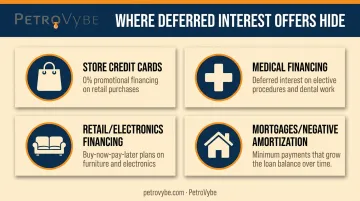
Retailers and lenders lean on deferred interest to encourage big-ticket spending: think furniture, electronics, appliances, and specialty goods, often pushed hard during Black Friday and back-to-school seasons.
Credit Cards and Retail/Medical Financing
Store-branded and co-branded cards are the most common source of these offers. The Home Depot Consumer Credit Card, for example, advertises "no interest if paid in full within 6 months" on storewide purchases of $299 or more. Disclosed APRs range from 17.99% to 29.99% if the balance isn't paid off in time.
Medical credit cards raise the stakes further. Cards like CareCredit finance elective procedures, dental work, and veterinary care over 6, 12, 18, or 24 months.
The CFPB found that consumers financed nearly $23 billion across more than 17 million healthcare purchases using deferred-interest products between 2018 and 2020, according to a 2023 CFPB report on medical credit cards. Stacking retroactive interest on top of an already unplanned medical bill is a rough combination.
Mortgages and Negative Amortization
Deferred interest shows up in mortgages too, though the mechanics differ. Instead of a lump-sum charge, unpaid interest gets added directly to the loan's principal — a process called negative amortization.
This was the engine behind payment-option ARMs before the 2008 housing crisis. Borrowers made minimum payments that didn't cover the full interest due, so their loan balances grew steadily month after month. When the loan eventually recast, payments spiked dramatically.
Because of that history, negative amortization mortgages are restricted or banned outright in several states, including Illinois, North Carolina, and New York. If you're evaluating a mortgage with flexible payment options, ask your lender directly whether negative amortization is permitted under the loan terms.
Does Deferred Interest Affect Your Credit Score?
Applying for a new deferred interest card generates a hard inquiry, which typically costs fewer than 5 points and fades from your credit report within a year or two.
Beyond that initial dip, the account behaves like any other credit line:
- On-time minimum payments help maintain your credit standing
- Late payments can hurt your score and stay on your report for up to seven years, according to the CFPB's guidance on credit report information
- Opening a new account temporarily lowers your average credit age, though this factor carries far less weight than payment history
The real danger comes at the promo deadline. If retroactive interest gets tacked onto your balance and you weren't expecting it, your outstanding debt jumps overnight. That sudden spike in credit utilization, one of the largest factors in your score, can drag your credit down right when you least expect it.
Pros and Cons of Deferred Interest
Deferred interest isn't inherently predatory, and for disciplined borrowers who pay in full, it can genuinely work. For everyone else, it's a minefield.
Pros
- Easier budgeting for large purchases, since smaller monthly payments spread out the cost
- Flexibility to pay more than the minimum whenever you have extra cash, with no prepayment penalty
- Real savings if you pay off the full balance before the deadline — you truly pay $0 in interest
Cons
- Retroactive interest can add hundreds or thousands of dollars back onto a purchase you thought was interest-free
- Strict rules mean one missed payment can void the entire offer, sometimes without much warning
- Minimum payment trap: even paying on time each month often isn't enough to clear the balance before the deadline, leaving borrowers exposed when they least expect it
How to Avoid Deferred Interest Charges
Avoiding the retroactive trap comes down to discipline and a little math, not luck.
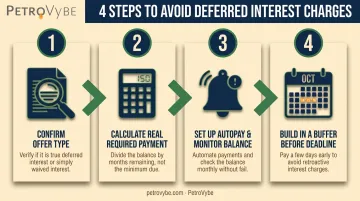
- Confirm the offer type before signing. Read the fine print for "if paid in full" language — that's your signal it's deferred interest, not true 0% APR.
- Calculate your real required payment. Divide the full balance by the number of promotional months, and pay that amount, not the smaller minimum listed on your statement.
- Set up autopay and check your balance regularly. A single missed payment can void the offer early and trigger interest immediately.
- Build in a buffer. Aim to pay off the balance one to two months before the actual deadline, in case a payment posts late or an unexpected bill throws off your plan.
Treat the promotional deadline like it's a month earlier than it actually is. That small mental adjustment protects you from billing delays that are entirely outside your control.
Alternatives to Deferred Interest Offers
If the retroactive risk makes you uneasy, you have better options for financing large purchases.
- 0% intro APR credit cards only charge interest on the balance remaining after the promo ends, never on the full original amount
- Personal loans offer fixed rates and predictable monthly payments, trading the deadline pressure for a straightforward repayment schedule
- Buy now, pay later (BNPL) plans work well for smaller purchases, splitting costs into short-term installments that are often interest-free
These options shift how you finance a purchase, but they're still forms of consumer debt. If your bigger goal is long-term financial security rather than just avoiding a bad card offer, it's worth looking beyond financing products altogether.
That said, this next point applies to a specific reader, not everyone weighing a credit card against a personal loan. Accredited investors with capital already set aside for long-term growth have a separate option worth knowing about. PetroVybe, for example, gives accredited investors direct access to natural gas development projects in South Texas. The structure is designed to reduce tax burden on active income and build monthly passive income over a multi-year hold period. It's not a financing alternative for the purchase in front of you—it's a longer-term use of capital for investors who've already settled that decision.
Frequently Asked Questions
How can I avoid paying deferred interest?
Pay the full promotional balance before the deadline, track your payments closely each month, and set up autopay so you never miss a due date. These three habits eliminate nearly all retroactive interest risk.
Why am I being charged deferred interest?
You're likely being charged because a balance remained unpaid when the promotional period ended, or because a late or missed payment voided the offer early. Either scenario triggers interest calculated back to your original purchase date.
Is deferred interest a good idea?
It can work well for disciplined borrowers who are confident they'll pay in full on time. But it carries real risk of large retroactive charges if your plans or budget change unexpectedly.
What is an example of a deferred interest?
Buying a $2,000 sofa on a 12-month deferred interest offer is a textbook example. If you pay down to $200 by the deadline, the store can charge interest backdated to the original purchase date on the full $2,000.
What is the difference between deferred interest and 0% APR?
0% APR only charges interest going forward on whatever balance remains after the promotion ends. Deferred interest applies retroactively to the entire original purchase amount if the balance isn't fully paid off.
Does deferred interest affect my credit score?
Your payment history affects your score just like any other credit account. If unpaid deferred interest gets added to your balance, the resulting jump in debt and credit utilization can lower your score.