
Introduction
Watching your portfolio balance shrink every time you sell shares to cover the rent is a specific kind of stress.
That's the appeal of retiring on dividend income: collect the cash companies pay out, spend it, and leave the shares untouched. No forced selling into a down market, no watching your nest egg shrink twice in the same quarter.
The strategy has gained followers as retirees grow wary of what happens when a market crash lands in year one or two of retirement instead of year fifteen.
Portfolio modeling from major brokerages shows that retirees facing steep losses early in retirement can run out of money decades sooner than those facing the same losses later. Timing, not just average returns, decides the outcome.
Results still vary widely, though. Portfolio size, yield targets, dividend safety, and whether income comes from individual stocks or funds all shape whether this actually works. A high yield alone guarantees nothing.
This guide covers the steps to build a dividend retirement portfolio, how much capital you need, and the variables that make or break the plan. It also covers common mistakes and where dividend income fits alongside other retirement income strategies.
Key Takeaways
- Living off dividends instead of selling shares reduces sequence-of-returns risk in early retirement downturns
- A 3.5%-4.5% starting yield implies needing roughly 22x-28x your desired annual income in invested capital
- Spreading holdings across 20-60 positions and sectors matters more than chasing the highest yield
- Qualified versus ordinary dividend tax treatment can swing your net retirement income considerably
- Most retirees pair dividend stocks with other income sources rather than relying on them exclusively
How to Retire on Dividend Income: A Step-by-Step Guide
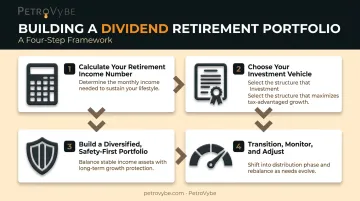
Step 1: Calculate Your Retirement Income Number
Start with your total annual expenses in retirement, then adjust for inflation across a 20-30 year horizon. A $60,000 lifestyle today won't cost $60,000 in year 20 of retirement, so build in a cushion.
Next, back into the portfolio size you'll need using the target-yield method. Fidelity's dividend yield formula rearranges to: required portfolio = annual income target ÷ assumed starting yield. Applying a realistic 3.5%-4.5% range produces this breakdown for every $12,000 of desired annual income:
| Starting Yield | Portfolio Multiplier | Portfolio Needed for $12,000/Year |
|---|---|---|
| 3.5% | 28.6x | $342,857 |
| 4.0% | 25.0x | $300,000 |
| 4.5% | 22.2x | $266,667 |
That's where the "22x-28x" rule of thumb comes from, though the exact math runs from 22.2x to 28.6x. These figures are pre-tax and assume the yield holds steady, which isn't guaranteed.
Before finalizing a number, subtract other income you'll already have coming in:
- Social Security benefits
- Pension payments
- Part-time or consulting income
- Rental income or annuity payouts
Each dollar from these sources shrinks the dividend income gap, and reduces the portfolio size required to fill it.
Step 2: Choose Your Investment Vehicle
Individual dividend stocks give you predictable, fixed per-share payouts and full control over which companies you own. You know exactly what Coca-Cola or Johnson & Johnson paid last quarter, and you can avoid a name entirely if you don't trust its balance sheet.
Dividend ETFs and funds offer instant diversification across dozens or hundreds of holdings, but the income isn't fixed. Fund-level payouts fluctuate based on the underlying companies' decisions, and that variability shows up in real data.
Vanguard's own SEC-filed fund reports show its High Dividend Yield ETF (VYM) paid $1.560 per share in fiscal 2008, dropping to $1.177 in fiscal 2009 and $1.099 in fiscal 2010 — a cumulative 29.55% income decline across the financial crisis. That's the trade-off for diversification: smoother risk, but less predictable cash flow.
Account type matters just as much as vehicle choice:
- Roth IRA - shelters dividend income from tax entirely
- Traditional IRA - defers tax until withdrawal, taxed as ordinary income
- Taxable brokerage account - exposes qualified dividends to capital gains rates, but keeps more flexibility to access cash
Step 3: Build a Diversified, Safety-First Portfolio
Concentration is the enemy of a dividend retirement plan. Most advisors suggest holding 20-60 individual positions across multiple sectors, with no single sector exceeding roughly 25% of the portfolio.
Prioritize dividend safety over the single highest yield. A company with a strong balance sheet, consistent free cash flow, and a modest payout ratio is a safer long-term income source than one paying an eye-catching yield built on a shaky business.
For context, S&P Dow Jones Indices reported the S&P 500's broad-market indicated dividend yield at roughly 1.12%-1.16% in recent readings, a useful floor to compare against when a stock or fund offers meaningfully more. A portfolio yield in the 3.5%-4.5% range sits well above the market average, which is exactly why safety screening matters before buying.
Step 4: Transition, Monitor, and Adjust Your Income Stream
Don't flip a switch on your last day of work. Phase into the dividend portfolio gradually as retirement approaches, shifting allocations over several years rather than all at once. Once positions are in place, map out a dividend payment calendar so monthly and quarterly payouts line up with your spending needs.
Ongoing monitoring is non-negotiable. Watch these signals for early warning signs of a dividend cut:
- Payout ratio - dividends divided by earnings. Fidelity's research found payout ratios in the 40%-60% range tend to be sustainable; above 80%, the market starts questioning whether the payout will hold.
- Earnings coverage trends - is the company's underlying business growing or shrinking?
- Dividend safety scores - third-party research tools flag deteriorating fundamentals before a cut is announced.
If a holding's safety score drops sharply, don't wait for the official cut announcement. Trim or exit the position and reallocate toward a company with stronger coverage.
Is Dividend Retirement Right for You?
This strategy isn't universal. It fits best if you have sufficient lump-sum capital, moderate risk tolerance, and a long retirement horizon that needs inflation protection.
When Dividend Income Makes Sense
You're a strong candidate if you have a meaningful existing portfolio and want steady cash flow without depleting principal. If you're particularly wary of sequence-of-returns risk, and you'd rather collect a check than sell shares in a down year, this approach directly addresses that concern.
When It May Not Be Enough on Its Own
If your portfolio is smaller and you need high income right away, it often can't generate enough yield without taking on excessive risk. Periods where dividend growth lags rising expenses can also leave a pure dividend strategy falling short. Many retirees address this gap by supplementing with other income sources rather than relying on dividends alone.
What You Need Before Getting Started
- A defined target income figure, adjusted for inflation
- Sufficient starting capital (often $250,000-$350,000+ depending on yield assumptions)
- A brokerage account, IRA, or Roth IRA set up and funded
- A plan for which account holds which dividend type, to minimize tax drag
Key Factors That Determine Your Dividend Retirement Success
Outcomes here depend on a handful of controllable variables, not luck.
Starting Yield
A higher yield requires less upfront capital, but it often signals elevated risk. Morningstar has flagged yields around 6%, 8%, and 9% as levels that warrant closer investigation, since a 6% yield can collapse to 2%-3% after a forced dividend cut.
A sustainable starting range for most retirement portfolios sits closer to 3.5%-4.5%. Anything well above that deserves extra scrutiny before you buy.
Dividend Growth Rate
Dividends that grow over time help preserve purchasing power across a multi-decade retirement. S&P Dow Jones Indices research found that S&P High Yield Dividend Aristocrats grew dollar dividends at a 5.18% compound annual rate from 2000 through 2023, versus 2.51% CPI inflation over the same stretch.
Mid-single-digit annual dividend growth has historically outpaced inflation by a wide margin.
Diversification and Sector Concentration
Overloading on high-yield sectors like REITs, MLPs, or utilities increases vulnerability to rate changes and sector-specific shocks. Even "Dividend Aristocrat" status isn't a guarantee.
General Electric cut its quarterly dividend 68%, from $0.31 to $0.10 per share, during the 2008-09 financial crisis, despite its long dividend history. Prior growth streaks don't protect against a genuine business downturn.
Tax Treatment of Dividends
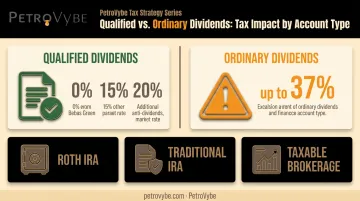
Qualified dividends are taxed at capital gains rates (0%, 15%, or 20% depending on income), while ordinary, non-qualified dividends get taxed at your regular income tax bracket, up to 37%. That gap materially affects net retirement income.
Holding dividend payers in a Roth or traditional IRA versus a taxable brokerage account changes how much of that payout you actually keep.
Common Mistakes That Derail a Dividend Retirement Plan
Even disciplined retirees stumble into these dividend-investing traps:
- Chasing the highest available yields without vetting dividend safety, risking "yield traps" where high payouts signal financial distress, not opportunity.
- Under-diversifying by overloading a single sector for extra income, increasing exposure to sector-wide downturns.
- Ignoring tax placement by holding dividend stocks in accounts that maximize tax drag instead of minimizing it
- Confusing income return with total return by ignoring capital preservation and price performance, not just the cash payout.
Alternatives and Complementary Income Strategies Beyond Dividend Stocks
Dividend stocks are one tool among several. Many retirees blend approaches for greater resilience and tax efficiency.
Short-Duration Bonds and Active Fixed Income
Better for capital preservation and predictable income with lower volatility than equities. The trade-off: typically lower long-term growth potential, and income can lag inflation over time.
Options-Based "Premium Income" Strategies
Covered calls and similar strategies can enhance monthly income while maintaining some market participation. The trade-off: upside gets capped if shares are called away, and the added complexity isn't for every investor.
Tax-Advantaged Direct Asset Investment
For high-income earners and accredited investors, direct participation in private energy development offers a different kind of income stream entirely: one built on tangible assets rather than public equity dividends.
PetroVybe, a Texas-based natural gas development company operating in Lavaca County and the Gulf Coast Basin, offers accredited investors direct access to natural gas development projects through limited partnership units. A few specifics worth knowing:
- Minimum investment of $100,000 in liquid capital, restricted to accredited investors
- Intangible Drilling Cost deductions offset active income, including W-2 earnings and capital gains, not just passive income
- Partners saw deductions as high as 94% against active income in 2024
- Distributions are illiquid and delayed, with a hold period of roughly 2-3 years before first payout, unlike public dividend stocks that pay from day one
The trade-off is real: less liquidity than a brokerage account, higher minimums, and less predictable timing than a public dividend calendar. But for investors with a heavy tax burden and a long time horizon, it's a meaningfully different lever than owning dividend-paying stocks or funds.
Frequently Asked Questions
How much do I need to invest to make $1,000 a month in dividends?
$1,000 a month equals $12,000 a year. At a 3.5%-4.5% yield range, that requires roughly $266,667 to $342,857 in invested capital, depending on the yield your portfolio actually achieves.
Is dividend investing a good strategy for retirement?
It can reduce sequence-of-returns risk and provide steady cash flow without selling shares. However, it shouldn't be a retiree's sole strategy without proper diversification and supplemental income sources.
What is the $1,000 a month rule for retirees?
It's a rule of thumb estimating the capital needed to generate $1,000 in monthly passive dividend income, based on dividing that annual target by a realistic starting yield.
How much money do I need to retire entirely on dividend income?
Multiply your desired annual expenses by roughly 22x to 28x, based on a 3.5%-4.5% starting yield assumption. A $60,000 annual need would require roughly $1.3 million to $1.7 million.
Are dividends taxed differently than other retirement income?
Yes. Qualified dividends are taxed at lower capital gains rates (0%, 15%, or 20%), while ordinary dividends are taxed as regular income, up to 37% federally.
What dividend yield is considered safe for retirees?
Very high yields often signal underlying risk or a shrinking share price. A sustainable range for most retirement portfolios sits at 3.5%-4.5%.