
CB Insights analyzed 431 VC-backed startups that shut down since 2023. Among the 385 with an identifiable failure reason, 70% cited running out of capital as the cause. That's a sample of failed companies, not every startup, but the pattern holds: cash exhaustion is usually the final blow, even when the root problem started months earlier.
"Managing cash flow" sounds like a simple task. In practice, outcomes vary wildly depending on how disciplined a founder is about forecasting, spending, and building financial systems that actually work.
This guide covers the step-by-step process for managing cash flow, the metrics that actually matter, the mistakes that sink otherwise good companies, how to respond when things get tight, and what to do once cash flow turns into surplus capital.
Key Takeaways
- Cash flow is a CEO-level job pre-Series A, not a bookkeeper's task
- Track liquid cash daily, forecast monthly, and hold 3-6 months of payroll in reserve
- Most cash crunches trace back to poor visibility, slow invoicing, or accrued-revenue confusion
- Surplus capital after stabilization opens the door to tax-efficient diversification strategies
How to Manage Cash Flow as a Startup Founder
Managing cash flow is not a once-a-quarter accounting task. It's a repeatable system founders build early and refine as the company scales.
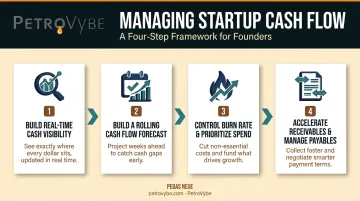
Step 1: Build Real-Time Cash Visibility
Month-end books tell you what already happened. They don't tell you if you can make payroll in three weeks.
- Reconcile bank accounts, receivables, and payables weekly at minimum, daily if you're within six months of a cash crunch
- Separate liquid cash (bank balance minus restricted funds) from accrued revenue that hasn't actually landed yet
- Never let a healthy-looking P&L convince you cash is fine when the bank balance says otherwise
This isn't a fringe problem. 45% of small firms with 0-100 employees across the US, UK, and Canada reported cash-flow problems in QuickBooks' 2026 survey of roughly 5,000 businesses. Startups, with their lumpier revenue and thinner margins, tend to feel this harder than the average small business.
Step 2: Build a Rolling Cash Flow Forecast
You need two forecasts running at once, not one.
- A 13-week rolling forecast, a short-term liquidity tool that catches operational pinch points before they hit
- A 12-18 month runway projection, the longer view that informs fundraising timing and hiring decisions
Update both monthly. Model three scenarios: best-case, base-case, and worst-case, so a revenue slip or a spike in churn doesn't blindside you. Separate operating cash (what you need for the next 12 months) from strategic cash you're holding for longer-term moves — these serve different purposes and shouldn't be commingled in your planning.
Step 3: Control Burn Rate and Prioritize Spend
Burn control means funding what moves the needle and cutting what doesn't, not simply spending less across the board.
- Set approval thresholds for hiring, marketing, and tooling spend before you need them, not after a budget blowout
- Prioritize high-return activities; delay office space, perks, and other fixed costs that don't affect growth
- Budget a contingency line for legal and accounting fees — founders consistently underestimate these. Even modest early-stage setups can run several hundred dollars a month in accounting and HR support alone, and that number climbs fast once you're raising a round or dealing with a compliance issue
Step 4: Accelerate Receivables and Manage Payables
The gap between when you collect money and when you pay it out is your runway multiplier.
- Invoice immediately upon delivery, not at the end of the month
- Offer a discount for upfront or annual payment to pull cash forward
- Follow up on late payments within days, not weeks
Late payments are common enough to plan for. QuickBooks' 2025 survey of nearly 2,500 US businesses found 47% had invoices more than 30 days overdue, with roughly 1 in 10 invoices sitting past that mark on average.
On the payables side, negotiate net-30 or net-60 terms with vendors where possible. Narrowing the gap between how fast customers pay you (Days Sales Outstanding) and how slowly you pay vendors (Days Payable Outstanding) extends your runway without raising a dollar.
Key Cash Flow Metrics Every Founder Should Track
Spreadsheets alone don't manage cash. The right KPIs surface problems while you still have time to fix them.
| Metric | Why It Matters | Impact on Decisions |
|---|---|---|
| Burn Rate & Runway | Shows how many months of operation remain at your current spending pace. | Most founders start fundraising once runway drops to around six months, since raises typically take 3-6 months to close. Under 12 months of runway can read as a warning sign to investors, not urgency. |
| Operating Cash Flow | Reveals whether day-to-day operations generate or consume cash, independent of financing activity like investor rounds or loans. | Tells you whether to scale spend or tighten the budget based on the business itself, not on how much cash remains from your last raise. |
| CAC-to-LTV Ratio | Shows whether what you spend to acquire a customer makes sense against what that customer is worth over time. | A 3:1 ratio is the commonly cited healthy benchmark for SaaS, signaling sustainable growth spend. Early-stage companies with limited data should wait until growth patterns repeat before leaning on this metric. |
| Working Capital / Current Ratio | Measures your ability to cover short-term liabilities with current assets. | A ratio above 1 generally means you can meet obligations with a buffer, though "healthy" varies by industry and stage. Pair it with burn rate and runway rather than using it alone. |
Common Cash Flow Mistakes That Sink Startups
Most cash crises aren't caused by one dramatic event. They're the result of small, repeated blind spots.
- Confusing revenue with cash: treating invoiced or accrued income as available money before it clears
- Overspending right after a raise: scaling headcount and marketing spend past unit economics until burn outpaces the plan
- Ignoring payment clearing times: ACH transfers don't settle on weekends or holidays, leaving founders short at the worst moment
- Outsourcing finance to generalists: hiring a bookkeeper unfamiliar with SaaS deferred revenue, marketplace take-rate accounting, or whatever model the business runs on
Each of these is fixable with a system. None of them are fixable after the fact, once payroll is due and the account is short.
When Cash Flow Problems Turn Into a Crisis
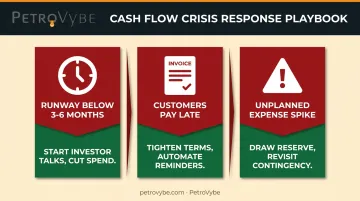
Even disciplined founders hit liquidity scares. Knowing how to respond matters more than pretending it'll never happen to you. Here are three common triggers and how to handle each one before it spirals.
Runway Drops Below 3-6 Months of Payroll
Likely cause: Revenue grew slower than planned, or a fundraise is taking longer than expected.
What to do: Start investor conversations immediately — don't wait until the number gets scarier. Cut discretionary spend now, and evaluate bridge financing or a convertible note to buy time until a larger round closes.
Customers Consistently Pay Late
Likely cause: Vague payment terms, or no real follow-up process on overdue invoices.
What to do: Tighten your terms, require upfront deposits on larger contracts, and automate reminder workflows so late invoices get chased automatically.
Sudden, Unplanned Expense Spike
Likely cause: Legal, compliance, or vendor costs that blew past what was budgeted.
What to do: Draw from your cash reserve first, before touching growth capital earmarked for hiring or marketing. Then revisit your contingency line item so the next surprise doesn't hit as hard.
What Smart Founders Do With Surplus Cash
Once cash flow stabilizes and starts generating real surplus, whether from consistent profit or a liquidity event like an exit or a big capital gain, the priority shifts. You're no longer managing for survival. You're managing for long-term wealth.
For short-term operating reserves, keep the money liquid. Money market accounts or sweep accounts make sense here. Illiquid instruments have no business holding funds you might need to cover payroll next month.
For strategic, longer-term capital, the calculation changes. Founders sitting on high W-2 income or a fresh capital gain often look beyond the standard stocks-bonds-real estate mix, especially if a big chunk of that surplus is about to get taxed hard.
This is where natural gas and oil development investments enter the conversation. Structures like PetroVybe ONE are built specifically around Intangible Drilling Cost (IDC) deductions, which offset active income (including W-2 earnings and capital gains) not just passive income like most real estate deductions do.
PetroVybe's own partners realized a 91% deduction against active income in 2024 and 94% in 2025, according to the company's performance reporting. On a $100,000 investment, IDCs typically represent 60-80% of invested capital — a deduction in the tens of thousands of dollars, taken in year one or spread over five years.
A few specifics worth knowing if you're evaluating something like this:
- Participation is limited to accredited investors with verified status, and the typical minimum commitment is $100,000
- These projects run on a 10-year hold, with first distributions generally arriving 2-3 years in, once wells reach production
- Monthly distributions are projected to exceed $10,000 per unit at peak production, tied to natural gas liquids development in South Texas and the Gulf Coast Basin
One caveat matters more than any of the numbers above: this approach works for surplus and strategic capital only — not the operating cash you need to run your business. Don't touch payroll reserves to chase a tax deduction. The whole point of getting cash flow under control in the first place is having capital you can actually afford to deploy for the long term.

Frequently Asked Questions
What is the difference between cash flow and profit for a startup?
Profit is an accounting measure that includes non-cash items and accrued revenue. Cash flow only reflects money actually moving in and out of your bank account. A "profitable" startup can still run out of cash entirely.
How much cash reserve should a startup founder keep?
The common benchmark is 3-6 months of payroll and operating expenses held in reserve. Adjust upward if your revenue is unpredictable or you're pre-revenue, and downward only once you have consistent, proven cash flow.
What is a good burn rate for an early-stage startup?
There's no single dollar figure that applies across every stage and funding level. The real signal is whether your burn lines up with hitting the milestones you need to raise your next round before runway runs out.
Should a startup use debt or equity to manage cash flow?
Debt works best for predictable, recurring cash flows, such as working capital or receivables financing. Equity suits funding unpredictable growth, even though it's the more expensive capital source long-term due to dilution.
What tools help startups track cash flow?
Accounting platforms like QuickBooks and Xero handle reconciliation and basic forecasting. Dedicated tools like Float, Fathom, or Runway add rolling forecasts and scenario modeling on top of your existing books.
What's the biggest cash flow mistake new founders make?
Many founders confuse revenue with available cash, spending against invoices that haven't been paid yet. This gap between billed and collected revenue is what sinks otherwise growing companies.