
Treasury teams have taken notice. In 2022, 68% of treasury practitioners ranked cash management and forecasting as a top priority, according to AFP's Strategic Role of Treasury Survey. That's not a fluke finding, it's a pattern.
Cash risk management goes beyond watching a bank balance. It means identifying, measuring, and controlling the threats to your liquidity and cash integrity before they become emergencies. This guide breaks down what cash risk actually is, the "big three" risks every finance team should control for, tools like VaR and CFaR that quantify exposure, and how these principles play out in capital-intensive industries like oil and gas development.
Key Takeaways
- Cash risk management protects liquidity and solvency in both stable and volatile markets
- Theft, handling errors, and cash flow gaps (the "big three") require preventive, detective, and corrective controls
- CFaR measures operating cash shortfall risk; VaR measures portfolio value loss
- Capital-intensive sectors like oil and gas need third-party validation and transparent cash reporting
What Is Cash Risk? Understanding the Foundation of Cash Risk Management
Cash risk is the possibility that a company won't have enough liquid funds available when obligations come due, or that the value and accessibility of its cash gets threatened by market or operational forces. It's not the same as simply having low cash.
A company can hold plenty of cash and still face risk if that cash is concentrated in one bank, tied up in receivables, or exposed to a fraud scheme nobody's caught yet.
Three related terms get used interchangeably, but they mean different things:
- Cash risk — broad exposure covering theft, errors, and shortfalls in liquid funds
- Liquidity risk — how readily a company can convert assets or access credit to cover obligations
- Cash flow risk — volatility in the timing or amount of inflows and outflows
Understanding these distinctions matters because the controls that fix one don't always fix another. A line of credit solves liquidity risk. It does nothing for a fraud problem.
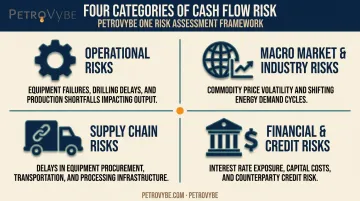
The Four Categories of Cash Flow Risk Every Business Should Monitor
Operational risks come from inside the business: poorly structured payment terms, weak fraud controls, or inefficient receivables and inventory management that ties up cash longer than necessary.
Macro market and industry risks hit from outside: interest rate shifts, tightening credit availability, recessions, or sector-specific volatility like commodity price swings that make inflows unpredictable.
Supply chain risks stem from dependency on suppliers or partners. When a key vendor delays delivery or a customer stretches payment terms, the cash conversion cycle stretches with it.
Financial and credit risks grow from how a company banks and borrows: concentrating deposits in a single institution, depending on one lender, or facing sudden covenant changes that cut off credit access right when it's needed most.
Poor cash flow management is a leading contributor to business failure. SCORE reports that 82% of small businesses that fail cite cash-flow problems as a root cause. That figure comes with a caveat: the original methodology isn't fully traceable. Still, the directional message holds up across nearly every treasury survey available, and cash discipline isn't optional.
The Big Three Risks in Cash Management (and the Controls That Prevent Them)
Internal audit and treasury practice generally recognize three core cash management risks. Each one needs a layered defense: controls that prevent the problem, controls that detect it if prevention fails, and a process to correct it once it's found.
Cash Theft and Fraud
Theft and fraud hit a business on three fronts: direct financial loss, operational disruption while you investigate, and reputational damage that's harder to quantify but just as real.
Preventive controls:
- Segregation of duties, so no single person controls both cash handling and reconciliation
- Dual authorization on payments above a set threshold
- Background checks for employees with cash access
Detective and corrective controls:
- Surprise cash audits on a rotating schedule
- Transaction monitoring for unusual patterns or amounts
- A formal investigation and reimbursement procedure once theft is confirmed
The ACFE's 2024 Report to the Nations found that lack of internal controls was the primary weakness in 32% of fraud cases studied. This makes weak controls the single biggest reason fraud goes undetected for months or years.
Errors in Handling Cash
Errors don't carry criminal intent, but they still create financial discrepancies, reconciliation headaches, and, in customer-facing businesses, real dissatisfaction when receipts don't match charges.
Preventive controls:
- Staff training on cash-handling procedures
- Automated POS or cash-handling systems that reduce manual entry
- Supervisory oversight during shift changes and closeouts
Detective and corrective controls:
- Regular reconciliation against sales and accounting records
- Exception reporting that flags discrepancies automatically
- A documented process for resolving and logging errors once found
Cash Flow Interruptions
This is the risk that gets the least attention until it's the only thing that matters. A cash flow interruption means liquidity shortages severe enough to threaten payroll, vendor payments, or the company's ability to operate.
Preventive controls:
- Rolling cash flow forecasts updated on a regular cadence
- Cash reserves or a standby line of credit
- Negotiated payment terms that smooth timing mismatches
Detective and corrective controls:
- Monitoring actual cash flow trends against forecast
- Vendor payment aging analysis to catch slippage early
- Contingency and financial resilience planning for worst-case scenarios
Best Practices to Strengthen Cash Risk Management
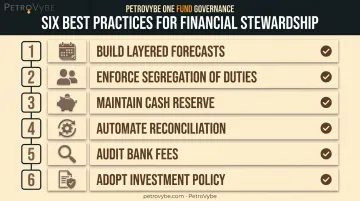
Strong cash risk management comes from layering several habits together over time. Here's where most finance teams get the most protection for the least effort:
- Build layered forecasts. Short-, medium-, and long-term cash flow forecasts, updated regularly with FP&A and business unit input, catch shortfalls while there's still time to act.
- Enforce segregation of duties and dual control. Every disbursement, wire transfer, and bank account change should require more than one set of eyes.
- Maintain a cash reserve or standby credit line. Size it to cover three to six months of operating expenses, not just a comfortable-feeling number.
- Automate reconciliation. Manual processes are where errors and fraud hide longest. Treasury management technology gives real-time visibility across accounts.
- Audit bank fees and strengthen banking relationships. Small fee reductions compound, and a strong relationship secures faster access to credit when you need it.
- Adopt a board-approved investment policy that prioritizes safety and liquidity. Most organizations already lean this direction with surplus cash. According to AFP survey data, most treasury teams rank safety over yield as their top short-term investment objective.
Measuring Cash Risk: VaR vs. CFaR
Two metrics come up constantly in cash risk discussions, and they get confused often enough that they deserve a clear breakdown.
Value at Risk (VaR) is a statistical measure of the potential loss in the value of an investment or portfolio over a specific time period, at a given confidence level. It's a market/financial risk tool, built for portfolios of tradable assets.
Cash Flow at Risk (CFaR) measures how much a company's future operating cash flow could fall short of a target due to market or operational factors. Each driver gets weighted by how important it is to the business.
| Dimension | VaR | CFaR |
|---|---|---|
| What it measures | Loss in portfolio market value | Shortfall in operating cash flow vs. target |
| Best suited for | Investment portfolios, tradable positions | Operating businesses with production/revenue exposure |
| Typical horizon | Days to one month | Multiple months to years |
For a company managing production volumes and commodity-driven revenue, like an energy developer, CFaR is the more directly useful tool. CFaR asks how much actual cash generation could fall short of target, the question that keeps operators up at night.
Why Cash Risk Management Matters in Oil & Gas Development
Oil and gas exploration and production carries amplified cash risk compared to a typical business. High upfront capital costs, long development timelines, and commodity price swings stack on top of each other in ways that most industries never experience simultaneously.
Natural gas price volatility illustrates the point well. EIA data shows Henry Hub natural gas volatility reached 179% in February 2022, compared to 57% just a year earlier. That kind of swing can turn a well-modeled cash flow projection upside down in a matter of weeks if a project isn't structured to absorb it.
Disciplined operators manage this risk through a handful of practices:
- Independent third-party engineering validation of reserves and production assumptions
- Transparent, regular investor reporting rather than sporadic updates
- Product mix diversification across oil, natural gas, and NGLs, so a downturn in one doesn't sink the whole cash flow picture
- Structured distribution cadences tied to actual production performance, not optimistic projections
At PetroVybe, this shows up concretely:
- The company's $48MM proved reserves valuation was determined by a licensed third-party engineering firm, not calculated in-house
- Chief Geophysicist Michael Stamatedes brings a 75.2% career well-success rate against an industry peer average below 40%, directly tightening the decline curve modeling that underpins cash flow forecasting
- CFO Clayton Riddle's dual background as petroleum engineer and financial strategist keeps the reconciliation between engineering reserve reports and financial statements accurate, rather than papering over assumptions

For accredited investors evaluating any oil or gas development partner, these controls belong on the due diligence checklist. Reconciliation practices, independent reserve validation, and clear reporting cadences directly protect the MOIC and IRR outcomes an investor is underwriting. A partner who can't show their cash risk controls likely hasn't built them, and that gap tends to show up in distributions, not disclosures.
Frequently Asked Questions
What is cash risk?
Cash risk is the potential that a company can't meet its financial obligations because it lacks sufficient liquid funds. It also includes threats to the value or availability of that cash from market or operational forces.
What are the big three of cash management?
The three core risks are cash theft/fraud, cash-handling errors, and cash flow interruptions. Each requires preventive, detective, and corrective controls layered together, not just one line of defense.
What is the difference between VaR and CFaR?
VaR measures the potential loss in the market value of an investment or portfolio. CFaR measures the potential shortfall in a company's actual operating cash flow against a target, making it more relevant for operating businesses.
What is the difference between cash management and treasury management?
Cash management focuses on day-to-day liquidity, payments, and short-term cash positioning. Treasury management is the broader function, covering long-term capital structure, financing strategy, and enterprise-wide risk.
How often should a company update its cash flow forecast?
Short-term forecasts should be updated weekly, medium-term forecasts monthly, and both should be revisited immediately whenever a significant business or market change occurs.
Why is cash risk management important for oil & gas investors?
Strong cash controls and disciplined forecasting protect distributions and returns against commodity price swings and long development cycles. Independent reserve validation and transparent investor reporting are practical signs those controls are working.