Introduction
Most economics students meet the circular flow of income as a diagram: arrows connecting households and firms, a model memorized the night before an exam, then forgotten. That's a problem, because central banks, treasuries, and institutional investors don't just memorize this model. They use it to read the economy in real time.
The scale is worth pausing on. U.S. nominal GDP reached $29.298 trillion in 2024, according to the Bureau of Economic Analysis. Every dollar of that figure moved through the same basic loop this model describes.
Many people can draw the diagram without understanding what happens at each stage, or why leakages and injections matter for anyone deciding where to put their own capital. This guide breaks it down step by step, focusing on the mechanism you can actually apply rather than the textbook drawing you memorized.
Key Takeaways
- Money flows continuously between households and firms, expanding to government, trade, and banks
- Households supply land, labor, capital, and enterprise; firms return rent, wages, interest, and profit
- Models scale from two-sector (basic) to five-sector (adds government, trade, and finance)
- Leakages (savings, taxes, imports) must balance injections (investment, spending, exports) for stable growth
- This balance is the foundation for how GDP and national income get measured
What Is the Circular Flow of Income?
The circular flow of income is a model showing how money, goods, and services move continuously between economic agents. In its simplest form, that means households and firms; more advanced versions add government, foreign trade, and financial institutions. Nothing sits still. Income earned in one stage becomes spending in the next, which becomes someone else's income after that.
The model exists to prove something specific: income earned from production equals the value of output, which equals total expenditure. That triple equality is the backbone of national income accounting used by the IMF and the UN System of National Accounts.
One common mix-up: the circular flow of income has nothing to do with a "circular economy." A circular economy refers to sustainable resource use, meaning reusing, repairing, and recycling materials. The circular flow of income is a macroeconomic model tracking money movement, not materials.
Real Flow vs. Money Flow
Two flows run in opposite directions simultaneously:
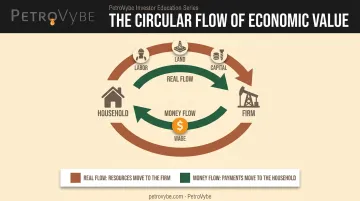
- Real flow: goods, services, and factor services (labor, land, capital) moving from one sector to another
- Money flow: the corresponding payments moving the opposite way
When a household works for a firm, labor flows to the firm (real flow) while wages flow back to the household (money flow). Same transaction, opposite directions.
Stock vs. Flow, Briefly
Income and expenditure are flow variables, measured over a period, like a month or a year. Wealth is a stock variable, measured at a single point in time. Your salary is a flow; your savings account balance is a stock. Keeping that distinction straight prevents a lot of confusion when reading GDP reports.
The model itself comes in versions of increasing complexity: two-sector, three-sector, four-sector, and five-sector. Each addition makes the picture more realistic and, admittedly, more complicated.
How Does the Circular Flow of Income Work?
The circular flow operates as a repeating sequence: factor supply, production, income payment, spending, and back again. It never really starts or stops. It's more accurate to say it's always mid-cycle.
Initiation: Households Supply Factors of Production
The cycle begins (conceptually, at least) when households provide land, labor, capital, and enterprise to firms. This isn't a one-time event triggered by anything. It's continuous and self-perpetuating.
A common misconception is assuming the flow starts with spending. It doesn't. Factor supply and production are equally foundational starting points. Spending is simply the next link in the chain, not the origin of it.
Core Operation: Firms Produce and Pay Factor Incomes
Firms combine those factors to create goods and services. In return, they pay:
- Rent for land
- Wages for labor
- Interest for capital
- Profit for enterprise
Households then spend that income buying goods and services from firms, completing two loops at once: the outer loop (factor payments) and the inner loop (goods and consumption spending). This dual movement is exactly why total output, total income, and total expenditure end up equal in national accounts. They're three ways of measuring the same activity.
Regulation/Control: Leakages and Injections Keep the Flow Balanced
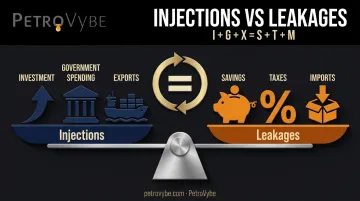
Not every dollar of income gets spent immediately. Some of it exits the cycle through:
- Savings (income not spent)
- Taxes (income collected by government)
- Imports (spending on foreign-made goods)
These are leakages. They're offset by injections:
- Investment by businesses
- Government spending
- Export revenue
The equilibrium condition is: I + G + X = S + T + M. When injections equal leakages, the flow stays balanced, preventing runaway growth or contraction.
Here's the part that matters beyond the classroom: converting idle savings into productive investment is what strengthens the flow. Savings sitting in a low-yield account is a leakage. That same capital deployed into a production-based asset, like a natural gas development program, becomes an injection.
This is a real consideration for accredited investors. PetroVybe's natural gas partnerships, for example, are structured for a minimum of $100,000, putting capital to work in upstream Texas energy development rather than letting it sit idle or erode under taxation.
In 2024, partners who directed capital this way received a 94% tax deduction against active income; in 2025, that figure was 91%. That's capital that would otherwise leak out through taxation instead getting redirected into tangible production.
Output/Result: National Income, Output, and Expenditure Equalize
The end result is a measurable national income figure, arrived at identically whether you calculate it via output, income, or expenditure. All three methods should produce the same number, because they're measuring the same circular activity from different angles.
Injections don't just add once. A single increase in government spending, for instance, gets re-spent repeatedly through the multiplier effect, where the simple multiplier equals 1 divided by (1 minus the marginal propensity to consume). One dollar of new spending can generate several dollars of eventual income as it circulates.
Real-world evidence backs this up: BEA's 2025 GDP data showed full-year real GDP growth of 2.1%, driven primarily by increases in consumer spending and investment, while a later downward revision was tied specifically to a pullback in investment. Investment isn't just one line item. It moves the whole number.
The Different Sectors of the Circular Flow of Income
The basic two-sector model is a teaching tool, not a real economy. Each added sector introduces flows that make the model closer to how money actually moves.
Two-Sector Model: Households and Firms
The simplest version assumes no savings, no taxes, no foreign trade. Just households and firms, exchanging on two loops: an outer loop, where factor services flow to firms and factor payments flow back to households, and an inner loop, where goods and services flow to households while consumption spending returns to firms.
It's clean, but it's fictional. Real economies leak and inject constantly.
Three- and Four-Sector Models: Adding Government and Foreign Trade
Government enters the picture, collecting taxes (a leakage) while injecting spending through subsidies, transfer payments, and public services. Two flows connect the state to the rest of the economy: households send direct taxes and receive transfer payments, while firms pay indirect taxes and receive subsidies in return.
Once trade with the rest of the world enters the model, exports become an injection (money flowing into the domestic economy) and imports become a leakage (money flowing out). This four-sector version is what most people mean when they ask about "the four sectors" of the circular flow of income.
Five-Sector Model: Adding the Financial Sector
The most complete version adds banks and financial intermediaries. These institutions channel household savings into loans and investment for firms and government. The flow continues indefinitely as long as lending equals borrowing, which is really just leakages equaling injections in a different form.
| Model | Sectors Included | Key Addition |
|---|---|---|
| Two-sector | Households, firms | Basic exchange, no leakages |
| Three-sector | + Government | Taxes, subsidies, transfers |
| Four-sector | + Foreign trade | Exports (injection), imports (leakage) |
| Five-sector | + Financial institutions | Savings channeled into loans/investment |
Why the Circular Flow of Income Matters
This model isn't academic trivia. It's the framework behind how GDP gets measured and how policymakers diagnose whether an economy is growing, stalling, or overheating.
That significance shows up in three concrete ways:
- Measuring national income: The interdependence between sectors explains why output, income, and expenditure calculations always converge on the same number.
- Guiding policy decisions: When leakages outweigh injections, policymakers respond, often through rate cuts that spur borrowing or stimulus packages that boost government spending.
- Directing investment capital: Idle savings or heavily taxed income act as leakages, while capital placed in production-based investments becomes an injection that fuels national income.
This is the practical logic behind PetroVybe's natural gas development structure. Investor capital goes directly into drilling and production infrastructure in Lavaca County, Texas, rather than remaining idle.
The program targets first distributions within 2 to 3 years, with monthly passive income projected to peak above $10,000 per month during full production. That's capital compounding as productive investment, not capital parked and taxed down.

Conclusion
In a healthy economy, money never actually disappears. It cycles continuously between production and consumption, sector by sector, income becoming spending becoming income again.
Understanding leakages and injections changes how you read a GDP report and how you think about your own capital. Savings sitting idle, or income lost to taxation, is a leakage from the system.
Capital deployed into production, whether through business investment, government spending, or a direct stake in an oil and gas development project, is an injection that keeps the whole cycle moving forward.
Frequently Asked Questions
What is the circular flow of income?
The circular flow of income model shows the continuous movement of money, goods, and factor services between households, firms, and other sectors of an economy. Income earned in one stage becomes spending in the next.
What are the 4 sectors of circular flow of income?
Households, firms, government, and the foreign sector. Some models add a fifth sector, financial institutions, to show how savings get channeled into loans and investment.
What is the difference between real flow and money flow?
Real flow is the movement of goods, services, and factors of production between sectors. Money flow is the corresponding payment, moving in the opposite direction.
What are leakages and injections in the circular flow of income?
Leakages (savings, taxes, imports) withdraw money from the flow. Injections (investment, government spending, exports) add money back in. Equilibrium requires the two to balance.
Why is the circular flow of income important for measuring GDP?
The model shows output, income, and expenditure are always equal. This equality is why national income can be calculated three different ways and still arrive at the same figure.
What happens when injections and leakages are not equal?
If injections exceed leakages, aggregate expenditure outpaces current output, pushing national income and output upward. When leakages exceed injections instead, the pressure runs the opposite direction, toward contraction.