

Introduction
Your debt-to-income ratio decides whether a lender says yes or no to your next rental property loan. Many real estate investors hit a wall not because a deal is bad, but because their DTI is too high for the lender sitting across the table.
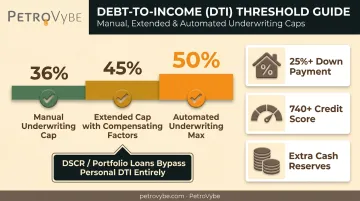
Fannie Mae's manual underwriting cap sits at 36%, though it can stretch to 45% with strong compensating factors. Automated systems allow up to 50% in some cases, according to a breakdown of Fannie Mae's DTI guidelines. Knowing where you fall on that spectrum changes how you structure every future purchase.
This guide covers:
- What DTI actually measures for investment property loans
- The DTI ranges lenders consider acceptable
- How rental income helps or hurts your number
- Steps to take once debt-based financing starts capping your growth
Key Takeaways
- DTI splits into front-end (housing costs only) and back-end (all monthly debts) ratios
- Conventional lenders cap back-end DTI at 36-45%; DSCR loans qualify on cash flow instead
- Lenders typically credit only 75% of gross rental income toward your qualifying income
- Paying down consumer debt and refinancing are the fastest levers for lowering your ratio
- Non-debt income streams can keep building wealth once real estate financing caps out
What Is Debt-to-Income Ratio for Investment Properties?
DTI is simple math with serious consequences: total monthly debt payments divided by gross monthly income, expressed as a percentage. A borrower earning $10,000 a month with $3,500 in debt payments carries a 35% DTI.
For investors, this number isn't static. It's recalculated with every single loan application, factoring in:
- The proposed new mortgage payment
- Any rental income the new or existing property generates
- Every other debt obligation currently on your credit report
That last point matters more than most investors realize. DTI shifts every time you add a property, pay off a car loan, or refinance a mortgage.
The investor who qualified easily for property number two might struggle with property number five, even with identical income, simply because the underlying math has changed.
Front-End vs. Back-End DTI Ratio
Lenders actually run two separate calculations:
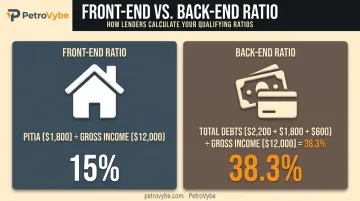
- Front-end ratio: Housing costs only, meaning principal, interest, taxes, insurance, and HOA dues (often called PITIA), divided by gross income
- Back-end ratio: Every monthly debt obligation, including auto loans, student loans, credit cards, and existing mortgages, divided by gross income
Back-end DTI carries the most weight in investment property underwriting because it captures your full financial picture, not just the new loan.
Example: An investor earns $12,000/month, already pays $2,200 on one rental mortgage, and is applying for a second property with a $1,800 PITIA payment. Add $600 in credit card and auto payments, and the back-end DTI lands at ($2,200 + $1,800 + $600) / $12,000 = 38.3%. That's right at the edge of many conventional caps, even before rental income offsets apply.
What's the Ideal or Maximum DTI Ratio for an Investment Property Loan?
Nominal DTI Range for Conventional Financing
Conforming loan limits come straight from Fannie Mae and Freddie Mac. Fannie Mae's manual underwriting maximum is 36%, extending to 45% for borrowers who meet specific credit score and reserve thresholds outlined in the Eligibility Matrix. Loans run through Desktop Underwriter can stretch to 50% in select cases.
For the best rate and terms, underwriters generally want to see back-end DTI closer to 36% or below. Anything higher still qualifies, but it typically comes with tighter pricing or added scrutiny.
Maximum Allowable DTI and Exceptions
Compensating factors can push approval odds well past the standard ceiling:
- Larger down payments (25%+ instead of the minimum)
- Higher credit scores (740+)
- Substantial cash reserves beyond the minimum requirement
DSCR and portfolio loan products sidestep personal DTI entirely. Lenders like CoreVest qualify borrowers at a 1.0x debt service coverage ratio, while Kiavi offers DSCR options as low as 0.8x with no W-2 or tax return requirement.
These products exist because investment property loans carry stricter DTI and reserve requirements than owner-occupied loans. Lenders simply view rental properties as higher risk.
Why Lenders Build in a Safety Margin
A cushion below the maximum threshold protects against real-world volatility: vacancies, unexpected repairs, or rate resets on adjustable mortgages. Operating right at the ceiling has consequences:
- Reduced approval odds on future applications
- Higher interest rate pricing
- Requirements for larger cash reserves before closing
Investors who leave room below the cap keep more options open for their next deal.
How Rental Income Impacts Your DTI Calculation
Rental income can be your best friend or your biggest obstacle in DTI math, depending entirely on documentation and property type.
The Rental Income Discount Rule
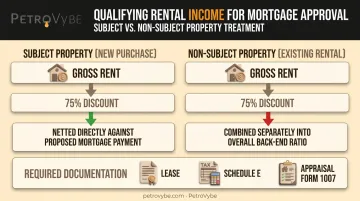
Lenders don't count gross rent dollar-for-dollar. The standard practice applies a 75% factor to gross monthly rent to account for vacancy and maintenance costs, whether pulled from a lease or an appraisal rent schedule according to Fannie Mae's Selling Guide.
Worked example: A property leases for $2,000/month. The lender counts $1,500 ($2,000 × 0.75) toward qualifying income, not the full $2,000. If the PITIA on that property is $1,300, the net figure is positive $200, which gets added to your qualifying income.
Subject Property vs. Non-Subject Property Treatment
Treatment differs based on whether the property is the one being purchased:
- Subject property (new purchase): The proposed mortgage is often excluded from DTI entirely because it's netted directly against the discounted rental income
- Non-subject property (existing rentals): The mortgage payment and rental income are calculated separately, then combined into the overall ratio
If the net calculation comes out negative (meaning discounted rent doesn't cover the mortgage), that shortfall gets added as a monthly liability rather than income. This single distinction trips up a lot of investors who assume every rental automatically helps their numbers.
Documentation Lenders Require
Expect to provide one or more of the following:
- Signed lease agreements for currently rented units
- Schedule E from recent tax filings for established rental history
- Appraisal rent schedules (Form 1007 or 1025) for new purchases without a rental track record
One exception: Freddie Mac Bulletin 2025-1 allows Form 71 or Form 1000 for properties purchased within 45 days of closing, when a lease isn't yet available.
Property type adds another wrinkle here: 2-4 unit owner-occupied properties are treated differently. The full PITIA still counts as a debt, but the discounted rental income from the additional units is added back as income, rather than netted against the payment.
How to Lower or Improve Your DTI Ratio as a Real Estate Investor
When your ratio is holding you back from the next acquisition, a few strategies move the needle faster than others.
- Pay down high-interest consumer debt. Credit cards and auto loans often carry an outsized impact on back-end DTI relative to their balance. Clearing a $400/month car payment can do more for your ratio than paying down a much larger mortgage balance.
- Refinance existing mortgage debt. Lowering your rate or extending your term reduces the monthly obligation counted in the ratio, freeing up qualifying room for the next loan.
- Recognize the ceiling on debt-financed growth. Every new property added purely through leveraged acquisition tightens your DTI, and eventually even a strong, cash-flowing portfolio can hit a wall where no lender approves another loan, regardless of how good the deal looks.
That third point is where a lot of investors get stuck. You can have a portfolio generating solid net income and still get denied financing simply because your personal DTI is maxed out.
Diversifying into non-debt passive income changes the equation entirely. Unlike another mortgage, income from vehicles like oil and gas development partnerships doesn't add a single dollar to your DTI, because there's no loan attached to the investment.
PetroVybe structures its offerings this way. PetroVybe ONE is an equity partnership, not a loan — investors contribute capital as partners, and the K-1 tax treatment confirms it's a capital contribution rather than debt. For accredited investors with $100,000+ in liquidity, this creates two things a maxed-out DTI can't touch:
- Passive cash flow with distributions projected to peak above $10,000/month during production, without a mortgage payment weighing down your ratio
- **Substantial upfront tax deductions against active income**, with partners realizing a 91% deduction in 2024 and 94% in 2025 through Intangible Drilling Cost provisions
- Portfolio diversification beyond real estate, targeting a 10-year MOIC of roughly 2.2-5.8x that builds wealth independent of lender approval
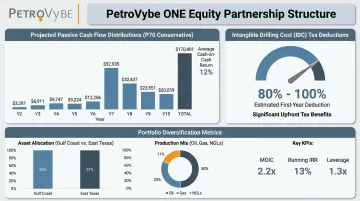
For an investor whose real estate DTI has capped out, this kind of structure offers a way to keep compounding wealth without waiting on another mortgage approval.
Common DTI Mistakes Real Estate Investors Make
Even experienced investors trip over the same handful of errors:
- Assuming personal DTI caps apply to every loan product. DSCR and portfolio loans qualify based on the property's cash flow, not your personal ratio, so treating them like a conventional loan often triggers unnecessary rejections
- Double-counting or omitting mortgage payments on retained rental properties, since PITIA is already factored into the net rental calculation and shouldn't be added again separately
- Expecting 100% of gross rent to offset a new payment, rather than the discounted 75% figure lenders actually credit
- Skipping reserve requirements. Fannie Mae's DU requires six months of PITIA for the subject property, plus additional reserves based on your number of financed properties; insufficient reserves can sink an approval even when the DTI math qualifies
Frequently Asked Questions
What is the maximum debt-to-income ratio for investment property?
Conventional lenders typically cap back-end DTI at 36-45%, depending on credit score and reserves. DSCR and portfolio loan products can allow higher ratios since they qualify based on property cash flow instead.
What is an ideal debt-to-income ratio when buying a house?
Underwriters generally view a back-end DTI at or below 36% as low-risk, which usually earns better rates and terms. Higher ratios can still qualify, just with tighter pricing.
Does rental income count toward DTI ratio?
Yes, but lenders typically count only 75% of gross rental income, using signed leases or appraisal rent schedules. For a new purchase, they usually net the subject property's mortgage against that discounted income instead of counting it separately.
Can I get an investment property loan with a high DTI ratio?
Yes. DSCR and portfolio loans, offered by lenders like CoreVest and Kiavi, qualify borrowers on property cash flow rather than personal DTI, making them a common workaround near the debt ceiling.
How is DTI calculated for a rental property?
Add all monthly debt payments, including the proposed mortgage, and divide by gross monthly income. Discount rental income to 75%, then net it against the property's PITIA to see whether it adds to income or counts as a liability.
What happens if my DTI ratio is too high for a mortgage?
Lenders may deny the loan outright, offer it at a higher interest rate, or require a co-borrower. Paying down consumer debt or increasing reserves before applying often resolves the issue.