

It's a fair question. Many workers assume any money coming in each month, whether earned or not, gets treated the same by their state unemployment office. That assumption is usually wrong, and it stems from confusing passive income with side hustle income, two categories state agencies treat very differently.
This guide breaks down what actually counts as passive income, gives you a direct answer on eligibility, explains the "material participation" test agencies use, and covers state-specific quirks like how California handles rental income.
Key Takeaways
- Passive income (dividends, interest, royalties, rental income) rarely affects eligibility
- Agencies weigh material participation, not income amount, for eligibility
- Self-managed side hustles count as earned income requiring weekly reports
- Reporting rules vary by state, so confirm specifics before certifying your claim
What Income Is Considered Passive Income?
The IRS defines passive activities as earnings from a trade or business you don't materially participate in, plus most rental activities regardless of participation level. This comes straight from IRS Topic 425 on passive activities, which forms the backbone of how tax law (and by extension, most unemployment agencies) thinks about "hands-off" money.
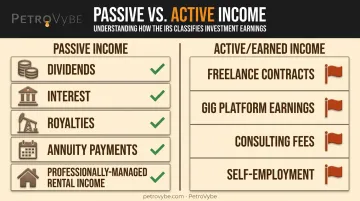
The most common forms of passive income include:
- Dividends from individual stocks or index funds
- Interest from savings accounts, bonds, or CDs
- Royalties from books, music, or oil and natural gas interests
- Annuity payments from retirement or insurance products
- Rental income from properties handled by a professional management company
Technically, the IRS separates "portfolio income" (interest, dividends, most royalties) from "passive activity income" under Section 469. Both share one trait that matters here: neither requires you to show up and work.
Here's what does not qualify as passive, no matter how it feels: 1099 self-employment income, freelance contracts, gig platform earnings, and even consulting fees from side projects. Driving for Uber or selling handmade goods on Etsy still counts as active earned income. Your state unemployment office taxes and reports this income differently than dividends or rental checks.
Passive Income Examples Relevant to Investors and High-Income Earners
For accredited investors and high-income W-2 earners, the passive income conversation usually centers on a handful of specific vehicles:
- Dividend-paying stock portfolios
- REIT distributions
- Bond interest and Treasury income
- Royalty or working interests in oil and natural gas development projects
That last category deserves attention. A working interest in a producing well, held without any day-to-day involvement from the investor, generates monthly income that requires zero labor once the capital is deployed. That hands-off structure is precisely why unemployment agencies typically classify it as passive rather than earned income.
Can You Collect Unemployment Benefits With Passive Income?
Yes. In nearly every state, passive investment income has no bearing on unemployment eligibility.
Here's why. Unemployment insurance exists to replace wages lost from an employer-employee relationship. It's not a means-tested welfare program tied to your net worth.
Money generated by assets you already own, whether that's a stock portfolio or a royalty interest, isn't "work." It doesn't touch your "able and available for work" status, which is the actual legal test states apply.
This holds true even at scale. A claimant earning six figures a year in dividends and royalties can still qualify for benefits. The only requirement: the job loss itself must be involuntary, meaning a layoff rather than a voluntary quit or termination for misconduct.
A few important clarifications:
- A former employer cannot successfully contest a legitimate claim by pointing to your investment income
- Fraud only occurs when someone conceals active wages (a job, freelance work, paid labor) while certifying for benefits
- Holding dividend stocks, bonds, or royalty interests is not fraud, ever
These principles play out clearly at the state level. California's Employment Development Department, for instance, requires claimants to report work and wages, including self-employment pay, in the week the work was performed. Notably, its guidance on reporting work and wages centers entirely on labor-based earnings, not investment receipts. That's a meaningful distinction: the reporting obligation is built around work, not wealth.
Passive Income vs. Active Side Hustles: Why the Distinction Matters
Think of income on a spectrum. On one end sits fully passive money: dividends, royalties, silent investments where you never lift a finger. On the other end sits fully active work: freelance gigs, consulting, driving for a rideshare app. In between sits a gray zone, and that's where most people get confused.
Self-managed rental property sits squarely in that gray zone. If you own a rental but hand it off to a property management company, that income typically looks passive to a state agency. The same holds true if you've structured a triple-net lease where the tenant handles maintenance and taxes.
Flip that around, though. Screening tenants yourself, handling repair calls, and running short-term Airbnb stays involves ongoing labor. That labor can shift the income's classification toward self-employment, which usually means weekly reporting.
Does Rental Income Affect Unemployment Benefits in California?
California's EDD generally treats rental income as passive and excluded from wage reporting when the landlord provides no ongoing services to tenants. If you're not fielding maintenance calls or managing the property day-to-day, the money typically doesn't count as wages during weekly certification.
That said, treatment can vary based on individual circumstances. If you're actively involved in managing the property in any capacity, confirm your specific situation directly with the EDD before you certify.
When a Side Gig Crosses the Line
The same active-versus-passive test extends beyond rental property to any side hustle you run. Any taxable earnings from freelance, contract, or gig work must be reported, full stop. Etsy sales, Fiverr projects, and Uber driving shifts all count. As CNBC reported, continued part-time or gig earnings can reduce a week's benefit or eliminate it entirely, unlike genuinely passive royalty or dividend income that sits outside the wage calculation altogether.
How to Build Passive Income Streams That Protect Your Unemployment Eligibility
If you're building a long-term financial strategy, prioritize investments that require zero ongoing labor. Dividend portfolios, bonds, and royalty or working-interest positions in asset-backed projects sit at the safest end of the spectrum. They're the least likely to ever get questioned as "work" income during a UI claim review.
This is exactly the structure behind PetroVybe's natural gas development projects in South Texas and the Gulf Coast Basin, including its flagship operations in Lavaca County. Accredited investors hold a royalty or working interest in producing wells, receiving monthly distributions through a K-1 tax document, without any operational involvement.
That structure matters for two reasons:
- Zero labor requirement: drilling decisions, well management, and production optimization are handled entirely by the operating team, not the investor
- Tax efficiency alongside passivity: Intangible Drilling Cost deductions from these projects aren't restricted to passive income; they can offset active income like W-2 wages and capital gains
PetroVybe partners who joined in 2024 received a 94% tax deduction against active income, though that figure settled at 91% in 2025. For high-income W-2 professionals, that combination of passivity and tax efficiency is hard to replicate through actively managed real estate or business ownership. It delivers inflation-resistant income without adding anything that could complicate a future unemployment claim.

Best Practices If You're Collecting Unemployment Benefits
A few habits will keep you out of trouble, regardless of how confident you feel about your income classification:
- Disclose everything during certification. Even income you believe is passive should be reported if your state's form asks about "any income from any source." Let the agency make the final call rather than assuming.
- Keep your documentation organized. Hold onto 1099-DIV, 1099-INT, and royalty statements (1099-MISC) so you can substantiate that income is investment-based, not earned, if your claim gets reviewed.
- Talk to a professional before assuming anything is exempt. Misreporting can trigger repayment demands, penalties, or a fraud investigation. California, for example, imposes a 30% penalty on fraud overpayments plus up to 23 weeks of disqualification from future benefits.
Frequently Asked Questions
What income is considered passive income?
Passive income comes from investments or assets that require little to no ongoing labor, such as dividends, interest, rental income, and royalties. It's distinct from active wages or self-employment earnings, which require your time and effort.
Does rental income affect unemployment benefits in California?
California's EDD generally excludes passively received rental income from wage reporting when the landlord isn't providing active services to tenants. Confirm your specific situation directly with the EDD, since individual circumstances can shift the classification.
Can I collect unemployment if I have investment income like dividends or stocks?
Yes. Dividend and stock income comes from past savings, not current work, so it doesn't affect your eligibility. Unemployment benefits are tied to lost wages, not your investment portfolio's performance.
Does withdrawing from a 401(k) or IRA affect unemployment benefits?
Retirement account withdrawals generally aren't counted as wages for unemployment purposes. Some states treat periodic pension-like distributions differently, though, so check your state's specific guidance before certifying.
What happens if I don't report passive income while on unemployment?
If your state ultimately considers that income "earned" rather than passive, failing to report it can lead to repaying the overpaid benefits, facing penalties, or fraud charges. Transparency during certification protects you either way.
Is passive income taxable while I'm collecting unemployment benefits?
Yes. Both unemployment benefits and passive income like dividends, interest, and royalties are generally taxable and must be reported separately on your tax return. Consult a tax professional to make sure you're handling both correctly.