

Cash feels safe. But "safe" and "growing" aren't the same thing. Many savings accounts still pay a fraction of a percent while inflation quietly chips away at purchasing power. Meanwhile, the array of cash-equivalent options, savings accounts, CDs, money market funds, T-bills, has gotten more complicated, not less.
This guide breaks down six low-risk cash investment options available today, how to choose between them, and what to consider once your emergency fund and short-term goals are already covered.
Key Takeaways
- Cash investments prioritize liquidity and principal protection, not growth, typically yielding 3%-5% today.
- FDIC insures bank deposits up to $250,000; SIPC covers brokerage cash up to $500,000.
- Your time horizon and liquidity needs, not just the advertised rate, should drive which option you pick.
- Once 3-6 months of expenses are covered, excess cash can work harder in growth or tax-advantaged assets.
Overview of Cash Investments in Today's Rate Environment
Cash investments, sometimes called cash equivalents, are short-term, highly liquid vehicles designed to return your principal plus modest interest. They sit at the opposite end of the risk spectrum from stocks or private investments, where the priority shifts from safety to growth.
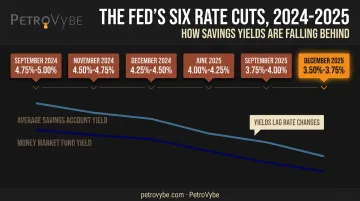
Since the Fed began cutting rates in late 2024, yields across nearly every cash category have trended downward. Taxable money market funds averaged a 3.9% seven-day yield at year-end 2025, according to the Investment Company Institute's 2026 Fact Book, down from the highs seen earlier in the cycle.
Top online savings accounts and CDs have followed a similar path.
That downward drift matters. It means the rates you locked in or earned a year ago are unlikely to be available today, so you should reassess where your cash actually sits.
The six options below are ranked roughly by liquidity and insurance protection, from the most flexible to the more restrictive or higher-yielding.
6 Low-Risk Cash Investment Options to Consider Now
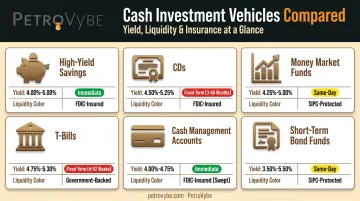
Each option trades off yield, access, and protection differently. Here's how they stack up right now.
High-Yield Savings Accounts
These are FDIC-insured bank accounts, usually offered by online banks, that pay meaningfully more than a traditional brick-and-mortar savings account. They're a natural home for emergency funds or money you'll need within the next year.
| Feature | Details |
|---|---|
| Typical Yield Range | ~4.35%-4.44% APY (top online offers, late 2025) |
| Liquidity | Immediate access, though some banks cap monthly withdrawals |
| Insurance | FDIC insured up to $250,000 per depositor, per bank |
The national average savings rate sat at just 0.38% as of mid-December 2025, per FDIC data. That gap between the national average and top online offers is enormous, so shopping around actually pays here.
Certificates of Deposit (CDs) and Brokered CDs
A CD locks your money in for a fixed term at a fixed rate. Pull it out early, and your bank will typically charge a penalty, though the exact terms vary by institution.
Brokered CDs, purchased through a brokerage account, work a bit differently. Instead of an early-withdrawal penalty, you sell the CD on the secondary market, which means the price you get can be above or below what you paid.
| Term | National Average Rate | Top Online CD Rate (approx.) |
|---|---|---|
| 3-month | 1.15% | ~4.30% |
| 6-month | 1.38% | ~4.25% |
| 1-year | 1.65% | ~4.30% |
| 5-year | 1.35% | ~3.75% |
A key detail: FDIC coverage for a brokered CD attaches to the issuing bank, and holdings are aggregated with any other deposits you have at that same bank under the same ownership category, so it's still capped at $250,000 total.
Money Market Funds
Don't confuse these with bank money market accounts. A money market fund is a mutual fund that invests in short-term government and corporate debt, offering same-day liquidity and often check-writing privileges.
| Feature | Details |
|---|---|
| Typical Yield Range | ~3.9% (7-day SEC yield, taxable funds) |
| Liquidity | Same-day access |
| Insurance | SIPC up to $500,000, not FDIC |
Since these are securities, not deposits, they're covered by SIPC protection if your brokerage fails, not FDIC insurance. SIPC protects against missing assets, not market losses.
Treasury Bills (T-Bills)
T-bills are short-term U.S. government debt, issued in 4-week, 13-week, and 26-week terms. They're about as close to risk-free as investing gets, and interest is exempt from state and local taxes.
| Feature | Details |
|---|---|
| Typical Yield Range | ~3.61%-3.65% (4, 13, and 26-week bills, late 2025) |
| Liquidity | Sellable before maturity at market price through a bank or broker |
| Insurance | Backed by the full faith and credit of the U.S. government |
One practical wrinkle: bills purchased directly through TreasuryDirect generally must be held 45 calendar days before they can be transferred for early sale, so a short 4-week bill bought there can't really be exited before maturity.
Cash Management Accounts
Offered by brokerages, these accounts blend checking-style features like debit cards and bill pay with competitive yields, generated by sweeping your cash into partner banks.
| Feature | Details |
|---|---|
| Typical Yield Range | 0.01%-3.30%, varies significantly by provider |
| Liquidity | High, with debit card and check access |
| Insurance | FDIC via sweep program (up to several million in some cases) |
The spread here is wide. Some legacy sweep programs pay next to nothing, while newer cash management platforms pay closer to 3.25%-3.30%. Read the fine print before assuming your brokerage's default cash option is competitive.
Short-Term Bond Funds
These funds hold investment-grade bonds with maturities under five years, aiming for slightly higher yield in exchange for some price movement.
| Feature | Details |
|---|---|
| Typical Yield Range | ~4.72%-4.79% (30-day SEC yield, representative funds) |
| Liquidity | Daily buy/sell, no fixed maturity date |
| Insurance | SIPC only; principal can fluctuate with interest rates |
Unlike a bank deposit or a T-bill held to maturity, there's no guaranteed redemption value on a specific date. That's the trade-off for the extra yield.
How to Choose the Right Cash Investment for Your Goals
The right choice comes down to three questions:
- When do you need the money? Cash needed within days belongs in a savings account or CMA. Cash you can lock up for a year fits a CD or T-bill.
- How much yield are you willing to trade for liquidity? Locked-term products generally pay more than instantly accessible ones.
- Does the insurance coverage match your balance? Large balances may need to be spread across institutions or ownership categories to stay under FDIC or SIPC limits.
Answering these three questions well also helps you avoid one common trap: parking large sums meant for long-term goals in cash for years at a time. That approach protects principal today but guarantees a slow loss of purchasing power after inflation and taxes, since cash yields rarely stay meaningfully ahead of both for long.
A simple laddering approach helps:
- Keep 3-6 months of expenses fully liquid in a high-yield savings account or CMA
- Ladder the next layer across 3-, 6-, and 12-month CDs or T-bills for slightly better yield
- Use short-term bond funds only for cash you're comfortable seeing fluctuate modestly
This structure keeps your safety net accessible while squeezing a bit more return out of money you won't touch for months.
Beyond Cash: What to Do With Capital That Doesn't Need to Stay Liquid
Cash investments protect principal, but they were never built to grow wealth over a decade. Morningstar's research on Treasury bills found that cash exceeded inflation by an annualized 0.64 percentage points on average across rolling 36-month periods from 1954 through late 2023.
That's a thin margin, and it depends heavily on the period measured.
High-income earners and accredited investors often keep excess cash idle simply out of caution, missing both growth potential and tax efficiency in the process. If your emergency fund is covered and your short-term goals are funded, capital sitting in a savings account earning 4% isn't doing much heavy lifting.
This is where diversifying beyond stocks, bonds, and cash comes in. Private energy development is one alternative that accredited investors use to access a different risk-return profile entirely, one tied to tangible assets and production income rather than market price swings.
PetroVybe, a Texas-based natural gas development company, offers accredited investors direct equity participation in early-stage development projects in Lavaca County and the broader Gulf Coast Basin. A few specifics worth knowing:
- Minimum investment: $100,000 per partnership unit
- 10-year target MOIC: approximately 2.2x-5.8x
- 10-year target IRR: approximately 26%
- Tax deductions: PetroVybe partners received a 94% deduction against active income in 2024 and a 91% deduction in 2025, applicable to W-2 earnings and capital gains, not just passive income
That last point is a meaningful structural difference. Unlike most real estate deductions, write-offs here aren't limited by passive-loss rules unless you qualify as a real estate professional. The intangible drilling cost deduction used in oil and gas partnerships can offset active income directly.
This is not a cash-equivalent investment. It's illiquid, carries commodity price and drilling risk, and is restricted to accredited investors who meet PetroVybe's broader partnership criteria, not just the accreditation threshold.

It belongs only in the portion of your portfolio built for long-term wealth, not your emergency fund or next year's tuition payment.
Conclusion
Low-risk cash investments still earn their place in any financial plan. They're essential for liquidity, safety, and near-term goals, but they were never designed to be a long-term wealth-building engine.
The practical approach: match each dollar to its job. Liquid cash covers emergencies, while CDs, T-bills, and money market funds handle near-term goals. Growth and tax-advantaged assets handle the long game.
If you've got capital beyond your cash reserves and a higher risk tolerance, private natural gas development may fit into that longer-term picture. PetroVybe works with accredited investors through a straightforward discovery call to assess fit before any commitment is made.
Frequently Asked Questions
What are the best cash investment options?
High-yield savings accounts, CDs, money market funds, and T-bills top the list for most people. The best choice depends on how soon you need the money and how much liquidity you're willing to give up for yield.
Where can I get a 10% return on my cash investment?
Low-risk cash investments rarely approach 10% returns; today's rates run roughly 3%-5%. Returns in that higher range typically require less liquid, higher-risk alternatives like private equity or energy development, which carry a very different risk profile.
How much do I need to invest to make $3,000 a month?
At a 4% yield, generating $3,000 monthly requires roughly $900,000 in principal. Private energy partnerships can target similar payouts with far less capital, but at much higher risk and illiquidity.
What's the safest place to invest cash right now?
FDIC-insured savings accounts, CDs, and Treasury bills backed by the U.S. government count among the safest options available today. Each offers a different mix of yield and access, so 'safest' doesn't always mean 'best fit.'
Are money market funds better than savings accounts?
Not universally. Money market funds often yield more with same-day liquidity, but carry SIPC, not FDIC, protection. Savings accounts add FDIC insurance, though some limit withdrawals, so the right pick depends on your priorities.
How much cash should I keep before investing further?
Most financial guidance recommends keeping 3-6 months of living expenses in fully liquid cash before allocating additional capital to higher-yield or higher-risk investments. That buffer protects you from needing to sell other assets during an emergency.