
Here's where confusion creeps in: the phrase "tax shelter" carries a shady reputation, conjuring images of offshore accounts and IRS raids. In reality, most tax shelters are completely legal, IRS-sanctioned tools. Your 401(k) is technically a tax shelter.
This article breaks down what tax shelters actually are, the main types available today, their real benefits, the risks worth knowing, and how to pick the right one for your situation.
Key Takeaways
- A tax shelter is any legal vehicle that reduces taxable income through deduction, deferral, or exemption
- Common types include retirement accounts, real estate, municipal bonds, HSAs, and oil & gas development deductions
- Benefits include lower tax bills, compounding growth, and diversification
- Risks include illiquidity and IRS scrutiny if the shelter is misused
- Most shelters offset only passive income, but select options like oil & gas IDC deductions also offset active W-2 income
What Is a Tax Shelter?
The Tax Policy Center defines a tax shelter as a way individuals and corporations reduce their tax liability, ranging from employer-sponsored 401(k) plans to more specialized investment structures. This isn't a legal gray area.
Judge Learned Hand made the point plainly in his 1947 dissent in Commissioner v. Newman, writing that there is "nothing sinister in so arranging one's affairs as to keep taxes as low as possible," and that nobody owes the public a duty to pay more tax than the law demands.
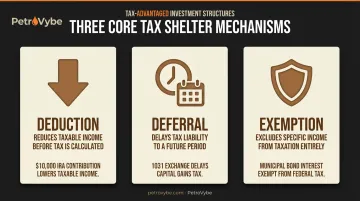
Legal tax shelters work through three core mechanisms:
- Deduction: lowers taxable income right now. Example: contributing $10,000 to a traditional IRA reduces that year's taxable income by $10,000.
- Deferral: pushes the tax bill to a later year, often when income falls into a lower bracket. Example: a 1031 exchange delays capital gains tax on an investment property sale.
- Exemption: the income is never taxed at all. Example: interest earned on a qualifying municipal bond is exempt from federal tax.
Tax Shelter vs. Tax Evasion
The line between the two comes down to honesty. A shelter operates within IRS rules and reports everything accurately. Evasion involves hiding income or misrepresenting facts to avoid paying what's owed, a felony under Section 7201 punishable by up to five years in prison and fines as high as $250,000 for individuals.
Abusive shelters cross this line while dressing themselves up as legitimate strategies. The Department of Justice recently secured guilty verdicts against four promoters behind a $40 million nationwide tax-evasion scheme built on layered trusts and fraudulent deductions for personal expenses. Clients reportedly paid $25,000 to $50,000 just to get set up in the scheme.
Tax Shelter vs. Tax Haven
These terms get used interchangeably, but they're not the same thing. A tax shelter is a strategy or vehicle for reducing tax liability. A tax haven is a jurisdiction (think the Cayman Islands, or even no-income-tax U.S. states like Texas or Florida) that imposes little to no tax.
A shelter can technically exist inside a haven, but havens carry a distinct reputation for secrecy and limited transparency. Mainstream onshore shelters like retirement accounts don't share that baggage. They're reported to the IRS every year, no hiding required.
Types of Tax Shelters
Shelters range from everyday retirement accounts to specialized investment vehicles, and each one leans on deduction, deferral, or exemption to do its job.
Retirement Accounts (401(k), IRA, Roth Options)
Traditional accounts deduct contributions now and tax withdrawals later. Roth accounts flip that: you pay tax today, but qualified withdrawals in retirement are completely tax-free.
Current IRS contribution limits:
| Account | 2025 Limit | Catch-Up (Age 50+) |
|---|---|---|
| 401(k) | $23,500 | $7,500 (or $11,250 for ages 60-63) |
| Traditional/Roth IRA | $7,000 | $1,000 |
| SEP IRA | Up to $70,000 | N/A |
Self-employed workers get accessible variants too. A Solo 401(k) lets you contribute as both employee and employer, while a SEP IRA works well for small-business owners wanting a simpler setup.
Real Estate Investments
Real estate offers several distinct angles:
- Depreciation lets you deduct a residential rental property's value over 27.5 years, even while the property appreciates
- Mortgage interest is deductible on the first $750,000 of debt
- 1031 exchanges defer capital gains tax entirely when you sell one investment property and roll proceeds into another, provided you identify the replacement within 45 days and close within 180
Homeowners get a shelter too: the primary residence exclusion lets you exclude up to $250,000 in gains ($500,000 if married filing jointly) when you sell your main home, as long as you've lived there two of the last five years.
Municipal Bonds & Tax-Exempt Funds
Interest income from municipal bonds is generally exempt from federal tax, and often state tax too if you live in the issuing state. That's the trade-off high earners accept for typically lower yields than corporate bonds. One caveat worth flagging: some private activity bonds can trigger the Alternative Minimum Tax, so it pays to check before buying.
Health Savings Accounts (HSAs) & FSAs
HSAs carry what's often called a triple tax advantage:
- Contributions are deductible or pre-tax
- Growth inside the account isn't taxed
- Qualified withdrawals for medical expenses are tax-free
For 2025, individuals can contribute $4,300 and families up to $8,550, plus a $1,000 catch-up if you're 55 or older. FSAs work similarly but cap at $3,300 for 2025 and generally require you to use the funds within the plan year.
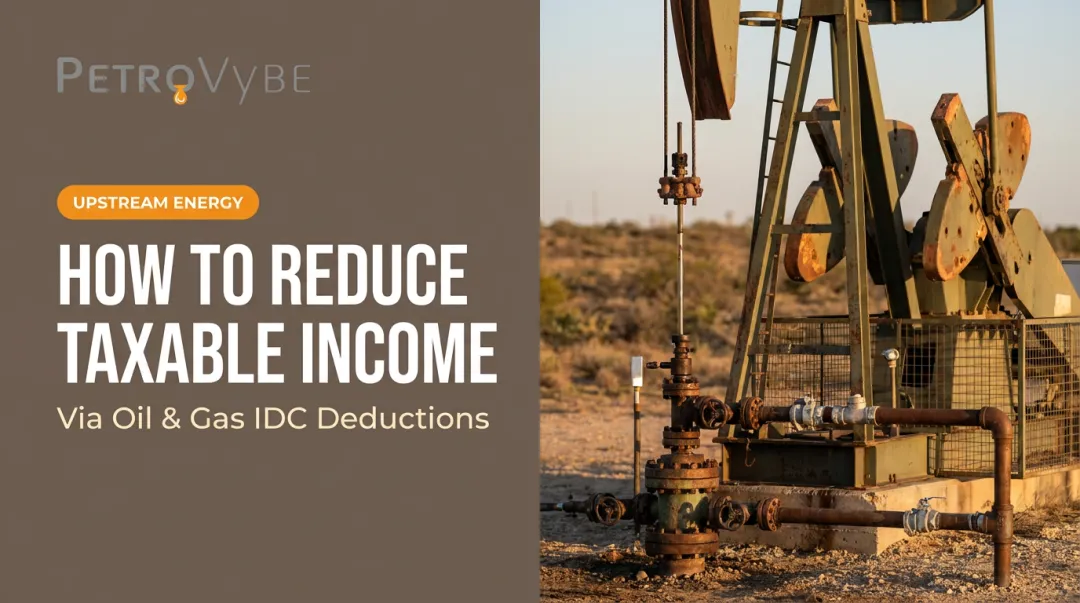
Oil & Gas Development (Intangible Drilling Cost Deductions)
This is where things get interesting for high-income earners. Intangible Drilling Cost (IDC) deductions, authorized under IRC Section 263(c), let investors deduct a large share of drilling and development expenses in the very first year. What makes IDCs unusual is their ability to offset active income, including W-2 wages and capital gains, not just passive investment income like most shelters on this list.
PetroVybe is a working example of how this plays out in practice. Partners in the company's natural gas development projects in Lavaca County, Texas reported first-year deductions of 94% against ordinary income in 2024 and 91% in 2025, applied directly against active earnings through direct participation in working interests.

This shelter type suits a narrow but underserved group: high-income W-2 earners and investors sitting on capital gains who specifically need an active-income offset — a gap most conventional shelters, from 401(k)s to rental real estate, simply don't fill.
Benefits of Tax Shelters
The most immediate benefit is lower marginal tax liability. Say you're in the 32% bracket and claim a $50,000 deduction: that's $16,000 you don't send to the IRS this year. That's real money staying in your pocket instead.
Deferral compounds this advantage over time. When you delay tax on investment gains, your full principal keeps earning returns rather than a reduced, post-tax amount. Over a decade, that difference adds up substantially.
Beyond tax mechanics, shelters offer:
- Diversification — real estate and energy development provide exposure outside traditional stocks and bonds, while simultaneously lowering your tax exposure
- Passive income potential — many shelters, including retirement accounts and direct energy participation, generate income streams alongside their tax benefits
- Long-term wealth building — PetroVybe's structure, for instance, targets monthly passive distributions exceeding $10,000 during peak production, layered on top of the upfront deduction
This combination of an immediate deduction and a multi-year income stream explains why investors who've maxed out 401(k)s and IRAs increasingly turn to specialized vehicles like direct energy partnerships.
Risks and Drawbacks of Tax Shelters
No shelter is free of trade-offs. Four risks show up consistently across shelter types.
Complexity risk. Misunderstanding contribution limits, eligibility rules, or reporting requirements can lead to unintentional non-compliance. A tax professional helps you navigate these rules and avoid costly compliance mistakes.
Illiquidity risk. Retirement accounts, real estate, and direct participation programs often lock up capital for years. Early withdrawals from a 401(k) or IRA typically trigger a 10% penalty on top of ordinary income tax.
Cost risk. Management fees, administrative costs, and compliance expenses can erode the net benefit of any shelter. Annuities are a classic example, where surrender charges can run for up to a decade.
The "too good to be true" risk. Shelters lacking genuine economic substance, or promising unrealistic returns, are exactly what draws IRS scrutiny. Before committing capital anywhere, verify:
- Independent audits or engineering reports backing the underlying assets
- Third-party accredited investor verification, where applicable
- Transparent, regular reporting from the sponsor
PetroVybe's structure, for example, includes a clean 2025 independent audit from Weaver and a $48 million third-party engineered reserve valuation (PV-09). This is the level of documentation any legitimate shelter should be able to provide before you commit capital.
How to Choose the Right Tax Shelter for Your Situation
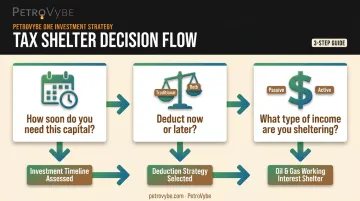
Three questions narrow the field quickly.
- How soon might you need this capital back? Retirement accounts and direct participation programs can lock up money for years. If you can't tolerate a multi-year hold, cross those off your list.
- Deduct now or later? Traditional accounts save you tax today; Roth accounts cost you now but grow entirely tax-free. The right answer depends on whether you expect to be in a higher or lower bracket in retirement.
- What type of income are you trying to shelter? Most shelters only offset passive income. If your tax problem is W-2 wages or capital gains, you'll need a shelter specifically built for active income, such as oil and gas IDC deductions.
That third question trips up more high earners than it should. Someone with a $400,000 salary and a chunky capital gain from a business sale won't get relief from a Roth IRA or a rental property loss capped by passive activity rules.
That's the exact gap active-income-eligible vehicles are designed to close, such as PetroVybe's direct working-interest oil and gas partnerships, which apply IDC deductions directly against W-2 wages and capital gains alike.
Frequently Asked Questions
What is the best tax shelter investment?
There's no single best option, since it depends on your income type, liquidity needs, and time horizon. Retirement accounts are the most accessible starting point, while specialized vehicles like oil & gas intangible drilling cost (IDC) deductions fit high-income active earners better.
Is a Roth IRA considered a tax shelter?
Yes. While contributions aren't deductible upfront, a Roth IRA shelters all investment growth and qualified withdrawals from taxation entirely, making it one of the most powerful long-term shelters available.
What are the pros and cons of tax-sheltered annuities?
Pros include tax-deferred growth and optional guaranteed income. Cons include surrender charges lasting up to 10 years, ongoing fees, and ordinary income tax rates applied to withdrawals.
Is a tax shelter illegal?
No. Legal tax shelters follow IRS rules and are reported transparently. Illegal shelters cross into tax evasion through hidden income or misrepresentation, carrying steep criminal penalties.
What is the difference between a tax shelter and a tax haven?
A tax shelter is a strategy or vehicle used to reduce tax liability. A tax haven is a low-tax jurisdiction, often associated with secrecy and limited financial transparency.
Can a tax shelter reduce taxes on W-2 income?
Most shelters, like retirement accounts and real estate passive losses, only offset passive or investment income. Certain vehicles, such as oil & gas IDC deductions, are structured to offset active W-2 and capital gains income directly.