

That reaction is understandable. Many investors freeze or panic when the Fed shifts policy simply because they never learned the mechanics behind the ripple effect. A quarter-point change sounds small, but it touches mortgages, bond prices, corporate earnings, and even commodity markets in different ways and at different speeds.
This guide breaks down how rates and investments actually interact, how each major asset class responds, and what strategies (including alternative assets outside the public markets) can help protect a portfolio no matter which direction rates move next.
Key Takeaways
- Rising rates raise the bar for a "good" return; falling rates lower it
- Bonds, stocks, savings accounts, and real estate each react to rate changes differently
- Real, inflation-adjusted returns matter more than nominal numbers
- Diversifying across rate-sensitive assets, including private alternatives, limits single-decision risk
What Are Interest Rates and How Do They Work?
An interest rate is simply the price of money. Borrow it and you pay a rate; save or invest it and you earn one. Every loan, bond, and deposit account has a rate attached, and that rate reflects risk, time, and how badly someone needs the cash.
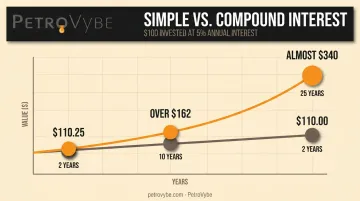
Simple interest pays a flat percentage on the original amount only. Compound interest pays on the growing balance, including prior interest earned, which is why it accelerates faster the longer money sits.
Here's the difference in practice. Start with $100 at a 5% annual rate:
- Simple interest, two years: grows to $110.00
- Compound interest, two years: grows to $110.25
- Compound interest, 10 years: grows to more than $162
- Compound interest, 25 years: grows to almost $340
That small compounding gap widens dramatically over decades. Time in the market ends up mattering as much as the rate itself.
Fixed vs. Variable, and the Fed's Role
A fixed rate stays the same for the life of the loan or investment. A variable rate moves with a benchmark, most commonly the federal funds rate, which is the rate banks charge each other for overnight loans.
The Fed doesn't set every rate in the economy directly. It influences short-term rates like Treasury bills and floating-rate loans almost immediately. Longer-term rates, including 30-year mortgages and corporate bonds, respond more to inflation expectations and future policy outlook than to any single Fed decision.
The Relationship Between Investment and Interest Rates
Here's the core principle: as borrowing costs rise, fewer projects clear the bar for being worthwhile. Economists call this the marginal efficiency of capital, but the logic is simple.
If you can borrow at 7%, your investment needs to return more than 7% just to break even after financing costs. Raise the rate to 9%, and suddenly a project that looked profitable at 7% no longer makes sense. Lower it to 4%, and previously marginal projects suddenly clear the hurdle.
There's no single "interest rate for investments." Every asset class carries its own rate, shaped by risk, duration, and creditworthiness:
- Savings accounts and CDs reflect bank liquidity needs and short-term policy rates
- Bonds price in credit risk and how long your money is locked up
- Private developments, like oil and gas partnerships, price in operational risk and production timelines
Real vs. Nominal Rates Matter More Than Headlines
A nominal rate is the number you see advertised. The real rate subtracts inflation, and it's the number that actually tells you whether you're gaining or losing purchasing power.
When inflation runs hotter than the nominal rate, the real rate turns negative. Oddly enough, negative real rates can encourage more borrowing and investment, not less, since the true cost of debt shrinks in inflation-adjusted terms.
Rates aren't the only lever, either. During 2008-2010, the Fed slashed its target from 2% down to near zero. Investment barely responded.
Why? A credit crunch had frozen lending regardless of how cheap money technically was. Firms that depended on distressed lenders financed roughly 30% less equipment than firms with healthier banking relationships.
More recent research backs up how uneven this channel can be. A Federal Reserve staff analysis found that a one-standard-deviation tightening shock led to a 2.8% cumulative decline in business investment after two years. Financially distressed firms cut investment by roughly 3.7% of their capital stock, while healthy firms barely flinched. Rate policy hits the weakest balance sheets hardest.
How Interest Rate Changes Affect Different Asset Classes
Not every asset moves the same direction when rates shift. Understanding the mechanics behind each one helps you anticipate portfolio swings instead of reacting to them.
Bonds: The Inverse Relationship
Bond prices and interest rates move opposite directions. When new bonds pay higher coupons, existing lower-coupon bonds become less attractive, so their price drops. Duration measures how sensitive a bond is to this shift.
FINRA's rule of thumb: a bond with a duration of 10 will lose roughly 10% in value if rates rise 1 percentage point, and gain roughly 10% if rates fall 1 point. A short-term bond with a duration of 2 would only move about 2% for the same rate change. Longer maturities carry more risk when rates rise.
Stocks, Savings, and Real Estate
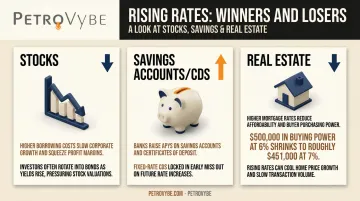
- Stocks: Higher borrowing costs squeeze corporate profits and can slow expansion plans, but stocks aren't mechanically tied to rates the way bonds are. Growth, earnings, and sector all factor in.
- Savings accounts and CDs: These benefit as short-term rates rise, though banks don't always pass along the full increase.
- Real estate: Mortgage rates directly determine buying power. A 6% rate supports about $500,000 on a $3,000 monthly budget, while 7% cuts that to roughly $451,000.
As of mid-2026, the FDIC's national savings rate sat at just 0.38% and the 12-month CD rate at 1.63%, compared to a Fed funds target range of 3.50%-3.75%. Locking a fixed CD works in your favor if rates later fall, but against you if they climb further.
That gap between 6% and 7% mortgages amounts to nearly $50,000 less home for the same monthly payment. Freddie Mac's weekly survey put the average 30-year fixed rate at 6.55% in mid-July 2026, up slightly from the prior week.
Commodities and Alternative Assets
Commodities often move inversely to rate changes, since higher real rates strengthen the dollar and raise inventory-carrying costs, pressuring prices. But supply shocks can override that pattern entirely.
Private, income-producing assets tell a different story. Development-stage projects tied to physical production, rather than public market sentiment, don't reprice every time the Fed makes an announcement. That disconnect from public-market rate swings is part of why some investors look beyond stocks and bonds entirely.
Interest Rates, Inflation, and the 7% Rule in Investing
The "7% rule" gets tossed around a lot in retirement planning. It refers to using roughly 7% as a historical, inflation-adjusted average annual stock market return, a benchmark for projecting long-term growth.
It's a planning shortcut, not a guarantee. Morningstar's research shows U.S. stocks delivered a 7.4% annualized real return over the trailing 20 years, but the same analysis forecasts a much lower 3.1% real return looking forward. That's a meaningful gap between what happened and what might happen next.
Here's why that matters for rate-sensitive planning:
- When inflation runs high and real rates stay elevated, the "safe" 7% assumption may not hold up
- Retirement projections built entirely on historical averages can fall short during volatile rate cycles
- Relying on a single return assumption leaves no room for years that underperform the average
Stress-testing your return expectations matters more than defending a single number. If your entire plan depends on markets averaging 7% every year, one rough decade can derail decades of planning. Diversifying where your returns come from, not just what asset class holds them, reduces that dependency. Direct investments in tangible assets, such as oil and gas development projects, generate returns tied to production and cash flow rather than stock market cycles.
Strategies to Protect and Diversify Your Portfolio Against Rate Volatility
The most reliable defense against rate-driven volatility is a portfolio that doesn't depend on predicting the Fed's next move correctly.
Diversification across rate-sensitive and rate-resistant assets spreads the impact. Bonds, stocks, real estate, and cash all react differently, so no single Fed decision can move your entire net worth at once.
Bond laddering is a tactical version of this idea applied within fixed income. Instead of buying one long-term bond, you spread purchases across multiple maturities. As each rung matures, you reinvest at whatever the current rate happens to be, balancing reinvestment risk against interest rate risk rather than betting everything on one outcome.
Looking Beyond Public Markets
Private, income-producing assets sit outside this rate-sensitivity chain entirely. PetroVybe, for example, develops natural gas projects in South Texas and the Gulf Coast Basin, structured as direct partnership units for accredited investors rather than publicly traded securities that reprice with every rate headline.
A few specifics worth knowing:
- Partners receive an upfront tax deduction against active income, including W-2 earnings and capital gains, through Intangible Drilling Cost provisions. 2024 partners saw a 94% deduction; 2025 partners saw 91%.
- Distributions are structured as monthly passive income, projected to peak above $10,000 per month during production, over a 10-year hold period.
- Projects carry a $48 million third-party proved reserves valuation, verified by a licensed engineering firm, not an internal estimate.
- PetroVybe's Chief Geophysicist has a 75.2% career hit rate on profitable well locations across 48 years, well above the industry average of under 40%.
Participation requires accredited investor status and a $100,000 minimum, so this isn't a fit for every portfolio. But for investors with capital to allocate and a tax burden to manage, this project offers real value. Independent engineering validation and a documented operational track record provide a way to evaluate opportunities that don't move in lockstep with the next FOMC announcement.

Frequently Asked Questions
What is the relationship between investment and interest rate?
Higher interest rates raise the cost of borrowing and the required rate of return, which generally discourages new investment. Lower rates have the opposite effect, making more projects financially worthwhile.
What is the interest rate for investments?
There's no single rate. It varies by asset type, risk level, and duration, ranging from savings accounts and bonds to private investments like oil and gas development partnerships.
What is the 7% rule in investing?
It refers to using a historical average stock market return, roughly 7% after inflation, as a planning benchmark. It's a guideline for projections, not a guaranteed outcome.
How do rising interest rates affect the stock market?
Rising rates increase borrowing costs for companies, which can slow growth and pressure valuations. The effect varies widely by sector and by how strong underlying earnings are.
What investments perform well when interest rates rise?
Savings accounts, CDs, and short-duration or alternative assets often benefit from rising rates. Long-duration bonds typically underperform since their prices fall the most.
Should I change my portfolio when the Fed raises or lowers rates?
Rather than reacting to every rate change, focus on diversification and your long-term goals. Adjust only when your actual strategy calls for it, not because of a single headline.